Artificial Intelligence at Khoury College of Computer Sciences
The science behind the AI technology that is revolutionizing everyday life
Artificial intelligence is reshaping our world at a pace comparable to the advent of the World Wide Web — but at Khoury College, researchers aren’t just building AI; they’re unlocking its mysteries, questioning its ethics, and ensuring it serves humanity safely and equitably.
From the mathematical foundations of trustworthy machine learning to real-world applications that improve lives, Khoury researchers are not merely participating in the AI revolution — they’re steering it toward a future where AI is powerful, comprehensible, and fundamentally aligned with human values.
Transforming the way we design, build, teach, and communicate
AI is changing how people work across nearly every sector — automating routine tasks and freeing people to focus on higher-order thinking and problem-solving. At the same time, it’s accelerating scientific discovery, making sense of datasets at scales that were previously unmanageable and opening new frontiers in drug discovery, medical research, and materials science.
AI is also reshaping computer science itself, touching every research area at Khoury College. Software development looks different than it did even five years ago — and Khoury researchers and students are helping define what comes next.
Sample research areas
- Interpretability
- Large language model science
- AI in health care
- AI in software development
- Cognitive, emotional, social, and physical behavior models
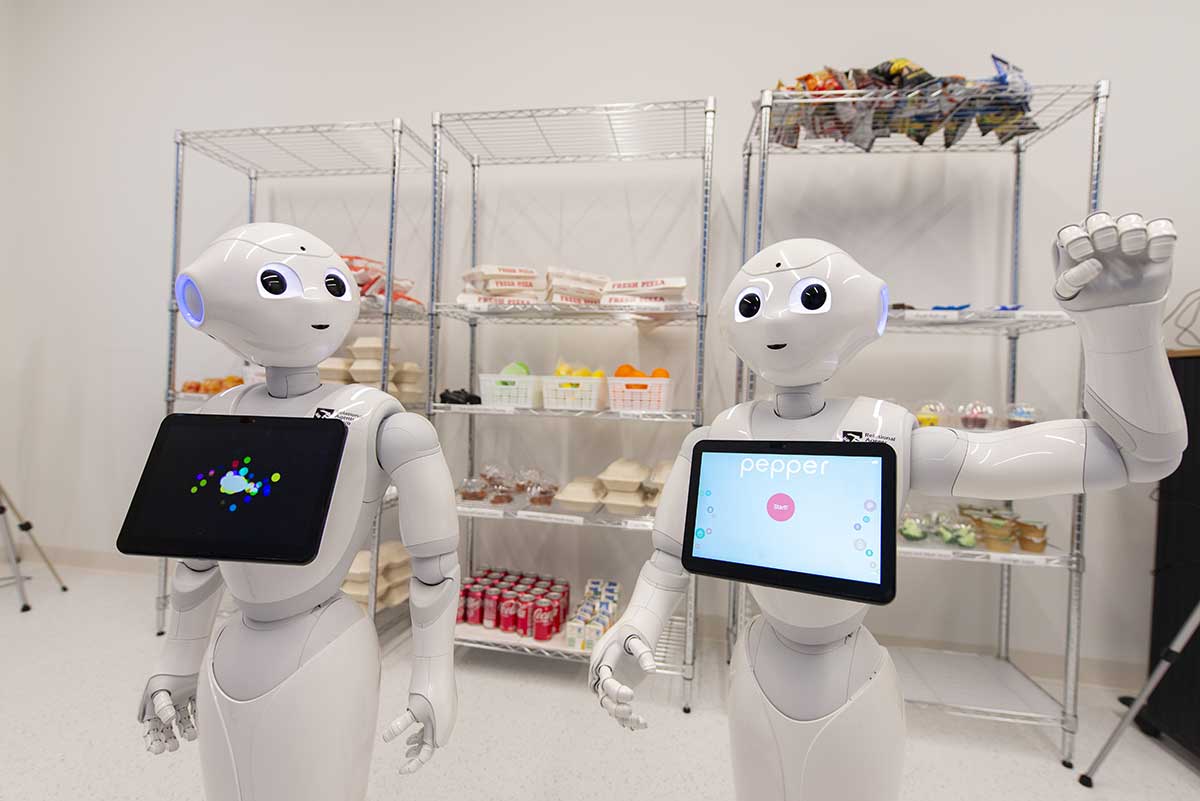
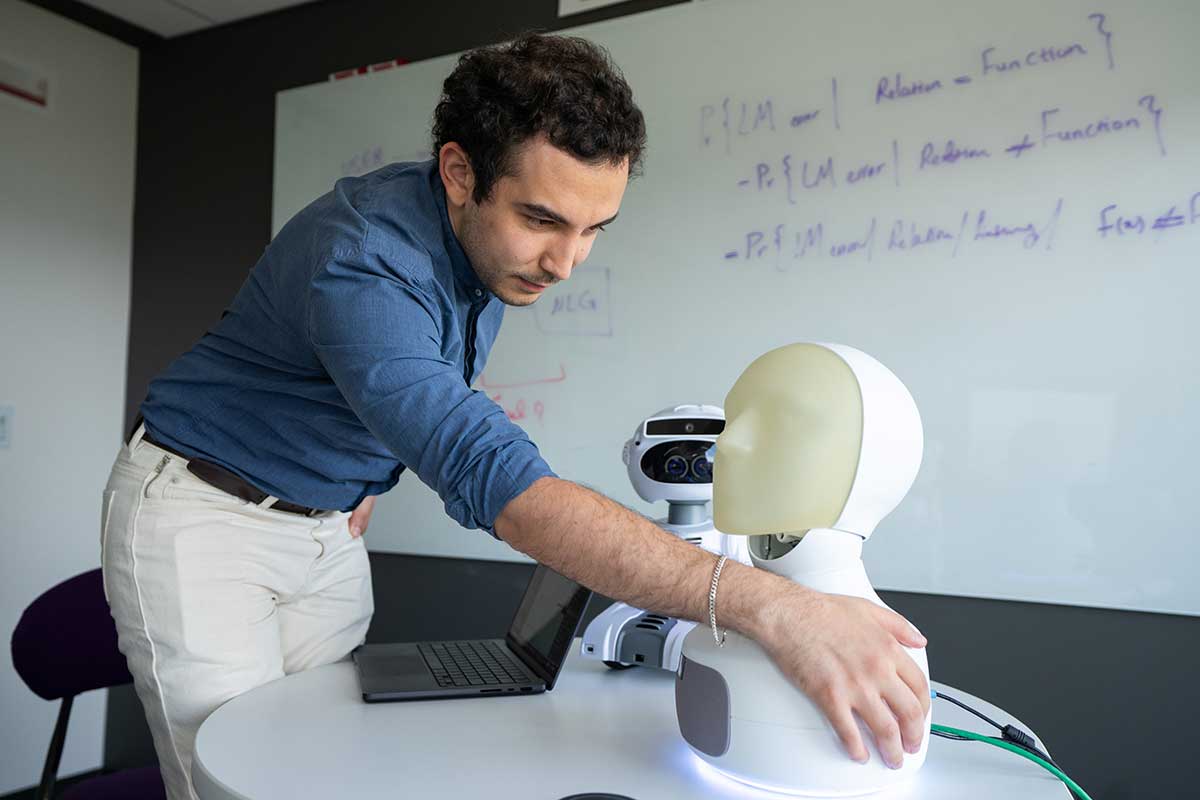
- Robotic systems capable of flexibly interacting with the world
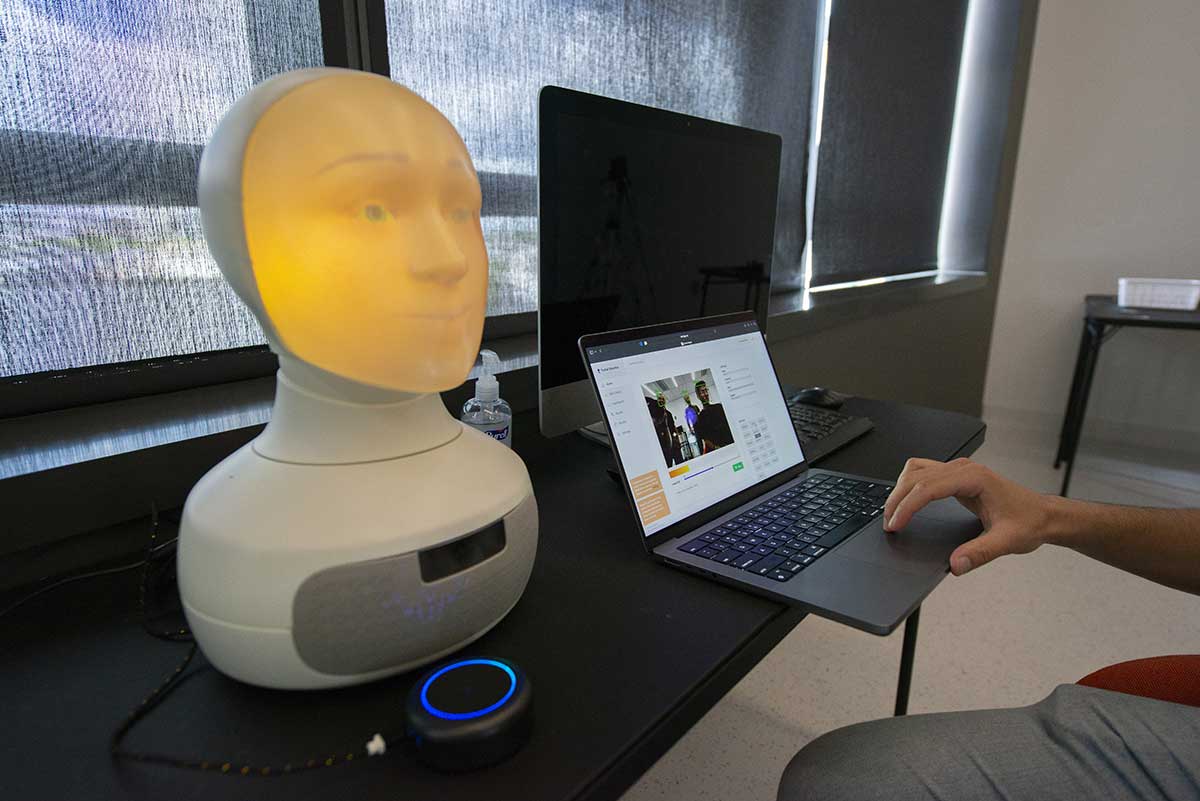
- Design of virtual humans capable of interacting with people using verbal and nonverbal behavior
- Sociotechnical aspects of AI
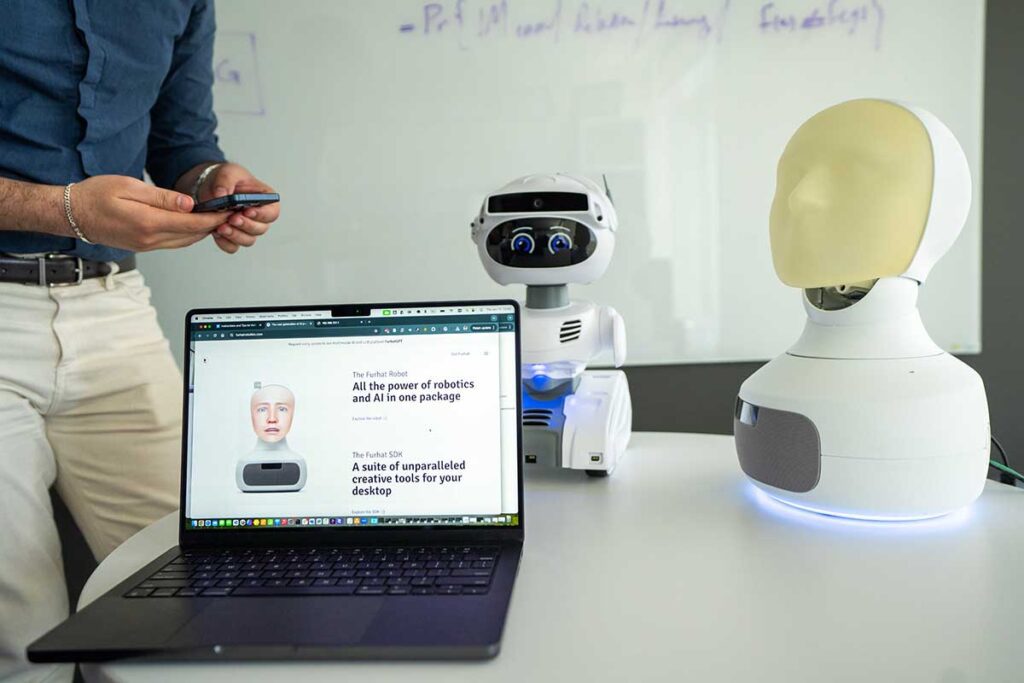
Khoury researchers: At the forefront
Current project highlights
National Deep Inference Fabric (NDIF): Cracking open the mysteries inside large-scale AI systems
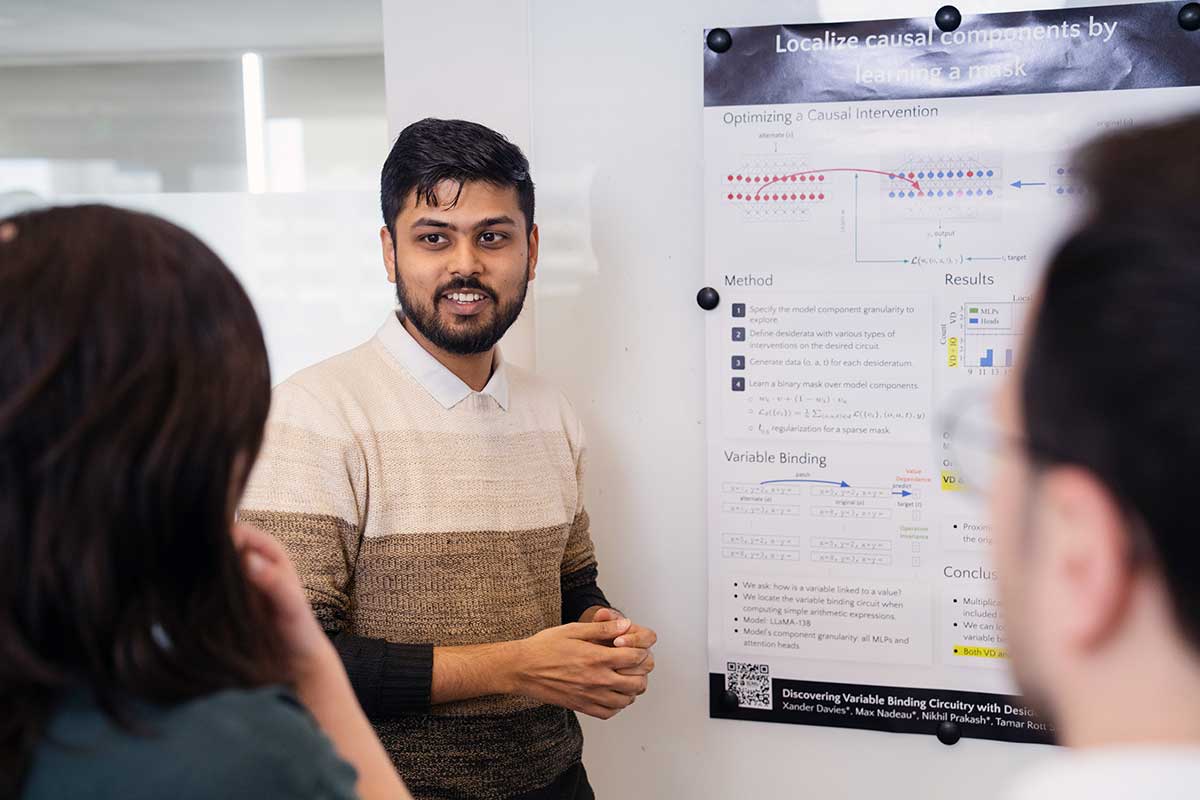
Large neural networks can perform tasks of extraordinary complexity — but how they do it is one of the greatest mysteries in science today.
Why? Because unlike ordinary computer programs, machine learning systems are trained from data instead of being designed by a programmer. As a result, the internal workings of these systems are inscrutable to humans; they are black boxes, even to programmers.
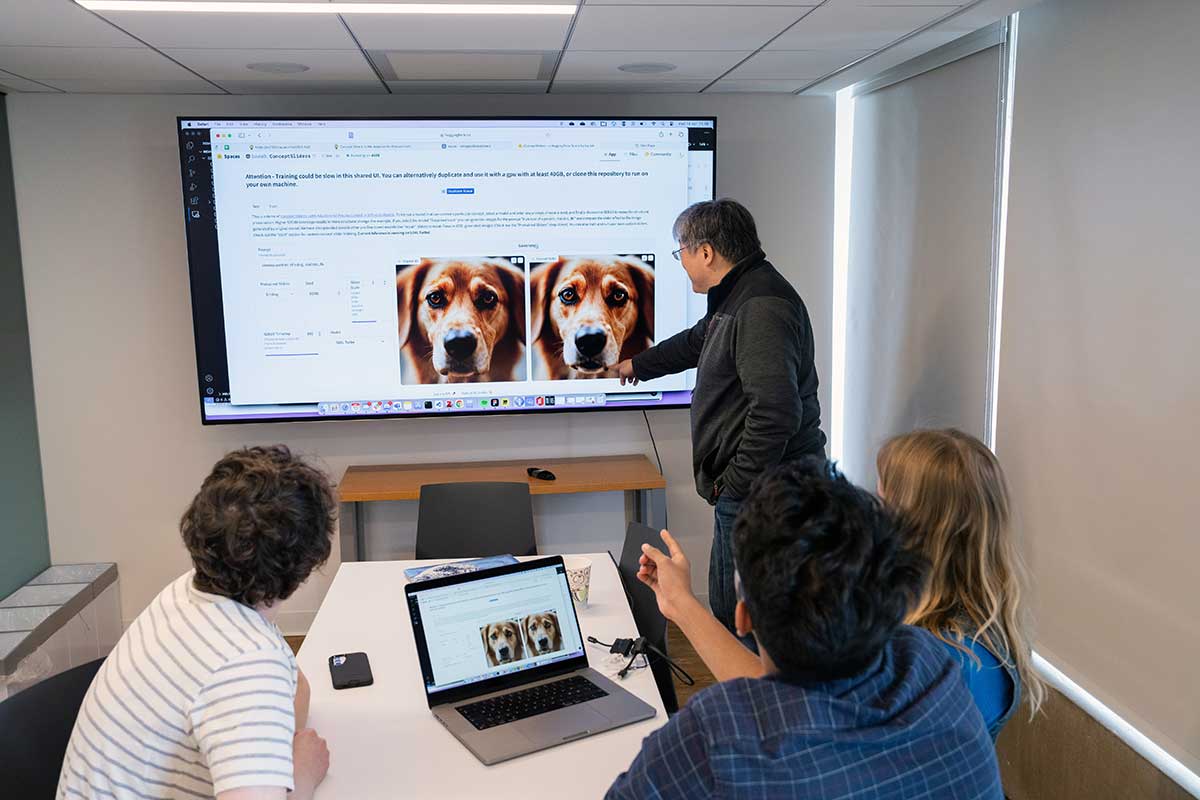
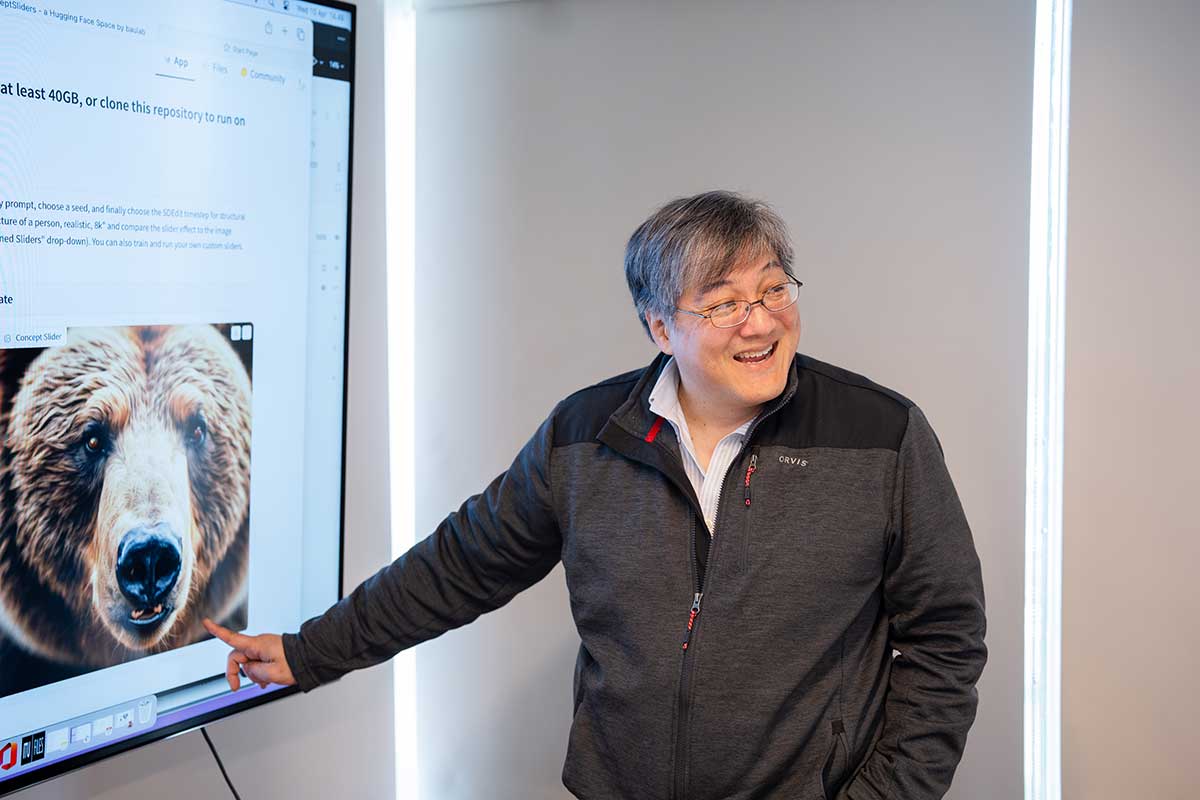
The US National Science Foundation (NSF) has announced a $9 million grant to Northeastern University to launch National Deep Inference Fabric (NDIF), a new national-scale research computing infrastructure project that will enable researchers to delve into the mysteries of large-scale AI systems and address a growing gulf between the efficacy of machine learning and scientists’ ability to explain it.
Human-centered AI for workers
As AI increasingly mediates gig work — shaping which jobs workers are offered, how their labor is tracked, and how they are compensated — gig workers themselves often lack access to the data and tools needed to understand or respond to these systems. This research develops AI-enhanced tools that give gig workers visibility into their own workplace data, helping them identify pay discrepancies, algorithmic patterns, and broader workforce trends. Rather than replacing human judgment, these tools are designed to surface insights and support collective action, empowering workers and unions to engage meaningfully with the technologies shaping their livelihoods. The work extends globally, with ongoing collaborations across North America and Latin America to study how AI impacts workers in diverse labor markets.
Teaching AI to compare instructional videos step by step
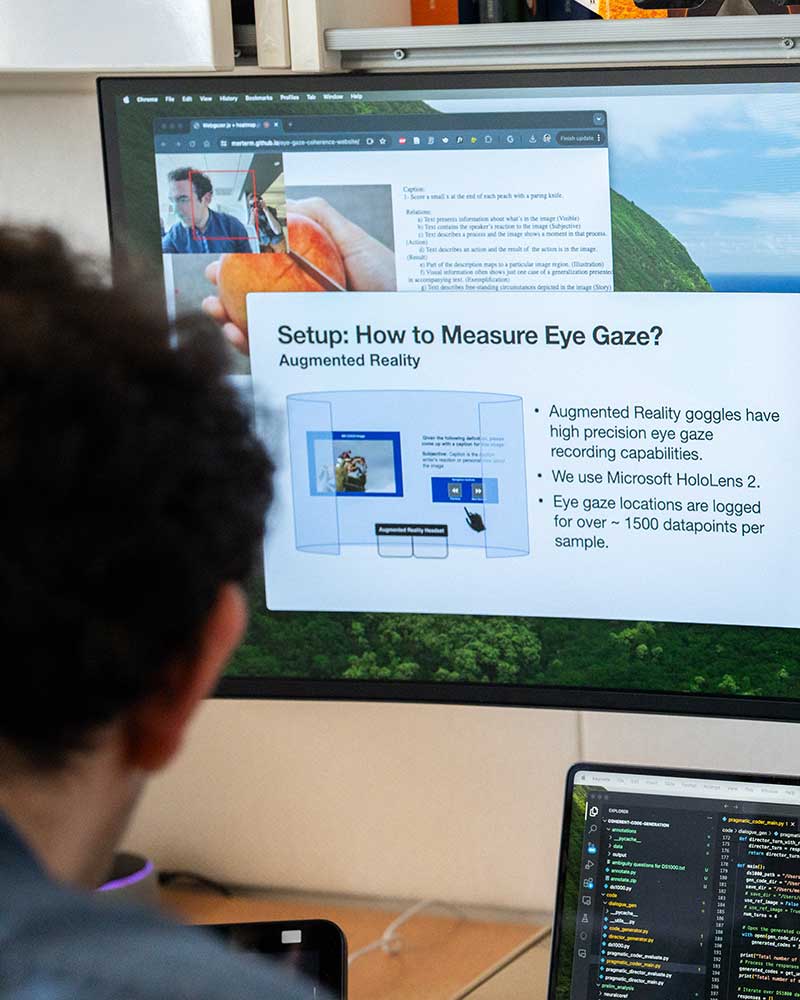
Imagine you’re learning to cook a new recipe and you have an AR headset that can watch your technique and compare it to an expert’s demonstration — then tell you exactly where you went wrong. That’s the vision behind this work. Researchers developed an AI system that can watch two videos side by side — a reference “how-to” video and a video of someone attempting the same task — and identify the key differences between them. To train this system, researchers automatically generated a large dataset of video pairs from real instructional content, teaching the AI to spot when steps are skipped, done out of order, or performed incorrectly, and even to judge how serious those mistakes are. This kind of technology could power the next generation of personalized, real-time coaching in augmented and virtual reality.
Related labs and groups
Faculty members
-
Malihe Alikhani
Assistant Professor
Malihe Alikhani is an assistant professor at Khoury College. Both enthused and wary of the transformative power of AI, Alikhani teaches courses and conducts research on AI ethics and equitable natural language processing.
-
Christopher Amato
Associate Professor
Christopher Amato is an associate professor at Khoury College and head of the Lab for Learning and Planning in Robotics. His research lies at the intersection of robotics, AI, and machine learning, including planning and reinforcement learning in partially observable and multi-agent/multi-robot systems.
-
Silvio Amir
Assistant Professor
Silvio Amir is an assistant professor at Khoury College. By applying natural language processing, machine learning, and information retrieval methods to personal and user-generated data, he aims to improve the reliability, interpretability, and fairness of predictive models and analytics.
-
Javed Aslam
Professor, Chief of Artificial Intelligence
Javed Aslam is a professor at Khoury College. His research emphasizes machine learning and information retrieval, with forays into human computation, transportation, computer security, wireless networking, and medical informatics.
-
David Bau
Assistant Professor
David Bau is an assistant professor at Khoury College and the lead principal investigator of the National Deep Inference Fabric project. His research centers on human–computer interaction and machine learning, including the gap between the efficacy of AI and scientists’ ability to explain it.
-
Kenneth Church
Professor of the Practice, Khoury College of Computer Sciences, Affiliate Appointment
Kenneth Church is a professor of the practice at Khoury College and a senior principal research scientist at Northeastern’s Institute for Experiential AI. His research focuses on natural language processing and information retrieval, artificial intelligence, and machine learning.
-
Jennifer Dy
Professor, Jointly Appointed with College of Engineering
Jennifer Dy is a professor in the College of Engineering and Khoury College of Computer Sciences. Her research explores machine learning, data mining, statistical pattern recognition, and computer vision.
-
Ehsan Elhamifar
Associate Professor, Director of the MS in Artificial Intelligence program, Affiliate Faculty with the College of Engineering
Ehsan Elhamifar is an associate professor at Khoury College, affiliated with the College of Engineering. The overarching goal of his research is to develop AI that learns from and makes inferences about visual data analogous to humans.
-
Tina Eliassi-Rad
Inaugural Joseph E. Aoun Professor
Tina Eliassi-Rad is the inaugural Joseph E. Aoun professor at Khoury College, as well as an external faculty member at the Santa Fe Institute and the Vermont Complex Systems Center. Her research at the intersection of data mining, machine learning, and network science has earned her a place as a core faculty member at both Northeastern’s Network Science Institute, and the Institute for Experiential AI.
-
Usama Fayyad
Professor of the Practice, Executive Director Institute for EAI
Usama Fayyad is a professor of the practice at Khoury College and the director of Northeastern’s Institute for Experiential AI. A recipient of awards from the ACM and NASA, he specializes in data science, machine learning, AI, and data mining.
-
Sina Fazelpour
Assistant Professor, Jointly Appointed with College of Social Sciences and Humanities
Sina Fazelpour is an assistant professor at Khoury College, jointly appointed with the College of Social Sciences and Humanities. His research draws on tools and techniques from philosophy, cognitive science, agent-based simulation, and machine learning to analyze issues of justice, diversity, and reliability in data-driven and AI technologies.
-
Yun Raymond Fu
Professor, Jointly Appointed with College of Engineering
Yun Raymond Fu is a University Distinguished Professor jointly appointed between the College of Engineering and Khoury College. He is a widely renowned scholar in AI, machine learning, data mining, and computer vision whose resume includes 500+ scientific publications and 40+ patented inventions.
-
Paul Hand
Associate Professor, Jointly Appointed with College of Science
Paul Hand is an assistant professor at Khoury College, jointly appointed with the College of Science. He researches theory and algorithms for AI and machine learning in the context of vision and imaging.
-
Wengong Jin
Assistant Professor
Wengong Jin is an assistant professor at Khoury College. His research aims to use geometric and generative AI models to improve the costly, time-consuming process of drug discovery.
-
Tala Talaei Khoei
Assistant Teaching Professor
Tala Talaei Khoei is an assistant teaching professor at Khoury College. Her research encompasses AI, deep learning, reinforcement learning, inclusivity in computer science, and data quality, visualization, interpretation, mining, and education.
-
Stacy C. Marsella
Professor, Jointly Appointed with College of Science
Stacy Marsella is a professor at Khoury College, jointly appointed with the College of Science. His work, which is grounded in the computational modeling of human cognition, emotion, and social behavior, has applications for human behavior, health interventions, social skills training, and planning operations.
-
Bruce Maxwell
Teaching Professor, Director of Computing Programs – Seattle
Bruce Maxwell is a teaching professor and director of computing programs at Khoury College in Seattle. His teaching and research encompass computer vision, computer graphics, robotics, machine learning, AI, and data science.
-
Varun Mishra
Assistant Professor, Jointly Appointed with Bouvé College of Health Sciences
Varun Mishra is an assistant professor at Khoury College, jointly appointed with the Bouvé College of Health Sciences. His research leverages ubiquitous technologies like smartphones and wearables to enable mental and behavioral health interventions.
-
Aanchan Mohan
Assistant Teaching Professor
Aanchan Mohan is an assistant teaching professor at Khoury College, who also holds positions as a lead data scientist at the technology services company Global Relay, and a research faculty member at the Indraprastha Institute of Information Technology in New Delhi, India. His research and teaching focus on machine learning, natural language processing, and speech recognition.
-
Mahsan Nourani
Assistant Research Professor
Mahsan Nourani is a research assistant professor at Khoury College. Her research explores how people of varying backgrounds understand and interact with AI-assisted decision-making systems and the impact those systems have on societies, with the goal of enabling human-centered and responsible AI.
-
Alina Oprea
Professor
Alina Oprea is a professor at Khoury College specializing in cloud security, applied cryptography, and security analytics. Over many years in industry and academia, she has researched and designed machine learning techniques to predict and protect against hacker behavior.
-
Lace Padilla
Assistant Professor, Jointly Appointed with College of Science
Lace Padilla is an assistant professor at Khoury College, jointly appointed with the College of Science. She combines cognitive, neural, and computer sciences to study how people process data visualizations and how those visualizations can communicate more accurately and effectively.
-
Jose Perea
Associate Professor, Jointly Appointed with College of Science
Jose Perea is an associate professor at Khoury College, jointly appointed with the College of Science. He is passionate about using nonstandard mathematical ideas to solve problems in data science and machine learning.
-
Ryan M. Rad
Assistant Teaching Professor
Ryan Rad is an assistant teaching professor at Khoury College with backgrounds in teaching, research, engineering, and management. He has founded two companies in the last decade and is currently active in computational biology, machine learning, and personal health informatics research.
-
Saiph Savage
Assistant Professor
Saiph Savage is an assistant professor and director of the Civic A.I. Lab at Khoury College. Her research focuses on creating intelligent civic technology to organize collective action for change, which includes battling misinformation and empowering gig and rural workers to access better jobs.
-
Weiyan Shi
Assistant Professor, Jointly Appointed with College of Engineering
Weiyan Shi is an assistant professor in the Khoury College, jointly appointed with the College of Engineering. She is interested in NLP in the context of social influence dialogue systems such as persuasion, negotiation, and recommendation, as well as privacy-preserving NLP applications.
-
David Smith
Associate Professor
David Smith is an associate professor at Khoury College. His research spans the fields of natural language processing, computational linguistics, information retrieval, machine learning, digital libraries, digital humanities, and political science.
-
Lorenzo Torresani
Professor, President Joseph E. Aoun Chair
Lorenzo Torresani is a professor and the President Joseph E. Aoun Chair at Khoury College. He is passionate about creating perceptual AI agents that go beyond recognizing user actions to understand how activities are performed and assist humans in daily tasks.
-
Byron Wallace
Sy and Laurie Sternberg Interdisciplinary Associate Professor, Associate Dean of Research, Director of the BS in Data Science Program
Byron Wallace is an associate dean of research, a director for the undergraduate data science program, and the Sy and Laurie Sternberg Interdisciplinary Associate Professor at Khoury College. He applies machine learning and natural language processing methods in the health informatics space, with the goal of developing hybrid human–AI systems and streamlining the synthesis of biomedical information.
-
Robin Walters
Assistant Professor
Robin Walters is an assistant professor at Khoury College. He leads the Geometric Learning Lab, where his research explores the role symmetry can play in developing data-efficient, trustworthy deep learning models.
-
Dakuo Wang
Associate Professor, Jointly Appointed with College of Arts, Media and Design
Dakuo Wang is an associate professor at Khoury College. He is also an ACM Distinguished Speaker and gives talks around the world on his research into human-centered AI (HCAI) systems.
-
Huihui Wang
Teaching Professor, Director of Computing Programs – Arlington
Huihui Wang is a teaching professor at Khoury College, and a director of computing programs for the Arlington campus. Her research examines challenges and opportunities for computing education in the third wave of artificial intelligence, and she enjoys helping students without undergraduate CS degrees to thrive in her computing foundations courses.
-
Lawson Wong
Associate Professor
Lawson Wong is an associate professor at Khoury College. His research focuses on learning, representing, and estimating knowledge about environments and the world in ways that autonomous robots can use.