Verizon Smart Campus Competition 2026-2027
Imagine a connected world
Verizon is bringing the Smart Campus Competition to Northeastern University to challenge students to reimagine their personal experiences through innovation, and Verizon’s 5G and technologies. Collaborating with the university, student teams will identify an area of opportunity and conceptualize a solution utilizing Verizon’s 5G and technologies.
Winning teams
3
Prizes for first-, second-, and third-place teams
Award money
$9,000
$3,000 for each of the top three winning teams
Verizon coaches
(more info to come)
Professionals to guide teams along their way
Smart Campus Competition overview

Co-innovate the future of connectivity and help advance Verizon’s network infrastructure. We challenge you to design, build, and engineer solutions that not only leverage but actually push the boundaries, optimize efficiency, and expand the capabilities of Verizon’s next-generation network architecture. We are looking for technical ideas that help Verizon evolve its network across three core engineering tracks:
- AI-Driven Automation and Efficiency Track: Build systems that use intelligent, real-time automation to optimize network traffic, streamline operations, and elevate performance.
- Cost and Sustainability Transformation Track: Engineer sustainable solutions and green-tech protocols that optimize hardware/software resource usage and reduce the network’s environmental footprint.
- Next-Gen Customer Experience Track: Architect next-generation applications and services that elevate how customers connect and interact with Verizon’s network.
Teams upload their video submission for the first round of judging; approximately 15 teams will be selected to advance to round two. Ideas will then be presented in poster form at the showcase at the end of January. Teams selected to advance will gain access to Verizon coaches, as well as a $500 stipend, to further develop their projects. We are incredibly excited to see what you can create, and what lasting impact you can make on your community!
Smart Campus Competition events
-
Smart Campus Competition: Kickoff
Boston | 2:00 pm EDT | September 29, 2026
September 29 -
Smart Campus Competition: Drop-in Session
Boston | 1:00 pm EDT | October 29, 2026
October 29 -
Smart Campus Competition Round 1: Video Submission
November 16, 2026
November 16 -
Smart Campus Competition Round 2: Poster Showcase
Boston | 10:00 am EST | January 28, 2027
January 28 -
Smart Campus Competition Round 3: Final Presentations
12:00 pm EST | February 24, 2027
February 24
Verizon tech hub
Verizon has curated the following articles and resources to help competition participants understand and access these technologies for use in project development.
5G
Slicing
AI
- AI: enhancing customer experience in a complex 5G world
- AI in telecommunications
- What is AIOps?
- How telecoms can thrive in the age of generative AI
- Scaling the AI-native telco
- AI Connect
MEC
- Verizon 5G Edge with public MEC
- Multi-access Edge Computing (MEC)
- Edge computing: the nervous system for 5G networks
- AWS Wavelength
Private Network
ThingSpace
IoT
Cybersecurity
Open RAN
Augmented reality
Cloud
Virtualized network services
Machine learning
- Machine learning for today’s telecom systems
- Explainable Artificial Intelligence: a Systematic Review
Fixed wireless
Fiber networks
Smart Campus Competition FAQ
General information: Competition details, guidelines for responsible AI use, and more
What is the Smart Campus Competition?
The Smart Campus Competition is an initiative aimed at encouraging students to develop innovative solutions that leverage technology to improve the world around them. This could include projects related to sustainability, accessibility, connectivity, and more.
Who can participate in the competition?
The competition is open to all undergraduate students enrolled at Northeastern University. Teams will consist of three to six students; interdisciplinary teams are highly encouraged.
How do I register my team?
Teams can register by completing the registration form (to be posted when available).
What if I don’t have a team?
You may register individually for the competition, and you will be placed on a team by the competition coordinators.
Prizes and recognition
What are the prizes for the competition?
Teams advancing to the final round will receive a $500 stipend to utilize in further project development, and the chance for one-on-one interaction with assigned coaches from Verizon. The top three teams will be chosen and will each receive $3000 to split evenly among team members.
How will the winners be announced?
Winners will be announced at the conclusion of the final round. The results will also be published on the competition’s webpage and through university communication channels.
Challenge statement and competition structure
The 2026 Verizon Smart Campus Innovation Challenge
We’re looking for one answer to a critical question: How can we leverage Verizon’s next-gen network to build a smarter, more efficient world and drive real growth?
Your challenge is to build a solution that delivers clear, measurable business value. To succeed, your project must align with one of Verizon’s strategic pillars:
- AI-driven automation and efficiency
- Cost and sustainability transformation
- Next-gen products and services to enhance customer experience
You’ll be collaborating with Verizon engineering mentors to develop your design. We’ll be evaluating how well you use our advanced network capabilities to drive scalable innovation and deliver tangible business outcomes.
- Round one: Concept pitch (video submission)
Teams upload their video submission for the first round of judging; approximately 15 teams will be selected to advance to round two.
General/round one guidelines
Round one pitch concept scorecard - Round two: Poster showcase
Teams will create poster presentations to be judged by Verizon mentors; mentor support will be provided to teams invited to this round. Approximately seven teams will be selected to move to round three. - Round three: Project presentations
Finalist teams will have 10 minutes to present their fully formulated plan. Three teams will be selected to the Winner’s Circle. - Winner’s Circle
Three team will be selected to present their idea to Verizon and university leadership at a Verizon location.
How are the projects evaluated?
Projects are evaluated based on innovation, feasibility, impact, and presentation. Judges will look for creative solutions that are well-researched and effectively address a real campus need.
Project guidelines (including rubric scoring guide)
What types of projects are acceptable?
Projects should aim to solve a problem or enhance an experience using technology. This can include, but is not limited to, areas such as sustainability, accessibility, connectivity, and more.
Are there any specific requirements for the project submissions?
Yes, projects must include a detailed problem statement, a value proposition, and a demonstration of how the solution works. Teams must also prepare a poster and a brief presentation for the round two showcase.
Resources and support
Teams will have the opportunity to attend a drop-in consultation session before the round two showcase. They will also have access to online resources to guide them through the development process.
Contact information
For more information about the competition, please contact Kelly Burke, associate director, University Relationship Management.
Congratulations to Northeastern’s 2025-2026 Smart Campus Competition winners
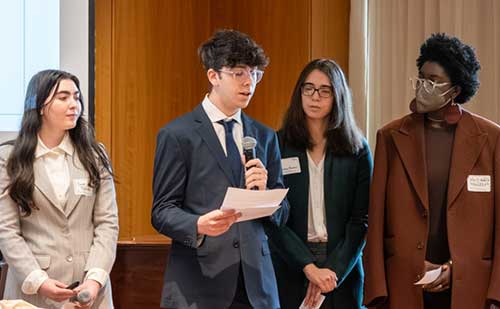
Real-Time Crash Defense System
Justin Haime, Kelsey Hammel, Miles-Kabilito Magoola, Sage Batchelor
The team behind “Real-Time Crash Defense System” combined three Verizon technologies — Smart Intersections, AI dashcams, and V2X — with the goal of reducing preventable car crashes and making roads safer.
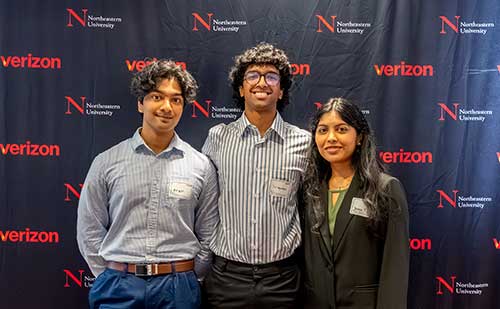
VitaLink
Divya Thoppae, Aran Dharma, Sriganesh Srinivasan
The VitaLink team created a continuous patient monitoring dashboard for hospital patient care technicians (PCTs) using 5G and federated learning. Their hope is that the technology can increase response time and help PCTs catch early warning signs in a patient’s deteriorating condition, particularly during busy times when PCTs may fall behind on routine patient checks.
FoodTrace
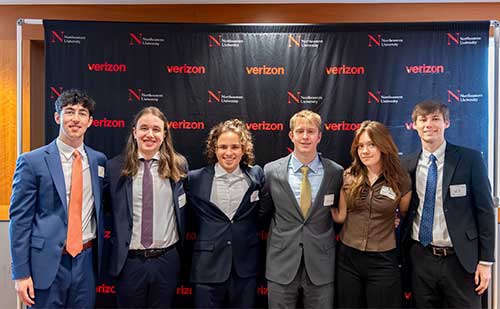
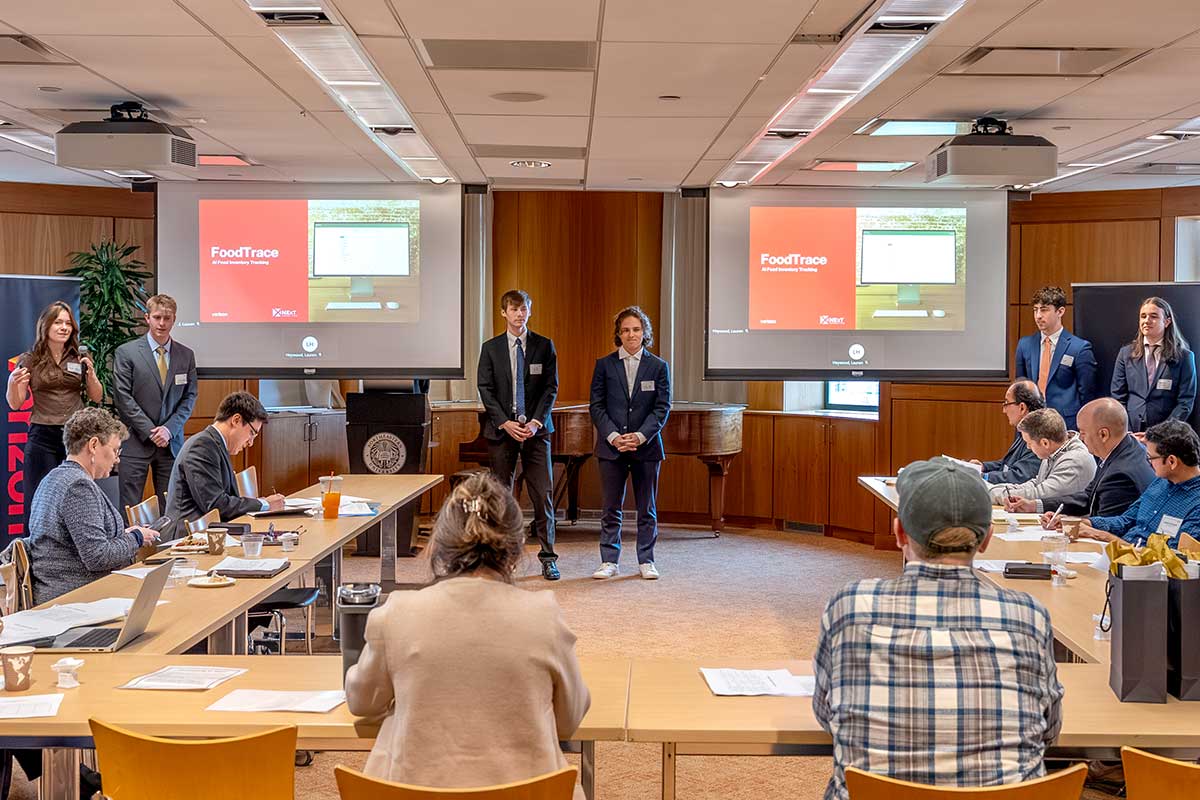
Jack Dreifus, Benedikt Winkler, Aidan Kelly, William Riser, Wyatt Bracy, Haylie Pederson
The “FoodTrace” team created a barcode-based inventory tracking app for food pantries to reduce waste and address food insecurity. The live-tracking app employs Verizon’s 5G network for fast, reliable syncing across food pantry locations, enabling food pantry workers to perform intake on supply items using a smartphone.