Khoury News
Research that hits home: Herman Saksono, Vivien Morris, and digital solutions for physical activity
By the time Herman Saksono began researching the power of tech to promote physical activity in Boston's Mattapan neighborhood, he had already immersed himself in the community. That, his chief collaborator says, made all the difference.
This story is part five of a six-part Khoury News series called “Research that hits home,” which showcases researchers who come from — or form close partnerships with — the communities they study. Previous installments covered research into queer online communities, user-friendly social media, inclusive video game design, and online safety for activists.
From smartwatches to calorie tracker apps, the past two decades have seen an explosion of personal health technologies. But health outcomes in low-income and majority-Black communities have remained lagged behind those of their neighbors’. Something is obviously missing, and Vivien Morris and Herman Saksono want to do something about it.

“There’s a long history of not including the community’s voice,” said Morris, a founding member of the Mattapan Food and Fitness Coalition, which creates resources like farmer’s markets and bike trails to help residents of the low-income, majority-Black Boston neighborhood to lead healthy lives. “Technology is extremely important, and it will continue to have a big impact on all of us, but the voices of low-income people in that world have been so limited. To have someone who said, ‘No, we need to have that voice integrated into how we go forward with these technological advances’ is so crucial, and so important.”
Saksono, an assistant professor in Khoury College and the Bouvé College of Health Sciences, agrees. By studying how to promote healthy behavior in minoritized communities, he and Morris gathered insights and built a tool that neither could have made alone — Storywell, a storytelling-based community fitness app. In doing so, they’ve magnified their impact in the community they care for and provided a model for epistemically just research collaborations, which tackle complex questions by respecting a community’s right to govern knowledge about itself.
Morris’s work began five decades ago when she moved to Boston from a recently desegregated town in the South. She quickly fell into community organizing and, while working as a dietician, recognized many of the same racial issues from her youth. She co-founded the Mattapan Food and Fitness Coalition in 2006 to ensure residents had the resources to support their own health.
“We’ve always viewed ourselves as an organization that is of the community, so anything we’re thinking about, we reach out to community members to hear their voices,” Morris said.
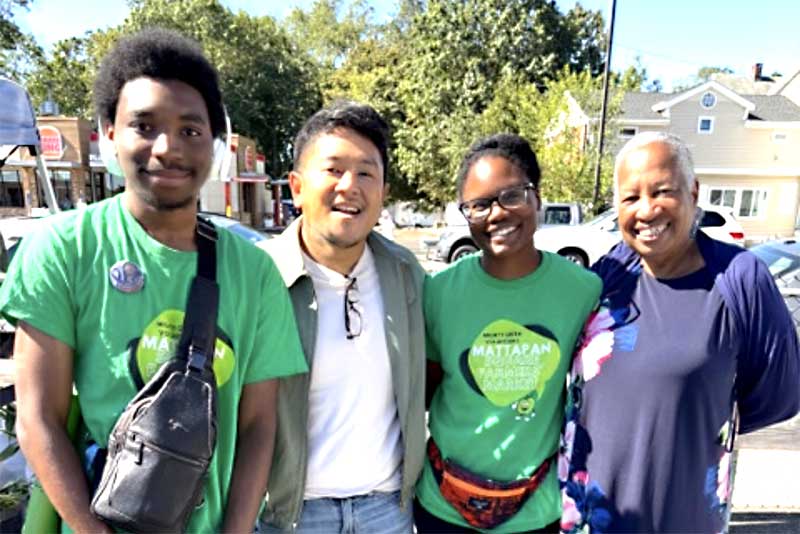
Morris and Saksono met in 2017 while Saksono was in grad school at Khoury College. Saksono was interested in community-based health technologies, but he doesn’t come from Mattapan, so the two spent a long time building their relationship informally before research ever entered the picture.

“He would come to our farmers market to talk to people. When we’d have events in the community, he would be there,” Morris recalled. “He learned about the community from his own experiences, and the more he felt at home in the community, the more the community felt at home with him.”
“Those relationships meant when Saksono became interested in storytelling technology to promote physical activity among low-income people, he knew exactly who to talk to.
“Every population has their own obstacles,” Saksono said. “When we’re designing technology to serve a specific population, it will be more effective if the solution is appropriate for the community, and only the community members know what kind of solutions are appropriate.”
The initial study asked whether someone telling a story about their exercise could motivate other people to be more active. Some stories didn’t do much, but matching minoritized people along racial and gender lines — for example, having one Black mother tell another Black mother about the Zumba video she and her kids danced to together in their living room — did plenty.
“I was focused on the scientific problem — can we match people, would that be effective? What was missing was the bigger picture,” Saksono said. “When I discussed this finding with Vivien, she said this showed the power of community in health promotion, and we built the takeaways of that paper around the idea that we need more technology so that community members can support their community to be healthy. It sounds simple, but we wouldn’t have framed the findings that way if Vivien was not involved.”
For Morris, that insight grew directly from the decades she’s spent experiencing her community’s challenges and joys.
“Remember the things that made you happy as a child. Remember what your mother told you about your grandmother or your grandfather, the ways that your family would come together to celebrate. What did you do? What did you eat? What songs did you sing?” Morris said. “Learning from people, drawing on their histories, their cultures, what they think and enjoy, what brings them love and peace and joy and happiness, and then seeing how to use those things to help them improve their own health — that’s the approach to take.”
Out of that initial paper grew the app Storywell, where community members could augment their fitness data by sharing their exercise success stories on a neighborhood map. Pilot evaluations show that Storywell inspires marginalized community members to be physically active, and the app received a Google Health Equity Research Initiative grant in 2023. Saksono doesn’t believe that would have been possible without Morris’s involvement and an approach that respected the epistemic autonomy of the Mattapan community.
“The projects that I run always start with a conversation with the community,” Saksono said. “You produce good research by having people who know the problem really well, who know what kind of solutions work well, who understand the context of the data.”
Morris highlighted several parts of Saksono’s approach that laid the groundwork for a fruitful collaboration, including reaching out to community members early, building trust outside of the study, and making sure his results went back into the Mattapan community. Most important was Saksono’s epistemically just approach — treating the community as the source and owner of the knowledge he was working with.
“People want to learn and grow, but sometimes when a person who’s brought to work with them has no understanding of their environment and history, it doesn’t go forward,” Morris said. “From the beginning, he was really interested in knowing more about the community, hearing and learning from the community’s voice, and then using that to modify the way things had historically been done … His reaching out made that very clear, and it’s important that that approach be shared with other researchers, so they learn that as well.”
The Khoury Network: Be in the know
Subscribe now to our monthly newsletter for the latest stories and achievements of our students and faculty