Khoury News
Research that hits home: Michael Ann DeVito and the case for a more just research approach
As director of the SEALab, Khoury–CAMD professor Michael Ann DeVito is advancing a research vision based on epistemic justice, and is elevating the communities she studies in the process.
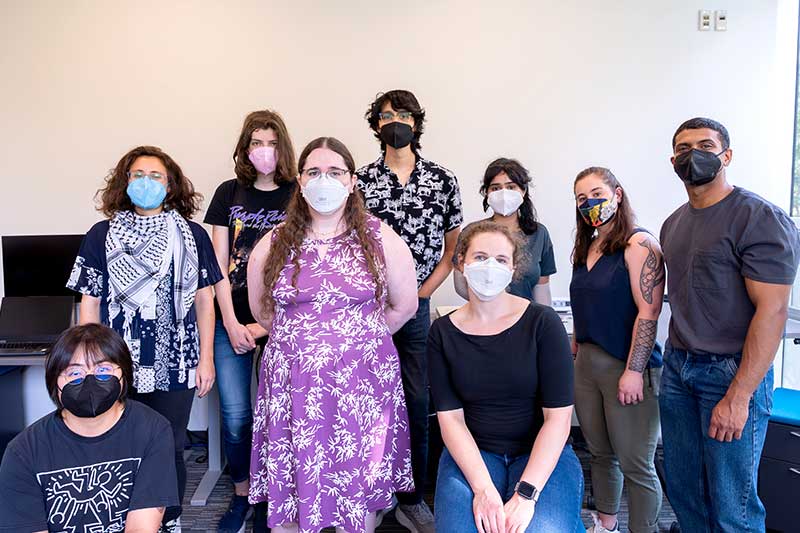
This story is part one of a six-part Khoury News series called “Research that hits home,” which showcases researchers who come from — or form close partnerships with — the communities they study. The remaining stories will be released throughout the fall.
Research starts with a problem.
Sometimes it’s a hard-to-articulate problem with an endless number of possible solutions: Social media is filled with harassment and conflict.
Sometimes it’s an interdisciplinary problem with historical roots: Low-income Black communities experience poor health outcomes.
Sometimes it’s a problem that can never be fully solved: Activists make trade-offs between safety and visibility.
Sometimes it’s a problem whose solutions can only be tested in the real world: Academia has historically treated marginalized peoples’ knowledge as unimportant.
And when a problem has all these characteristics — when it crosses disciplines, resists clear articulation, and is impossible to fully solve — it’s called a “wicked problem.” These are the society-shaping problems traditional research tends to dismiss as unsolvable. But the better answer, says Michael Ann DeVito, is to turn toward your community.
“From the outside looking in, a problem has to start from a deficit; there is something going wrong here. But to solve it from an in-community perspective, you have much more insight into what people want to preserve; that lets us start much, much closer to what we do about it,” says DeVito, an assistant professor with joint appointments at Khoury College and the College of Arts, Media and Design, and the director of the SEALab. “When you’re trying to solve a problem that affects you or people you care about, it’s a lot easier to keep going and to spot surprising things.”
DeVito’s work is built on the assumption that respecting epistemic justice — the idea that people and communities should have authority over their own life experiences — surfaces better answers to more complex questions. Her philosophy has underpinned work at Northeastern since well before her 2024 paper on epistemic autonomy received an honorable mention at CHI, the world’s top human-computer interaction conference, and it’s now helping Khoury researchers make progress on wicked problems in their communities.
So right now, research starts with a problem. But what if it began somewhere else?
How to study the margins, and why
DeVito’s journey into epistemically just research began in 2015. Her PhD advisor was studying user behavior on gay dating apps, part of a larger trend toward member-researchers — someone part of the community they study — among gay men.
“Other contemporary studies were all about pathologizing sexual and health behavior, and had this tone of ‘How do we save these poor, misguided people from themselves?’ Whereas his work captured the joy, the positives, and the benefits, while also being very honest about the safety challenges,” DeVito says. “It was an amazing series of studies. I don’t think it could have happened unless it was someone in the community, living it, that did the research.”
DeVito noticed member research had yet to take off in her own sapphic and trans human–computer interaction communities, so she decided to take a crack at it herself. Because she had seen LGBTQ+ social media communities both transform lives and explode into infighting, misunderstanding, and unchecked bias, DeVito was curious which values LGBTQ+ people broadly agreed on that could facilitate a lasting, healthy online community.
DeVito assembled an Asynchronous Remote Community, the research equivalent of an online community space where participants respond to questions, prompts, and autoethnographic activities, as well as chat with the facilitators and one another about their answers. Meeting asynchronously allowed often-excluded people to contribute, including disabled stakeholders who couldn’t travel and low-income stakeholders who couldn’t miss work. The format also allowed for a lot of disagreement.
“In a good ARC, you can have people work through the conflict they’re going to have to in the end anyway, before you design the big thing that’s hard to completely turn around,” she said. “We’re moving conflict from a post hoc disaster into part of the design process.”
While participants experienced different problems, all agreed on two main values regarding online platforms. The first was self-determination — each person decides what they interact with — and the second was inclusion, the group’s ability to safely welcome different parts of their community. They also wanted to socialize and interact with each other’s content — whether via large social media sites like Facebook, group messaging platforms like Discord, or theoretical future tools — using opt in/opt out structures and local control over algorithms that supported inclusive, self-determined behavior.
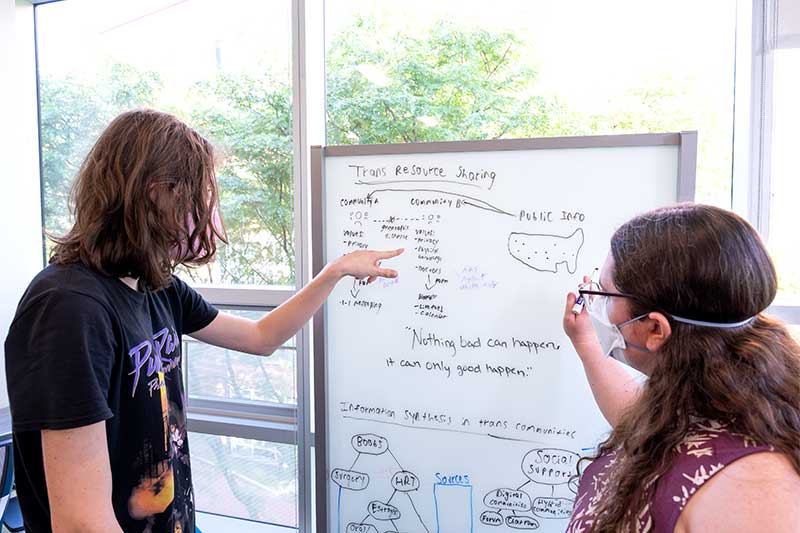
If those ideas sound like they’d work well on mainstream social media, DeVito would agree. Marginalized people often deal with more extreme forms of the problems everyone faces, so solutions that work for edge cases also tend to benefit the center.
“If you work on broad populations without looking into specific groups that are at risk or targeted, it’s like taking cold medicine. NyQuil does not cure a cold, it just handles the worst symptoms so we can move on,” DeVito says. “At the edges, you have to solve the problem. It doesn’t matter how much NyQuil you throw at cancer, it’s not going to help.”
But focusing on edge cases is only half of what gives epistemically just research its insight. The other half is who’s doing the research.
“Research — especially computer science research — has to start from a problem. If you’re coming in as someone outside the community, all you have to hold on to is that problem. You have more potential for balance if you’ve had both positive and negative experiences in the community,” DeVito says. “The thing people claim against epistemic autonomy is, ‘You’re going to be biased writing about your own group.’ But bias comes in when you’re making guesses about a life you don’t know, and all you’ve got to work with are the stereotypes.”
Handling humility
Just because DeVito believes in epistemic justice doesn’t mean she’s always done it right.
In her recent paper “Moving Towards Epistemic Autonomy; A Paradigm Shift for Centering Participant Knowledge,” she offers an example from her grad school days. While studying hijra, a South Asian people who parallel — but are considered distinct from — DeVito’s own transgender community, she relied on a canon penned by white, cisgender academics.
“I now see this as a failure on my part,” DeVito wrote, noting that, contrary to existing research, many hijra view themselves as trans women. “We did not respect the epistemic authority of the hijra, and as a result, we did not even get the chance to consider the nuance that their own diverse understandings of themselves and their needs might have revealed.”
Such examples, DeVito points out, are rarely conscious bigotry. More often, epistemic injustice is an unintended consequence of the traditional research relationship between one who investigates and that which they study.
Aside from the struggle to distinguish stereotypes from reality, this relationship presents a subtler problem: Treating someone as objective doesn’t eliminate their unique worldview. When a researcher’s perspective is treated as objective and authoritative, other perspectives are redefined as subjective, biased, or lesser in relation, and the research can’t be expanded or challenged by new insights from its subjects.
“If you’re doing a traditional quantitative study and something radically surprises you, the design is scuttled; you’ve got to start again,” DeVito says. But within an epistemically just framework, the opposite is true; a radical surprise is a sign of uncovering new knowledge.
While member-researchers are the most straightforward way to respect epistemic autonomy, it’s unrealistic to expect that researchers will only study their own demographic groups. So how can nonmember researchers ensure their methods are just?
The key, says DeVito, is humility.
“You need to get comfortable being wrong,” she says. “A lot of researchers struggle with that because being right is what we’re paid for, but the path to being right involves a lot of being wrong. It’s the first step toward acknowledging you would like to get better.”
Which brings DeVito back to “Moving Towards Epistemic Autonomy.” Published two decades after the hijra study, the new work is co-authored with Indian radical transfeminist Talia Bhatt, who shares her experiences being ignored or harassed when asserting epistemic authority. The paper describes a research culture predicated on superiority and disbelief and lays out actionable ways — like decoupling the ideas of “scientific” and “objective” — that researchers can shift toward justice.
Epistemic justice at Khoury College
When DeVito joined Northeastern in 2023, one of her first acts was to establish the Sociotechnical Equity and Agency Laboratory (SEALab).
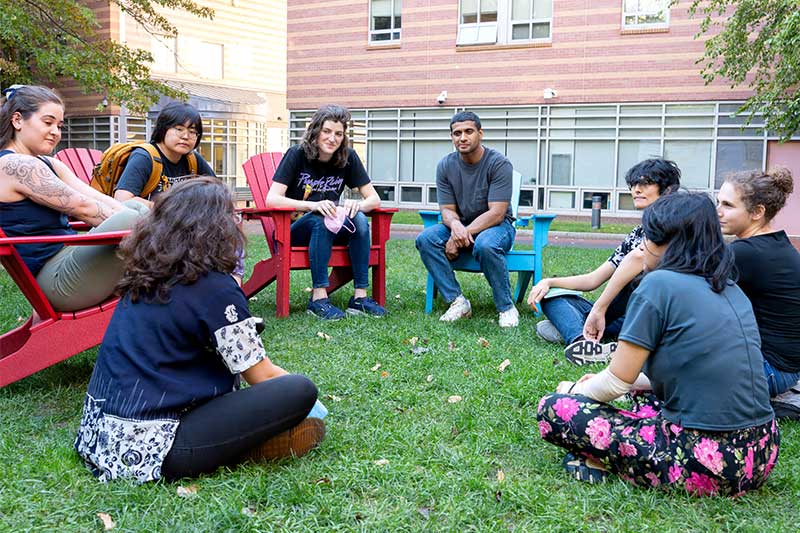
“A computer science lab is often based around the type of problem it solves; we’re based around a set of shared values, principles, and tools,” DeVito explains. “We’re methods experts, and the goal is to empower researchers to use accessible, storytelling-based, qualitative, and critical methods to make an impact on the problems directly impacting their communities.”
The lab has attracted graduate students tackling questions that plague queer communities, racialized communities, disabled communities, activist communities, and more.
DeVito has also continued to dive deeper into epistemically just research methods, including by spending a year becoming a TikTok influencer to understand how transfeminine TikTok users balance safety and visibility. Since joining Northeastern, she’s also published further theoretical work on epistemic justice and is currently working on an ARC study into asexual and aromantic communities.
DeVito says she’s grateful for the environment at Khoury College, in which she and her students can count on being supported, given opportunities, and treated well, a basic expectation that her trans identity has frequently barred her from.
“It would be foolish to dismiss people’s talent and impact based on immutable identity characteristics; that’s just a given here, in a way I’ve never encountered before,” she said. “Even my colleagues who don’t align with me on larger social issues have trans women in their lab and treat them incredibly well compared to pretty much every other place I’ve ever seen. I think that’s because we have a culture of, ‘Are you good at this? Then we’re going to support you; who cares about the other stuff.’”
Because marginalized people have historically been excluded from academia, DeVito is also excited by Khoury College’s Align program, which welcomes students from nontechnical backgrounds to pursue graduate degrees in computer science.
After spending years focused on research philosophy and design recommendations, DeVito is looking forward to building some of the systems she’s designed, from social media platforms with inclusive, self-determined governance structures to a better sapphic dating app. She’s also excited to see what questions her students tackle with the epistemically just methods she brings into the classroom.
More than anything, she’s excited to see what Khoury culture creates in the coming years.
“Khoury College has something genuinely special,” DeVito says. “If you give people an environment in which they feel safe and heard, most people are pretty damn clever. I think it’s a core piece of what a human is; we all have that potential to discover amazing things, but only if we feel safe enough to do it.”
The Khoury Network: Be in the know
Subscribe now to our monthly newsletter for the latest stories and achievements of our students and faculty