Khoury News
With first-of-its-kind double major, Reese Cantu strives to build tech for the deaf community
Reese Cantu's passions of computing and sign language were such an unusual combo that he had to forge his own degree path. Now, just weeks from graduating, he's ready to leverage his learning to benefit the deaf community.
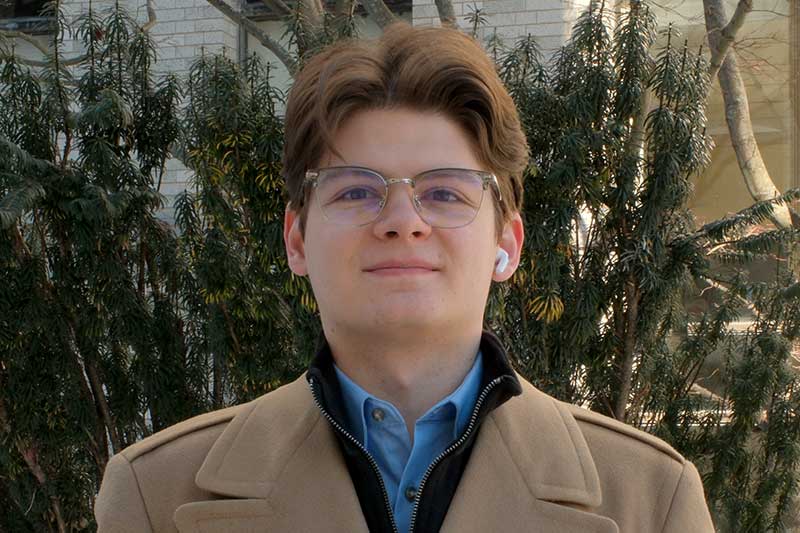
Accessibility for the deaf and hard of hearing community is too often an afterthought in software development.
Reese Cantu is combating the problem head-on by combining his interests to create a double-major path that is entirely his own. He’s majoring in computer science at Khoury College and American Sign Language–English Interpreting at the College of Social Sciences and Humanities, with plans to complete his ambitious degree in May.
“It’s something that is brand new for a lot of people. I don’t know that this has been done before at Northeastern,” Cantu says.
Either major is enough to keep most students busy, but ASL and CS are enduring passions for Cantu and he hasn’t wanted to abandon either pursuit. Fortunately, at Northeastern, he hasn’t had to.
Cantu’s interest in ASL took root in third grade when a classmate brought in a book on sign language, which gave Cantu and his friends a way to discreetly communicate with one another behind the teacher’s back. This subterfuge grew into a genuine passion for Cantu, who later created an ASL club at his high school and started attending social events for the deaf, hard of hearing, and signing community.
Meanwhile, Cantu was developing his math and computer science skills, learning programming from his grandfather who was a developer back when the trade still involved punch cards.
“I grew up watching my grandfather make websites, and he taught me little bits and pieces of JavaScript, so I’ve always had this math and science brain going on,” Cantu says.
As Cantu prepared to apply for college, he knew that he wanted to enroll in an accredited ASL program, which narrowed his search to just over a dozen universities. But he also wanted to study computer science. When he visited Northeastern’s Boston campus and saw the Interdisciplinary Science and Engineering Complex, he felt he had found a place where he could marry his interests.
“Northeastern was the only school I applied to,” Cantu says.
After getting accepted, Cantu showed up to orientation with a spreadsheet of the courses he wanted to take to fulfill his double-major dream. Although he worked with Khoury and CSSH advisors to develop a plan, he found the bridging of these two rarely paired fields, both for his major and his career aspirations, was his puzzle to solve.
“The tech industry is moving very quickly,” Cantu says. “A lot of folks know a little bit about sign language, but they don’t really know a lot about deaf folks and the deaf community and what they want or need.”
Cantu’s goal is to work directly with deaf programmers to develop useful technologies centered around their input. As he points out, many innovations in the ASL-CS world involve gloves that translate the motions of hands and fingers to ASL words, but this approach neglects the importance of facial expressions. The raising of eyebrows, for example, is used to indicate a question, and without this kind of information, the richness of ASL is diminished.
Cantu gained further experience with ASL when he completed what he calls a “study domestic” (as opposed to a “study abroad”) at Gallaudet University, a Washington, DC-based liberal arts school for deaf and hard of hearing people with which Northeastern has a partnership. All the professors there are deaf or hard of hearing, and the courses are taught entirely in ASL. He was there for his ASL and Interpreting major but also took several computer science classes.
“Talking about CS concepts in ASL forced me to know my stuff,” Cantu explains. “You don’t get to hide behind vocabulary in the same way you do in English because often, the ASL representation of a concept is a description of what it means rather than one individual sign.”
Acclimating to an ASL-only environment took some getting used to, but the deaf community’s emphasis on inclusivity helped make Cantu’s adjustment much easier.
“One benefit about learning anything in a deaf environment is a cultural attitude of making sure everyone in the room understands what is going on,” Cantu says. “I have never been in a classroom where the teacher and students were so willing to pause and clarify if someone asked for it.”
Back at Northeastern, Cantu recently completed Khoury College’s Professional Practicum Capstone, in which Professors Mark Fontenot and Wendy Truran guide students through real-world application development. In Cantu’s case, he worked with the Massachusetts National Guard’s Explosive Ordnance Disposal Unit to digitize their inventory-taking process, which was previously done on paper. In speeding up the inventory process, his solution freed up cadets’ time for more important work.
Cantu and his group dealt directly with the Massachusetts National Guard to assess their needs. Creating an application for nontechnical users meant Cantu had to flex his interpretative skillset to translate everyday English into technical code. The product was designed to be as user-friendly as possible, something that Cantu, with his emphasis on accessibility, always keeps front and center.
Now Cantu hopes to continue bridging computer science and ASL with his senior capstone project, which aims to assess the state of sign language recognition technology.
“To what extent can computer vision models notate sign language? There’s often so much nuance that’s getting lost,” Cantu says. “Essentially, how can [innovators] make a product that actually works for deaf people?”
The Khoury Network: Be in the know
Subscribe now to our monthly newsletter for the latest stories and achievements of our students and faculty