Khoury News
Northeastern alum Nicolai Jacobsen brings analytics to the world of competitive sailing
Nicolai Jacobsen was born into a family of Olympic sailors and has spent countless hours on the water. But in blending his computing and entrepreneurial skills with his childhood passion, he's found a new way to compete.
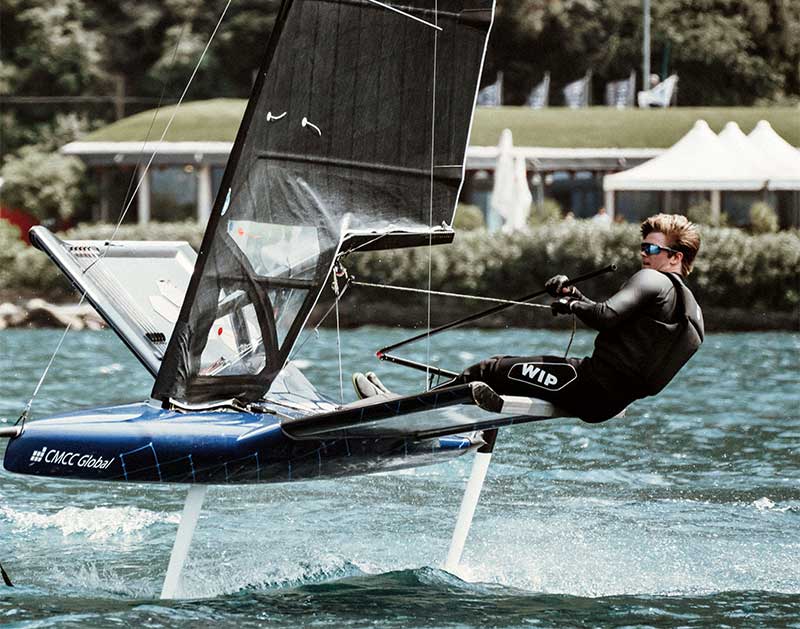
From a childhood spent on the water to developing a machine learning application that helps competitive sailors optimize their performance, Nicolai Jacobsen has transformed a lifelong passion into a platform that serves sailors at every level.
Vantage Sailing began as a personal project — a way for Jacobsen to translate his years of sailing experience into useful feedback through data.
Jacobsen, originally from Norway, graduated from Northeastern in 2025 with a degree in data science and business administration. Throughout his time at Northeastern, he continued sailing competitively, seeing many similarities between the complexity of the sport and the problem-solving nature of computer science.
Hailing from a family of Olympic sailors, Jacobsen built on his legacy by finding new ways to enhance performance through technology.
“Sailing is a very technical sport,” Jacobsen said. “You have to adapt and learn how to respond to the changing conditions. It’s kind of like you’re playing chess.”
In the beginning, Jacobsen tried applying simple concepts he learned in class to his own sailing ventures. In using his sailing data to track his performance and give himself feedback, he quickly realized that others were intrigued by his approach and that he might be onto something bigger.
“My friends that I was sailing with, they loved it. So, I decided to do it for a few more people,” he said. “I started thinking to myself, how could I make this into a viable product?”
In the first semester of his fourth year at Northeastern, he created an independent co-op to focus on the project for six months. With the help of Eric Gerber, a Khoury professor whose research interests include sports analytics, Jacobsen refined his idea and began turning it into a practical product.
Having only completed data science classes, Jacobsen approached the business side through trial and error.
“It was a big learning experience,” he said. “That’s the way you learn best, by making mistakes and then figuring it out along the way.”
He collaborated on product testing and user feedback with the Norwegian national sailing team, where his sister Julia competes.
“When I developed the platform early on, I needed someone to test it,” Jacobsen said. “The Norwegian sailing team gave me valuable feedback to help refine the product and usability. They were a huge help.”
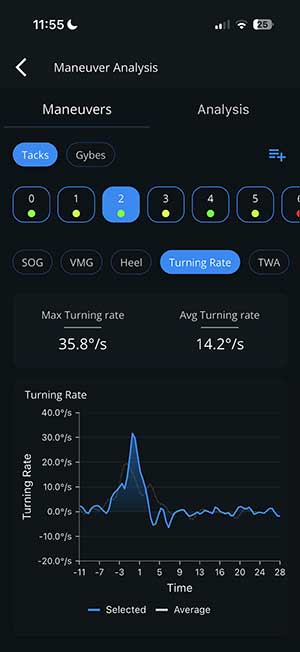
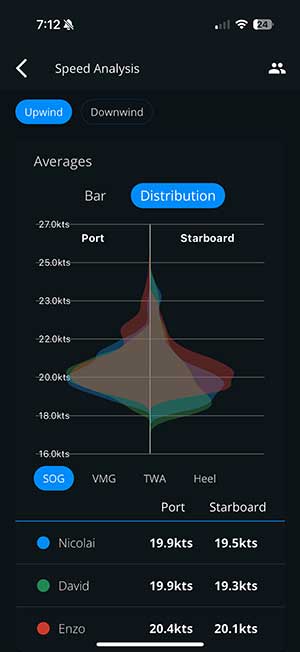
Sailing is particularly data-intensive because there are so many variables at play, including numerous environmental factors. Jacobsen estimates that it would take thousands of sensors to capture everything happening in any given race; fortunately for him, this complexity mirrors the kind of thinking required in data analysis.
“You need to learn a lot of physics to truly understand how a boat works,” Jacobsen said. “That’s always made me think a little bit creatively and critically around the approaches, which has helped in terms of how I look at data algorithms, design, and problem-solving.”
One challenge was designing a user experience that made the data easy to access and understand.
“Because there are so many factors, it is very tempting to go all the way in terms of analytical capabilities — to implement the most advanced AI neural networks and overcomplicate things,” Jacobsen said. “But you need to simplify the insights enough so that sailors and coaches can use it.”
The project started by relying purely on statistical analysis but has since evolved to incorporate more machine learning techniques. A wind prediction algorithm, for example, is trained on data from more than 10,000 uploaded sailing activities.
“The more people use it, the better the algorithm becomes,” Jacobsen said.
Using a random forest algorithm, the model analyzes this data to predict how the wind will shift throughout a session. It’s trained on polar plots, which represent the physical limitations of how fast boats can travel relative to their angle to the wind.
This focus on clarity and usability, Jacobsen says, is where Vantage Sailing sets itself apart. What started as a small project to analyze his own data for competitions now has a team of four and a user base of 1,500 — ranging from amateur sailors to Olympians.
“For a long time, I was the sailor with the most activity uploaded on the app,” Jacobsen said. “Now I’m nowhere close.”
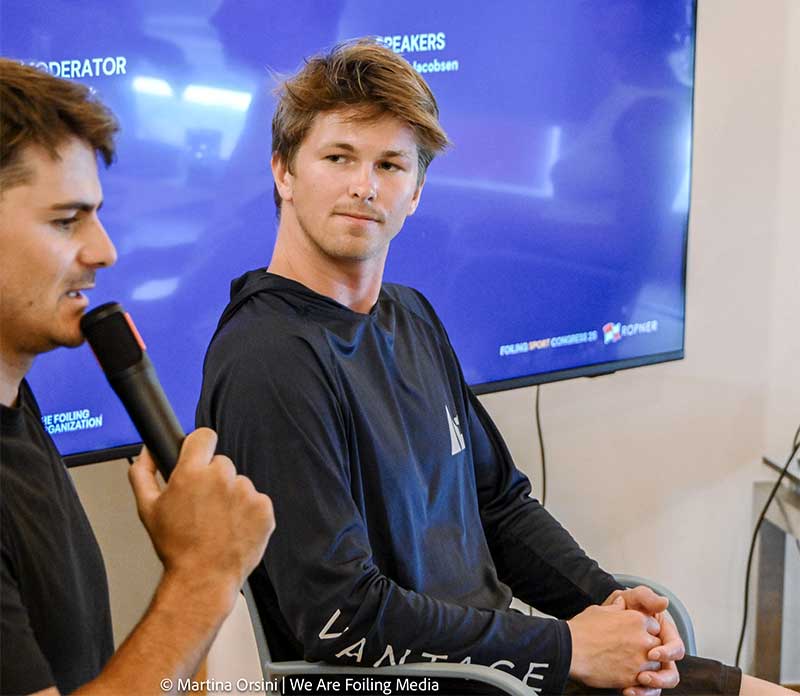
Jacobsen now works at Luna Rossa, Italy’s long-standing challenger team in the America’s Cup — a result of the risk he took to develop the project through a full-time co-op.
“I’ve gone from sailor to performance analyst,” Jacobsen said. “As much as I love competitive sailing, I’ve realized that I love helping aid performance from behind the scenes.”
Looking ahead, Jacobsen hopes to maintain the platform’s user-friendly design while incorporating more advanced tools, with artificial intelligence high on the agenda. Another idea is a virtual coach that can give users even friendlier, more accessible recommendations.
“We’re looking at bringing some of the advanced capabilities behind the scenes and then communicating [those insights] in a natural language form with the user,” Jacobsen said.
Jacobsen also looks forward to incorporating more live processing for a shorter feedback loop where users will get quicker responses.
“Right now it’s a post-training analytics tool,” he said. “What we’re looking to do eventually is bring the insights to on the water.”
As he considers new possibilities, Jacobsen encourages students who are just beginning their journeys to go after their passions.
“So many people have ideas of things they want to do and projects they want to pursue, and it’s very difficult because there’s a really steep learning curve and time commitment in the beginning without seeing any real results,” Jacobsen said. “But you’ve just got to get started.”
The Khoury Network: Be in the know
Subscribe now to our monthly newsletter for the latest stories and achievements of our students and faculty