Khoury News
Meet the 2026 Khoury College award winners
Whether for working co-ops far and wide or strengthening community close to home, Khoury College's students have made their mark. Per annual tradition, ten were recognized this spring for their achievements.
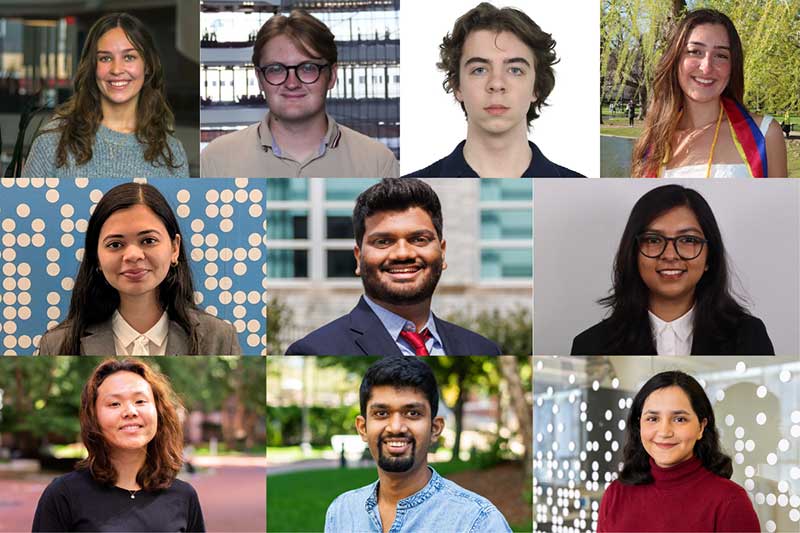
Each year, Khoury College honors exceptional students for achievement in research, teaching, community service, and co-ops. To learn more about this year’s winners, find their stories below or simply scroll to read more.
- Undergraduate Co-op: Sabine Laurence
- Undergraduate Teaching: Misha Ankudovych
- Undergraduate Research: Zack Eisbach
- Undergraduate Service: Katherine Aristizabal
- Master’s Teaching: Mansi Modi
- Master’s Research: Nihar Sanda
- Master’s Service: Ritika Kumar
- PhD Teaching: Hye Sun Yun
- PhD Research: Harsh Chaudhari
- PhD Service: Andisheh Ghasemi
Sabine Laurence, Undergraduate Co-op
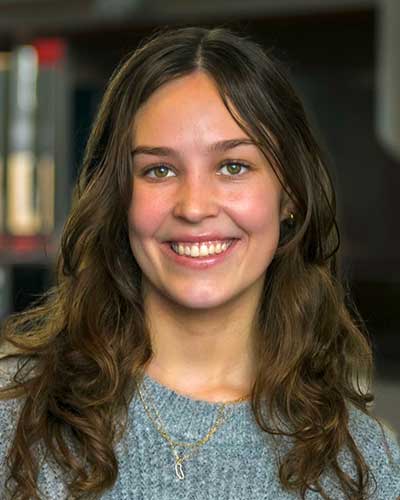
Sabine Laurence had no plans of pursuing computer science. Originally from San Jose, she spent much of her time focused on the humanities. But after taking one CS course at Northeastern, she was hooked — and the new CS and economics graduate has no intention of turning back.
During her first co-op, she worked as a full-stack software engineer for Cisco, a technology company based back home in California. She was tasked with creating a new project management tool to replace Cisco’s outdated one.
“I was the only one working on this project,” she said. “I got a lot of freedom.”
With her co-workers as customers and a three-month deadline before the company stopped funding their old tool, Laurence built a customized internal app that featured more than 200 columns of data, enabling Cisco teams to track more than 500 projects. Using her app, teams could filter, group, and view only the information relevant to them, all from a single database.
“I definitely learned a ton,” she said. “By the end of my co-op, a couple of other teams had onboarded to the app. That was just a really cool feeling. I’d never done something like that before.”
Returning home to San Jose for her second co-op, Laurence worked as a back-end software engineer at Intuit, building on her skills from the previous co-op but with a larger team.
“It was a very different experience,” Laurence said. “This one was a lot more technical.”
She worked with application programming interface management tools that connected data across teams, building systems to route and unify information like customer phone numbers and bank data. She also helped develop a metrics dashboard to measure and improve developer efficiency and contributed to a company-wide GraphQL layer by organizing and parsing through duplicate data.
“As a whole, my team worked on making other engineers’ lives easier,” Laurence said.
Her co-op work deepened her involvement in Northeastern Women in Technology. Alongside her second co-op, she became website manager and later president, virtually running the site while applying her new skills and bringing herself closer to the community she had joined as a first-year.
“I feel like I’ve met some really incredible people at Northeastern,” Laurence said. “And I’m proud to be part of that network.”
Misha Ankudovych, Undergraduate Teaching
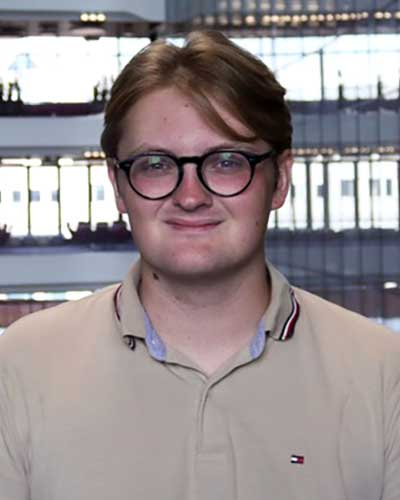
As a tour guide, parliamentarian of student government, chair of the Senior Year Experience Board, and leader of the hockey student section, Misha Ankudovych contributed to nearly every phase of student life. But it’s his role as a teaching assistant where he had the most direct impact on students.
Originally a psychology major, Ankudovych became a regular at office hours for “Discrete Structures.” The support he found there helped him earn an A and inspired him to apply to become a TA himself. A combined data science and economics major who graduated this spring, Ankudovych says his parents, one of whom is a high school teacher, instilled in him an early appreciation for education and mentorship.
“I don’t think I ever imagined that I would be a teacher or a teaching assistant,” Ankudovych said. “The value and the privilege it is to teach — I definitely got from an early age with my mom.”
Ankudovych spent the last three semesters as a TA for “Introduction to Databases” with Teaching Professor Mark Fontenot, including the last two as lead TA. Alongside eight other TAs, he tested homework, hosted office hours, proctored, graded, and made rubrics for a class of approximately 200 students.
“The community you build between the TAs and the professor, I’ll definitely keep in contact with everyone long after I’m gone from Northeastern,” he said. “That’s such a unique thing to be a part of.”
His connection to the course extended beyond colleagues to the students he supported.
“There were people I would talk to almost every week in office hours and then I’d see them doing better over time,” Ankudovych said. “It’s extra special if you saw them along that journey and saw the connections happen.”
Ankudovych never stopped learning himself. With three internships and one co-op under his belt, he remained driven to take on new challenges. In August, he’ll move to Washington, DC, to work as a forward-deployed software engineer for data management systems.
“If you have the privilege of being able to be uncomfortable, take advantage of it. Northeastern’s a great place to do that,” he said. “You never know what you’ll love to do, and you never know where it’ll lead.”
Zack Eisbach, Undergraduate Research
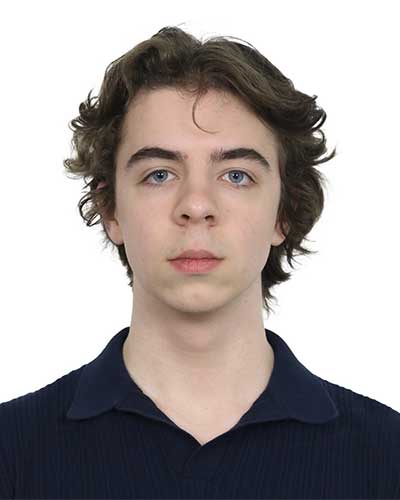
Zack Eisbach, a recent computer science and mathematics graduate, has dedicated himself to studying language interoperability, the ability of programs written in different programming languages to communicate safely.
At the heart of Eisbach’s research are application binary interfaces, or ABIs. Eisbach has focused on transforming these ABIs, which have lots of room for ambiguity and security risks, into precise, machine-checkable mathematical models, enabling formal verification of whether software components correctly adhere to them.
Under the supervision of Khoury PhD student Andrew Wagner and Professor Amal Ahmed, Eisbach co-authored a paper presented at OOPSLA 2024 that introduced a novel framework for formally specifying ABIs.
“There are all of these nice programming languages with new systems that rule out bugs by construction. But in practice, we have to interact with these unsafe languages,” he said. “Some of my research is partially concerned about how we can make unsafe languages safer for the purposes of interoperability.”
This approach models how high-level language types correspond to low-level machine behavior, demonstrated through a Swift-like language with reference counting. The work led to an ongoing collaboration with Apple’s Swift language team, where Eisbach’s contributions include developing a formal specification of Swift and its ABI on the LLVM platform.
Beyond research, Eisbach served as president of Northeastern’s Math Club. After graduation, he returned to Jane Street Capital, his former co-op employer, as a full-time compiler engineer.
Katherine Aristizabal, Undergraduate Service
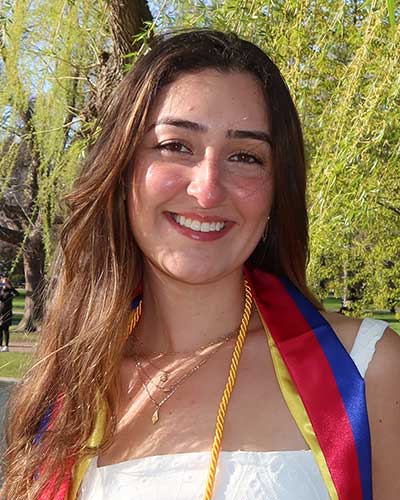
As a native of Lowell with roots from Medellín, Colombia, Katherine Aristizabal began her time at Northeastern through PODER, a student mentorship program for incoming first-generation first-years run through the Latinx Student Cultural Center. She studied computer science with a concentration in human-centered computing and a minor in psychology — and ended up going full circle as a program manager with PODER, where she served as a mentor to first-year students.
“Through PODER I made a really good support network of upperclassmen who had been through similar things. That really helped when it came to applying to co-ops,” she said. “I’m so thankful for all the people who helped me along the way. I wanted to be that for other people.”
Drawing upon skills learned from her co-ops at Johnson & Johnson, Notability, and Apple, Aristizabal also spearheaded the construction of the program’s first website, coordinating with program managers to create a centralized place for resources and photos.
“They didn’t have a website before. At first it was just bare-bones WordPress we were working on,” Aristizabal said. “Since then, the program has grown so much, which is so great.”
At Northeastern’s student chapter of the Society for Hispanic Professional Student Engineers, Aristizabal transferred these skills to work as a website administrator. She was also part of the first cohort of Khoury F1rst — the college’s group for first-generation college students — and similarly returned to help lead workshops on themes such as fine-tuning resumes and overcoming impostor syndrome.
“It is so important, especially in computer science,” she said. “It’s a predominantly male field and I wanted to be that resource even more within CS.”
After graduation, Aristizabal will return to Apple in San Francisco as a full-time software engineer, where she hopes she can continue mentoring future interns.
“Those moments where you see pieces of yourself, you’re like, ‘It’s crazy how far you’ve come,’” she said. “I’m very proud to be in a role where I can help other students and see that.”
Mansi Modi, Master’s Teaching
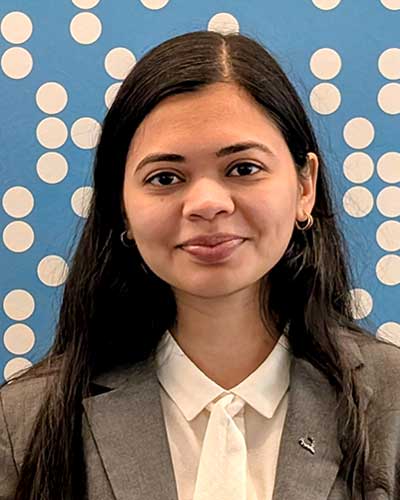
Before ever stepping foot in a college classroom, Mansi Modi was already teaching herself to code. She started with the C programming language, built herself a working calculator, and eventually moved on to web and mobile applications.
Now, four semesters into her studies at Northeastern’s Vancouver campus, she’s on the other side of the classroom, having helped teach four courses to a wide range of students: some with prior programming experience and others encountering the field for the first time.
“I wasn’t introduced to computers early in school,” Modi said. “My first time writing an actual program was my first year of the bachelor’s program.”
Her first course as a teaching assistant, “Programming Design Paradigms” with Jack Thomas, was straightforward for her. Having worked with Java for five years, Modi was familiar with the material and could focus on helping explain the content to her students.
The following summer, she continued with Thomas, pivoting to teaching “Object Oriented Design.” Then, as she returned to campus in the fall, she helped teach “Foundations of AI” with Richard Hoshino, a course for Align master’s students that, for many, served as their first introduction to computer science.
“I helped them set up the environment; I even helped them with the labs and explained how a Java program is run,” Modi said. “It was a good moment that I was able to explain to the non-technical folks how something works in very simple terms.”
In her final term, Modi took on a TA role for “Building Scalable Distributable Systems” with Yvonne Coady, helping guide the course through a significant overhaul. The syllabus was reworked to incorporate AI, giving students access to Claude Code and extensive server logs.
As part of the shift, students were tasked with using AI. Modi supported their work through weekly interviews, spending about nine hours each week tracking their progress, examining their AI-assisted assignments, and probing their code and decision-making to better understand how they arrived at their solutions.
As she finishes her final research capstone, Modi is researching how to empower students with AI, designing assignments and analyzing how students interact with the tools.
“Most of the students I talk to have so much to share, so much to inspire,” Modi said. “I’m going to miss all these conversations and meeting these new people and getting to know about their experiences.”
Nihar Sanda, Master’s Research
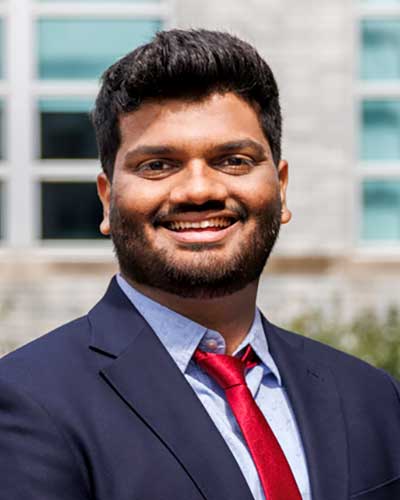
Nihar Sanda completed his undergraduate computer science degree amid the upheaval of the COVID-19 pandemic. This ignited an interest in health care and biomedicine, which has shaped his research ever since.
“I really like the idea of computers trying to understand human language,” Sanda said. “My common thread of applying all of these NLP tasks was always related to life sciences or health care. This interesting interaction was very surprising to me.”
Having wrapped up his master’s in computer science at Khoury College last December, Sanda now works as a machine learning engineer at Northeastern’s Institute for Experiential AI.
Throughout his time at Khoury College, Sanda was involved in a multitude of research projects, publishing six peer-reviewed papers in leading venues such as ACL, CHI, ISMB, and AIED. For his master’s thesis, Sanda, who was advised by Ayan Paul, Benjamin Gyori, and Auroop Ganguly, worked with three Northeastern labs to build a cross-domain knowledge aggregation system to understand the effects of climate on health.
He also completed a co-op at Vanderbilt University; joined Assistant Professor Maitraye Das’s Technology, Equity, and Accessibility Lab; served as a graduate research assistant; and collaborated with NASA on AI safety in geospatial science. In recognition of his work, Sanda received the Best Poster Award for Impact and Novelty at the Khoury Poster Day in 2025 and was named to Northeastern’s Laurel and Scroll 100.
“In research, especially when you are collaborating, having multiple ideas is interesting because there are so many professors who’ve worked in their specific domain for so many years,” he said. “As a student, you get a plethora of ideas that I think you wouldn’t get if you weren’t collaborating.”
Ritika Kumar, Master’s Service
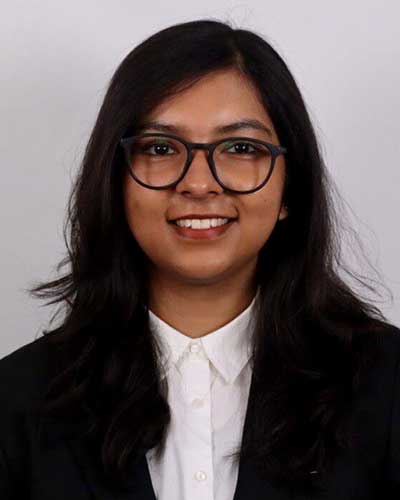
Ritika Kumar is no stranger to building projects from the ground up.
As a self-developed data science co-op at Bevi, a company that designs smart water dispensers, Kumar designed a real-time AI summarization pipeline for customer service calls. Beyond the technical work, she collaborated closely with the customer service team and consistently engaged with colleagues.
She credits these communication skills to her work with Khoury SHEROs of Color, an affinity group that supports female faculty and graduate students of color in Khoury College, of which she’s a founding member and director of events.
“Starting a club is scary,” Kumar said. “That experience itself taught me a lot about leadership, soft skills, and communicating with people.”
Having just completed her master’s in data science, Kumar is most proud of her time at SHEROs.
“This is such a male-dominated field, and I feel that women need the space to feel like they belong — a space to talk about their achievements, what they’re doing, where they’re struggling, how they can do better,” Kumar said. “In a room, you’re the only girl sometimes. In labs, you’re the only girl on the team. It was just nice sharing experiences, connecting with people, and feeling like you’re not the only one feeling this way and that there are others who can support you.”
Kumar is working on her thesis under Assistant Teaching Professor Deahan Yu, who specializes in health care and natural language processing. Her job involves predicting International Classification of Diseases codes. These codes are used for billing within health-related services and research into the patterns and causes of diseases. She is also working to further automate this process using large language models and synthetic data augmentation.
As she wraps up her last semester, she’s excited about the possibility of returning to SHEROs as an alumna to inspire future students.
“I came to Khoury College with one singular goal of computer science and becoming this technical person who’s really good at her job, but I gained so much more,” Kumar said.
Hye Sun Yun, PhD Teaching
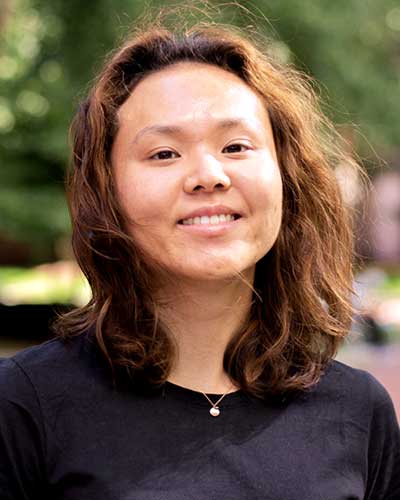
Hye Sun Yun’s path to teaching began long before her PhD studies.
Yun attended Wellesley College for undergrad, where she studied computer science and had very approachable, supportive professors — sparking her interest in academia.
“That environment allowed me to have the confidence to pursue computer science as a career,” Yun said. “I’m highly influenced by how my [Wellesley] professors taught my courses.”
After working as a full-stack engineer, Yun came to Northeastern with the goal of taking on more teaching in addition to her research in natural language processing, human–computer interaction, and health communications. She designed and taught her own course, “Research in Human-Centered Natural Language Processing,” working closely with a small group of 10 undergraduate and graduate students.
Last fall, she stepped into a much larger teaching role, co-teaching an undergraduate data science course. There, she coordinated with instructors, managed a team of 14 TAs, and helped guide a section of 11 students through the material.
The two experiences helped Yun to clarify her teaching style, and to realize that she thrives in more intimate classroom settings.
“There is instant gratification in some sense when students get it,” Yun said. “You see students progress, you see students actually learn something.”
Throughout her time teaching, Yun has watched — and adapted to — evolving educational needs.
“AI has infiltrated pretty much every aspect of the research process, whether for good or bad,” Yun said. “There’s been a lot of changes with teaching computer science to students.”
Still, she’s excited for the challenge. After defending her thesis in June, Yun will join Lafayette College to teach an introductory programming course and an intermediate course on the principles of data science.
Harsh Chaudhari, PhD Research
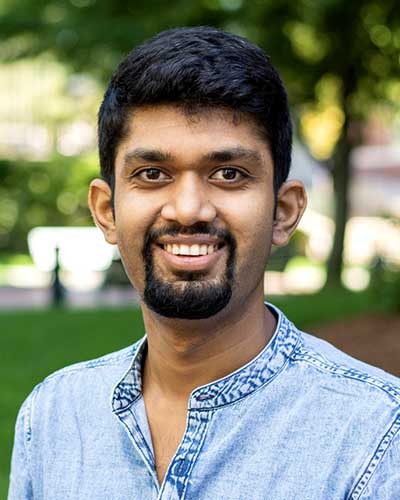
As a fifth-year PhD student, Harsh Chaudhari has been a witness to what he calls the “LLM boom.”
Chaudhari’s path to machine learning grew out of an early interest in applying cryptography to real-world problems. While completing his master’s degree, he began exploring machine learning as a practical use case. Over time, his focus shifted toward understanding machine learning itself, particularly the security vulnerabilities that arise when training these models.
“You have to adapt,” he said. “Whatever the new technology is, you have to be proactive to learn new technologies that are needed to become a better researcher.”
Under his advisor Alina Oprea, Chaudhari began investigating how model behavior would change when the data LLMs scrape is manipulated.
“When learning, LLMs don’t really learn what is good from bad,” Chaudhari said. “We show that it’s easy for the model to learn bad behavior.”
With the right kind of prompting or slight manipulation of training data, models can revert to earlier patterns or be nudged into producing outputs they were designed to avoid, Chaudhari explained, essentially learning harmful behavior without recognizing it as such. The implications raise broader concerns about how easily AI systems can be influenced. Because models can absorb and reproduce biased or misleading patterns from even small examples, they can potentially be leveraged for malicious purposes.
“This capability of the LLM to learn, to try to solve things that it has not seen before — you can use it to your advantage while spreading bad behavior,” Chaudhari said. “You can imagine it spreading stuff like propaganda. You can easily change the narrative.”
As he wraps up his PhD, Chaudhari has grown more comfortable with ambiguity, recognizing that perfect safeguards are unrealistic. Instead, he sees the work as a constant balancing act, a cat-and-mouse game between those building protections and those trying to break them.
“When joining, I thought that by the end of my PhD I would probably be more of an expert on things,” he said. “I’ve learned to navigate better not knowing is fine and that you need to keep learning.”
Andisheh Ghasemi, PhD Service
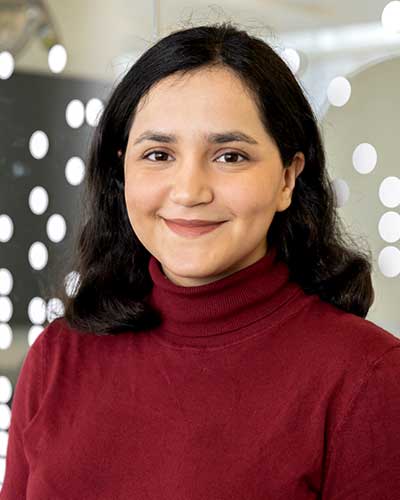
Computer science always felt like a natural fit for Andisheh Ghasemi. Building professional connections, however, was less intuitive. Now in the third year of her PhD, she has made an effort to turn that challenge into an opportunity for growth.
“Networking didn’t come naturally to me, but I knew how important it was,” Ghasemi said. “I decided I had to actively work on it rather than avoid it.”
Throughout her academic journey — from her undergraduate studies at Sharif University of Technology to her master’s at the University of Paris — Ghasemi regularly attended theory seminars. So, when she arrived at Northeastern, getting involved in the Theory Seminar was an intentional first step toward building community.
“One of the first things I did was join the seminar, meet people, and start forming connections with students and faculty,” she said.
The seminar brings together students and visiting researchers for weekly talks and discussions. Since 2024, Ghasemi has taken on a leadership role as an organizer, coordinating speakers, managing logistics, and leading outreach efforts to encourage broader participation.
“I especially wanted to motivate junior PhD students to attend,” she said. “Creating a supportive environment helps everyone feel more comfortable engaging.”
Encouraging attendance can be challenging, as many PhD students are deeply focused on their own research. Still, Ghasemi sees the seminar as a valuable space for connection and mutual support. Under her involvement, participation has steadily grown, with 10 to 15 attendees at each session.
“It’s important to show up for each other,” she said. “If your lab mate is presenting, go listen, ask questions, be part of that moment. It’s good for our sense of community — and even for our mental well-being.”
As she continues her PhD, Ghasemi plans to pursue a career in research. She credits her experience with the Theory Seminar not only for expanding her professional network, but also for helping her become more confident and engaged within the academic community.
“I’ve learned how much of a difference it makes to support others,” she said. “That shift has helped me grow, both professionally and personally.”
The Khoury Network: Be in the know
Subscribe now to our monthly newsletter for the latest stories and achievements of our students and faculty