Khoury News
Lace Padilla wins VGTC research award for studying uncertainty in data visualization
Visualizations aim to make complex data accessible for non-experts. But what happens when the data is definitionally uncertain, like with pandemics or natural disasters? Khoury–CoS professor Lace Padilla is on the case.
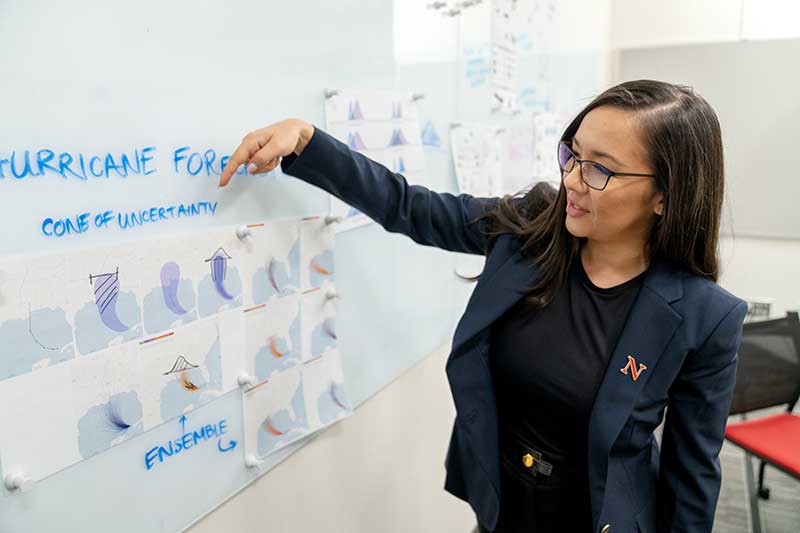
Lace Padilla, an assistant professor in the Khoury College of Computer Sciences and the College of Science’s Department of Psychology, has been awarded the Institute of Electrical and Electronics Engineers’ Visualization and Graphics Technical Committee (VGTC) 2025 Significant New Research Award.
The honor recognizes Padilla’s work at the intersection of data visualization, human cognition, and graphical perception. In particular, her work tackles a deceptively simple question: How do people interpret complex data visualizations when the data behind them is uncertain?
“Uncertainty is a very complicated topic because many people don’t understand how to reason for it,” she said. “I use data visualizations to communicate uncertainty in forecasts — like hurricanes, wildfires, and COVID-19 — and apply what we know about the brain to design visualizations that are easier to understand and better support decision-making.”
Padilla’s work explores how cognitive processes such as attention, memory, and emotion shape a person’s ability to draw conclusions from uncertain displays of data. Her findings have shown that even small design decisions, such as how uncertainty is visually shown or how contextual cues are presented, can dramatically influence how people perceive risk and make choices.
“We’ve found that visualization techniques that show distributional information in an easy-to-count format can actually reduce misinterpretations of uncertain forecasts,” Padilla explained. “This helps viewers make more informed judgments without oversimplifying complex information. This approach, called frequency framing, has been studied in psychology, and we are developing new ways to apply it to data visualizations.”
Padilla and her collaborators, including those in the Khoury Vis Lab, have demonstrated that these techniques help the average person visually quantify uncertainty in forecasts.
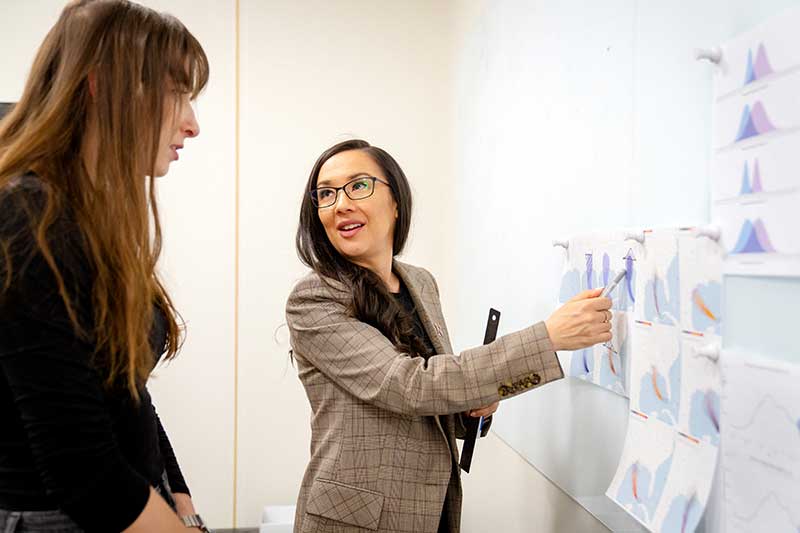
“Visualizations have the power to transcend education and language barriers,” she said. “If designed well, they can allow more people to understand critical information, but if designed poorly, they can make things more confusing. That’s why understanding how people process visual information is so essential.”
Padilla’s joint appointment in computer science and psychology places her at a unique crossroads. While many visualization researchers focus on computational methods or design innovation, Padilla’s work is rooted in understanding how the human brain processes visual information.
“It’s an amazing opportunity to be jointly appointed in two colleges that are both very supportive,” she said. “Northeastern has found a clever way to balance commitments across departments, so I get the benefits of collaborating widely without being overextended. Psychology helps with human subjects research and IRB processes, while computer science has been essential for building strong collaborations in computational modeling.”
Beyond advancing the academic understanding of visualization, Padilla’s research helps to make complex, uncertain information more accessible, equitable, and actionable — empowering non-experts to make data-based decisions in everyday life. In an age of information overload and misinformation, creating effective visualizations isn’t just a design issue; it’s a psychological and social issue, too.
Padilla’s group has collaborated with scientists, educators, and government agencies to design visualizations that help people make sense of uncertainty in contexts ranging from natural disasters to public health. By bridging lab studies and applied design, she’s helping set a foundation for evidence-based visualization, where what we know about cognition directly informs how we present data to the world.
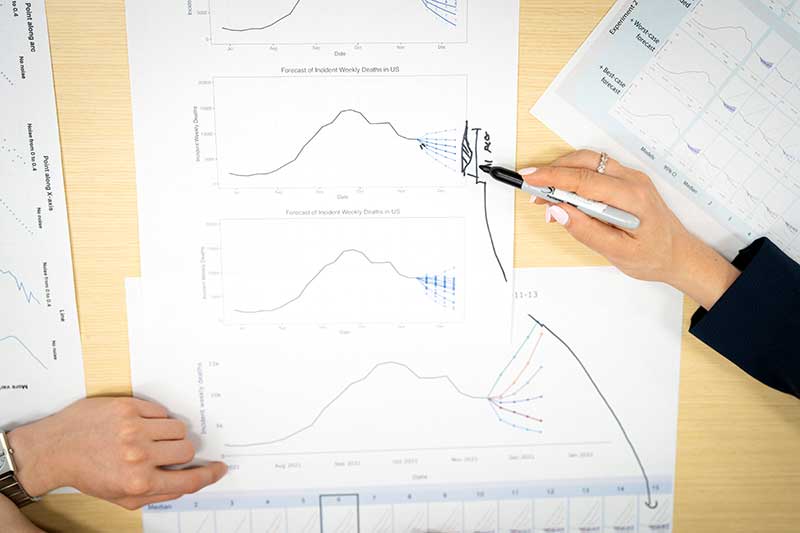
“During COVID-19, for example, there were more than 50 pandemic models produced by teams around the world,” Padilla said. “We’re trying to understand whether people can integrate and reason with those competing forecasts, and how we might visually communicate their reliability and precision. Using this research, we developed a technique called multiple forecast visualizations that can balance trust in the forecast with a person’s ability to predict future events from it.”
Padilla also hopes to continue taking her findings beyond academia.
“I’m really excited to work with industry partners to implement what we’ve learned,” she said. “For instance, we’re collaborating with the Red Cross Climate Center, working in risk-prone regions like Bangladesh to help them interpret competing climate forecasts. That kind of applied work is where we can make a real difference.”
As a VGTC Significant New Researcher Award recipient, Padilla joins a distinguished list of visualization scholars.
“I’m deeply honored and grateful,” she said. “It’s the largest early-career award in my field, only two people receive it each year internationally, and nominations are anonymous. I’m so thankful to whomever nominated me and to the community that has supported me throughout my research career.”
The Khoury Network: Be in the know
Subscribe now to our monthly newsletter for the latest stories and achievements of our students and faculty