Khoury News
Khoury undergrads win three categories at prestigious MIT hackathon
Every year, more than 1,000 undergraduates from around the globe gather in Cambridge for a student-run, 24-hour project blitz. In 2025, three Khoury teams with wildly different ideas all found success.
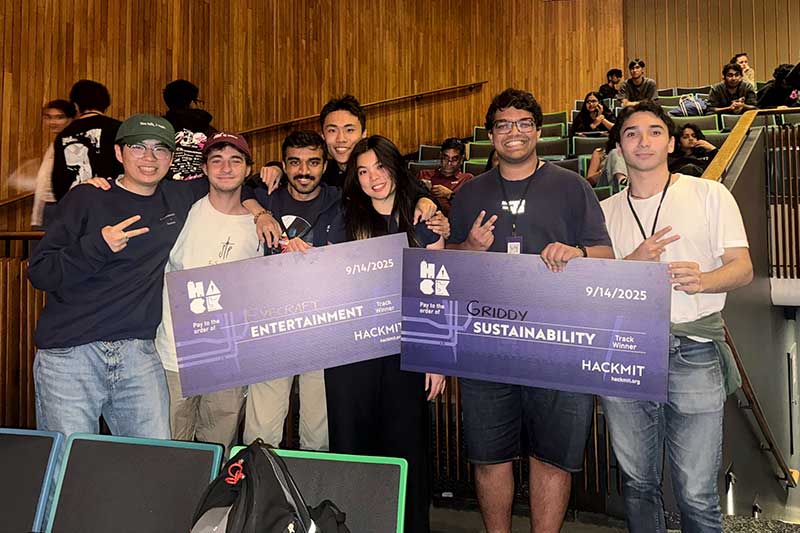
Three teams of Khoury College students won big at HackMIT 2025, creating products that allow for accessible gaming, a new means to file insurance claims after significant loss, and an energy-saving micro-grid. In so doing, they secured the number one spot in the event’s entertainment track, sustainability track, and EigenCloud-sponsored competition, respectively.
The annual student-run hackathon, hosted at MIT in Cambridge, Massachusetts, brings together more than 1,000 hackers, coders, and college students, providing makerspaces and energy drinks to keep participants competing for 24 straight hours.
An accessible way to play Minecraft
Tomas D’Avola (mathematics and computer science), Xiaole Su (mathematics and computer science), Troy Gunawardene (computer science and business administration), and Qihong Wu (computer science) competed in the entertainment track under the name “EyeCraft.” Recognizing that players with low hand movement capabilities or who had mobility issues might struggle to play the popular video game Minecraft, the team created a mod that recognized players’ facial features. By opening their mouth, players could move forward. Looking up would make their character look up. Winking with their right eye would let them jump.
“There are better solutions we can create for people who have difficulty accessing the same things that we do,” Gunawardene said. “More people should work on these fun projects in hackathons that have an impact on the world.”
Su, who has made a point of expanding her network of friends and colleagues at Northeastern, brought the team together, knowing they’d be a great fit.
“We had a unique combination of skills,” Gunawardene said. “We had technical talent, we had good pitchers, and we had a good product at the end.”
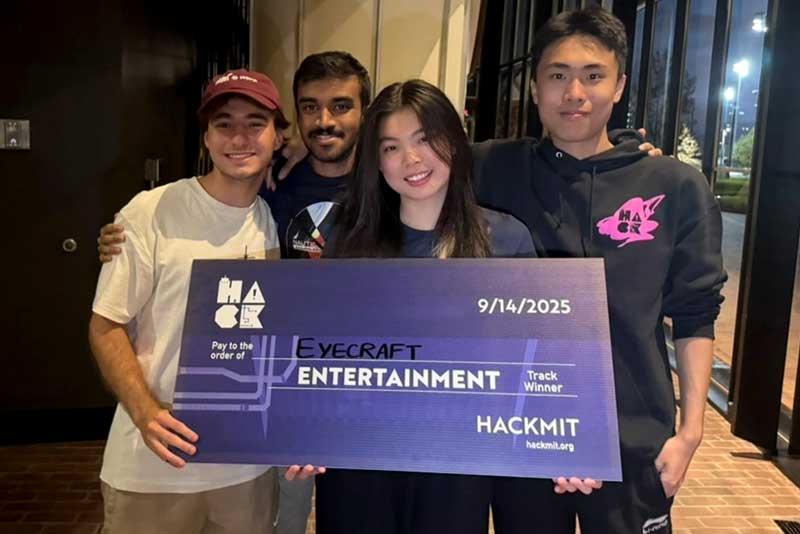
The teammates collaborated on practically every creative step, bouncing ideas off each other and addressing code complications as they arose. They cite their keen understanding of each other’s work processes and skillsets as a major reason for their win.
“Having a successful demo from top to bottom is so rare in hackathons these days because people try to go so above and beyond that nothing works,” Su said. “One thing that really made us stand out is how well the demo worked and how everything flowed together. It was a product that you could use.”
While they haven’t formally celebrated their big win yet, EyeCraft plans to eventually — and possibly to compete in another hackathon together.
Simplifying insurance claims through AI
Arav Budhiraja (computer science) and Rimjhim Singh (computer science and mathematics), competing under the name “Kava,” won in the HackMIT EigenCloud Sponsor Prize Side Track, a HackMIT division sponsored by EigenCloud, a service that aims to create secure, private, and verifiable apps.
After witnessing the complications faced by families in California who lost homes in the January 2025 wildfires, Kava was inspired to create an AI-powered insurance claim generator that allows users to upload documents and quickly create a claim.
“We aimed to simplify the whole insurance process, and I feel like we did it in the best way possible,” Budhiraja said, noting that after uploading housing documents and damage images, users can “have a whole package ready to go in just a couple of minutes.”
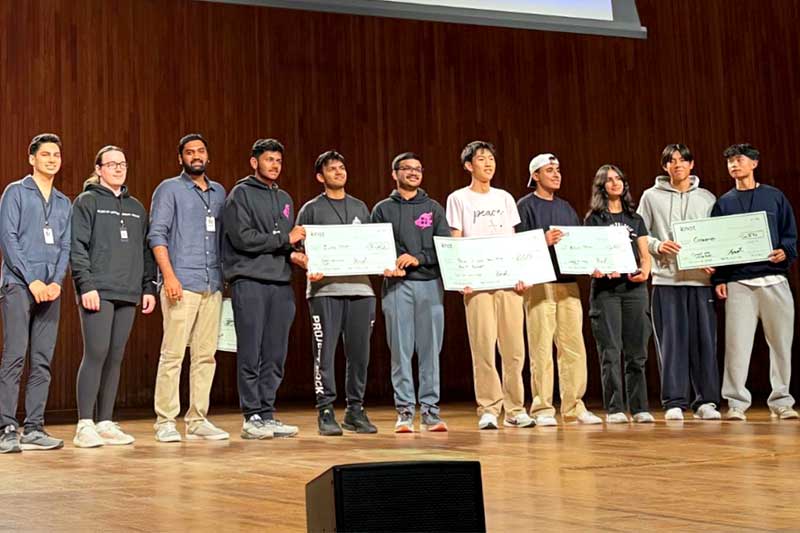
Budhiraja and Singh learned a lot from a hackathon they competed in together in spring 2025, where they ran into several problems that taught them the importance of playing to each other’s strengths, having a clear focus, and managing each other to produce the best possible outcome. At HackMIT, that’s exactly what they did.
“In hackathons, learning how to collaborate with other people is really important because if you push a code that’s breaking the entire thing, when you try to merge your code, that’s when you get a bunch of errors and it’s really annoying,” Singh said.
Throughout the 24 hours of HackMIT, the pair kept coming back to their central message of streamlining the insurance claim process.
“We made this to help people because hiring someone to do it for you is already expensive, and beyond that, losing a house is stressful enough,” Singh said. “And the stress of finding relevant documents is even worse. So we just wanted to help simplify the process.”
Kava plan to continue working together in future hackathons and are excited to see where their ideas take them.
Batteries and grids that save power
Mouad Tiahi (computer science and physics) and Shresht Bhowmick (computer science and linguistics), competing under the name “Griddy,” took home a win in the sustainability track for their creation of a micro-grid system run on homemade iron-air batteries. By handling dangerous chemicals and pushing their coding skills to the limit, the duo, joined by MIT undergrad William Feng, created a means of powering small areas for longer periods while losing less energy.
READ: Mouad Tiahi started coding on a decades-old computer. Now he’s a 2025 Top 50 Hacker
The team began by looking at the biggest problems facing the US and deciding which one they felt they could tackle.
“One of the issues is energy independence and grid resilience,” Bhowmick said. “The US power grid is really, really bad, and that’s because most of the companies in the US want short-term returns [on the money they spend on energy]. Our iron batteries get you that return while also being extremely resilient long term.”
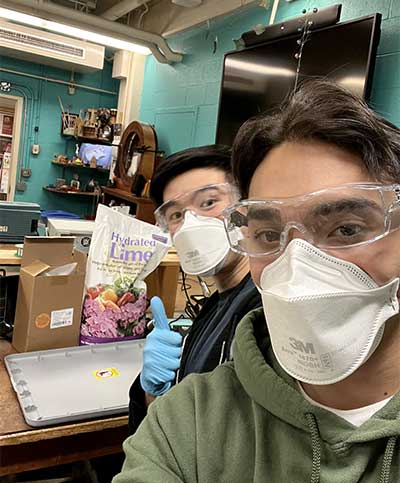
Using chemicals from fertilizer and other components, the Griddy team created batteries that fit into pieces of wood and metal they cut in one of MIT’s makerspaces. They wore gloves, masks, and protective gear as they handled substances like calcium hydroxide, which poses a severe burn risk.
By the end of the 24 hours, the team had developed a micro-scale model, with batteries, of what a more sustainable power grid could look like in the US — all using accessible materials.
For both Tiahi and Bhowmick, sustainability is a growing point of concern and interest.
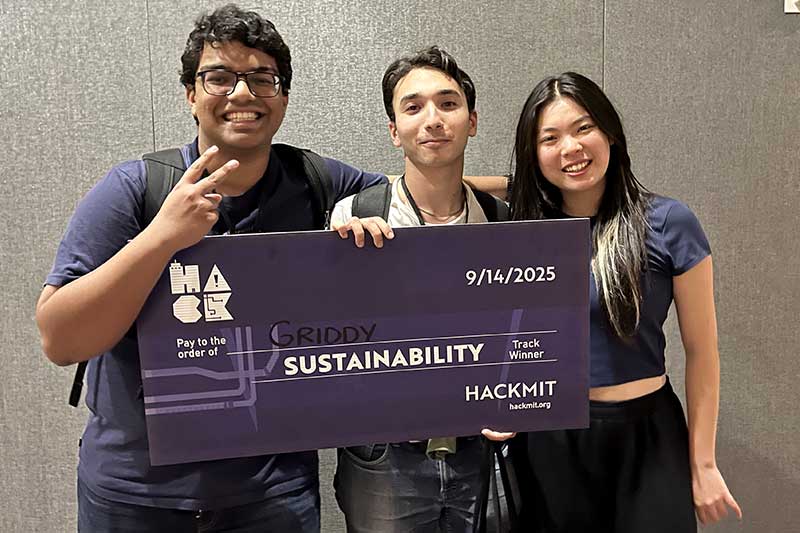
“Most of the approaches that were adopted in regard to sustainability are wholly and entirely wrong,” Bhowmick said. “They’re very small remedies that are trying to pacify consumers into thinking they’re something worthwhile … the vast majority of the problem we’re trying to mitigate through sustainability can be solved by two solutions — increasing energy output exponentially and making sure that you increase said energy output by building only renewable forms of energy.”
The Khoury Network: Be in the know
Subscribe now to our monthly newsletter for the latest stories and achievements of our students and faculty