Khoury News
Khoury PhD student named Apple Scholar for empowering users of AI-powered wearable tech
Users of wearable devices often have little control over how their data is collected and used, including for AI training. Now, backed by a prestigious Apple fellowship, Ha Le wants to put those users in the driver's seat.
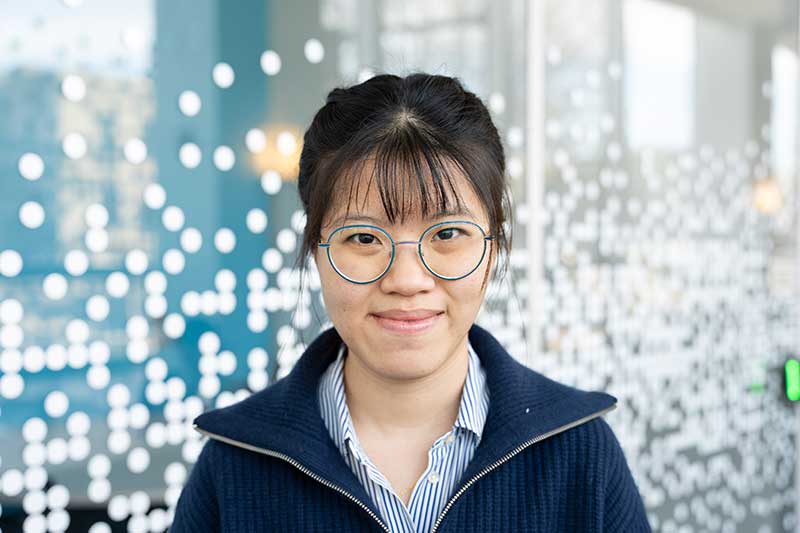
As AI technology develops and its advanced capabilities transform society, how will this impact users of wearable tech devices?
That’s the question Ha Le is trying to solve in the UbiWell Lab and the mHealth research group under the guidance of Khoury professors Stephen Intille and Varun Mishra. Now that work has landed her a prestigious Apple Scholarship in AIML, along with accompanying resources to further her work.
Originally from Vietnam, Le moved to the US to attend a small university in Minnesota, where she fell in love with research and realized the opportunities within the CS field. After being accepted into Northeastern’s PhD in Computer Science program, Le began reaching out to professors and eventually joined the UbiWell Lab, which focuses on the role of the user in wearable smart technology.
“The biggest issue with all these kinds of commercial, off-the-shelf devices is that the user has basically zero control over how these devices and algorithms work,” Le said. “But this data is being used to train algorithms … and these AI models used don’t support personalization.”
Le’s lab examined the limited-to-nonexistent role users play in the data collection of wearable devices, with the goal of creating an interface that allows users to report their data quickly and effectively. With that interface, users would be able to define which activities they want their device to recognize, from general locomotion like walking, standing, and sitting to more specific activities, including sports and hobbies.
“We want to allow people to define what they actually want to recognize and what they don’t want to recognize,” Le said. “The system or research team can still gain quality data from the users’ input that can go into the training of these models.”
Today, wearable smart technology tracks users’ data, then uses that information to train AI models that interact with users across the board rather than on an individual level, despite every person using the device for potentially different reasons. Le’s research involves using the unique data from each wearable device to train customized AI, producing a more tailored relationship between each user and their device.
As an Apple Scholar, Le gains access to a PhD fellowship program that supports students’ research through funding, mentorship, and internship opportunities. Le found out she’d won after a yoga class, checking her phone to find dozens of texts from her advisor and lab-mates congratulating her.
“I got connected to a researcher at Apple who has a different perspective and was able to provide great feedback on my work,” Le said. “This has just been a great experience.”
Now in her fourth year of PhD work, Le will continue her work on human-centered AI — putting the human and user experience at the forefront of interaction with large language models.
“I think that we need to keep humans in the loop. And there are so many different, interesting research questions that come out of it. Like, how can we actually involve the user in a way that doesn’t take a lot of time and effort, but gets people to invest in the system?” Le said. “How can we enable an effective human–AI collaborative environment?”
The Khoury Network: Be in the know
Subscribe now to our monthly newsletter for the latest stories and achievements of our students and faculty