Khoury News
From farm fields to fact checks: Khoury students put AI agents to work at Subconscious Hackathon
In a homegrown competition powered by a co-op partner's AI tools and organized by two of the company's co-ops, students set out to solve challenges near and dear to their daily experiences.
Approximately 40 Northeastern undergraduate and graduate students gathered in April for the Subconscious Hackathon, a fast-paced competition that challenged participants to build AI-powered tools using the Subconscious platform. Organized by Khoury undergraduates Jack Senders and Owen Stepan, both of them co-ops with Subconscious, the event offered students an opportunity to experiment with agentic AI, solve problems, and connect with industry professionals.
Subconscious is an AI platform for building and orchestrating AI agents. The idea is for the systems to reason through tasks, use tools, and work together to complete complex workflows with minimal human intervention. Instead of responding to a single prompt, the agents can carry out multistep processes.
The hackathon, which used the Subconscious platform, produced projects ranging from agricultural policy assistants to real-time misinformation detection tools. While the winning teams approached vastly different problems, both used AI technologies to create practical, impactful solutions.
For many participants, the event was their first chance to work with AI agents in a hands-on setting.
Huizhi (Sara) Zou, a rising third-year computer science major focusing on software, attended after hearing about the event through a class announcement. Having spent much of the year searching for technical opportunities outside the classroom, she saw the hackathon as a chance to gain experience and challenge herself.
“I had been looking around at events and hackathons,” Zou said. “This was my first one, so I was really excited to get into a hackathon and see what it was like.”
Her teammate, Halcyon Skinner, also a rising third-year CS student, entered for a different reason. Most of his experience had been in cybersecurity, reverse engineering, and low-level systems programming rather than AI.
“Agents aren’t something that I had really dabbled in before,” Skinner said. “I wanted to dip my toes in, and I think it was a pretty good experience.”
The event’s structure encouraged exactly that kind of experimentation. Participants with backgrounds ranging from software engineering to data science were given access to Subconscious’s tools and challenged to build something useful within a compressed time frame.
For Jeffrey Krapf, a fourth-year data science major, the appeal was twofold. After learning about Subconscious through LinkedIn posts, he was intrigued by both the company’s technology and the opportunity to gain more experience building with AI.
“AI has shaped my whole college experience and career trajectory,” Krapf said. “Developing with it and utilizing it as a tool allows you to do some pretty incredible things, especially within a short hackathon.”
The resulting projects reflected the diversity of participants’ interests and experiences. Some focused on information access, others on automation — and all were grounded in real-world challenges.
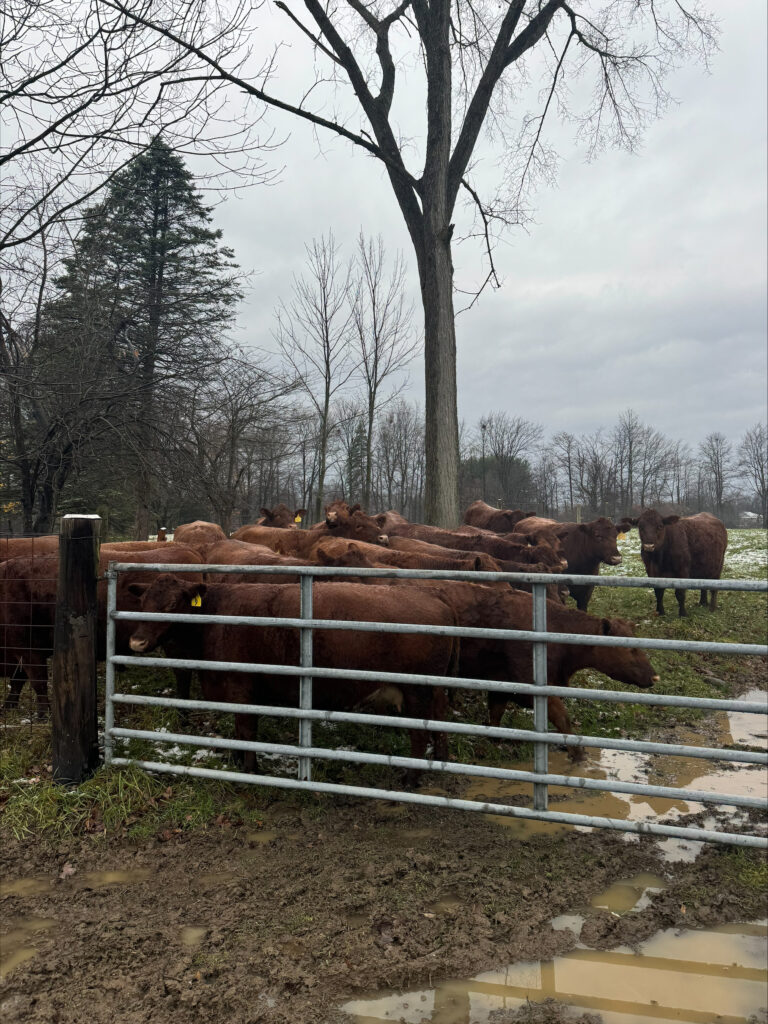
Krapf’s winning project in the profitability category began with a deeply personal problem. His family owns a farm operated by his great-uncle, and he has seen how difficult it can be for small farms to navigate the web of available loans, grants, tax incentives, and government programs.
“Farms are complicated,” Krapf said. “There are a lot of tax regulations, loans, and incredibly complex financial information.”
Those challenges inspired AgriPolicy, an AI-powered assistant designed to connect farmers with financial resources. The system begins by interviewing users about their operation to collect information such as farm size, crop types, and income. Using those details, the agent searches for relevant loan programs, tax benefits, and other forms of assistance.
AgriPolicy was also designed to reduce administrative burdens. Krapf built features that could automatically draft emails and assist with filling out required forms, helping users move from information-gathering to action.
“The goal was to bridge the gap between farmers and all of this really useful financial loan and tax information,” Krapf said.

Krapf would like to continue developing the project, particularly by expanding the range of forms and programs it can support and conducting more testing to improve reliability. For him, the project demonstrated how AI can be used not only to automate tasks, but also to increase access to resources that might otherwise remain difficult to navigate.
“Using AI for good areas like that to help out local businesses, especially the agricultural industry, would be pretty cool,” he said.
The hackathon also opened new doors professionally. Krapf interviewed with Subconscious and accepted a fall 2026 co-op position.
While AgriPolicy focused on helping users find information, the winning project in the creativity category focused on verifying it.
Developed by Skinner and Zou, LiveCheck is a Chrome extension that performs real-time fact-checking on YouTube videos and livestreams. The tool monitors closed captions, identifies factual claims, and evaluates their accuracy using AI agents.
The concept emerged from brainstorming sessions in which the pair explored different ways to apply agent-based systems. Rather than creating another chatbot, they wanted to build something that worked in the background and delivered information automatically.
“We thought maybe we could take a different direction and make it more convenient,” Zou said.
The finished prototype works by collecting a buffer of captions from an active livestream or video.
“Our extension creates a buffer of captions that are currently being said in the livestream,” Skinner explained. “The first agent extracts the claims, and then another agent does extensive fact-checking on those claims and sends the results back to the user.”
Although designed with political content in mind, the concept could potentially be applied across a range of livestreaming contexts where accuracy matters.
For both students, the project represented an opportunity to learn unfamiliar technologies. Neither entered the competition with extensive experience building AI agents, forcing them to learn quickly and experiment as they went.
The experience paid off. Beyond winning the creativity category, both students said the project boosted their confidence and encouraged them to continue exploring technical challenges outside the classroom.
“It definitely gave me more confidence in my technical skills and creativity,” Zou said.
The pair have continued refining LiveCheck since the competition. Future plans include supporting additional platforms such as Twitch, expanding fact-checking capabilities to recorded videos, and improving response times while reducing operating costs.
The Khoury Network: Be in the know
Subscribe now to our monthly newsletter for the latest stories and achievements of our students and faculty