Khoury News
From coast to coast: Khoury master’s students showcase work in fall 2025
Throughout the fall 2025 semester, more than 100 Khoury master's students across Northeastern's global network — including some who took part in the college's apprenticeship program — produced original research on topics of their choosing.
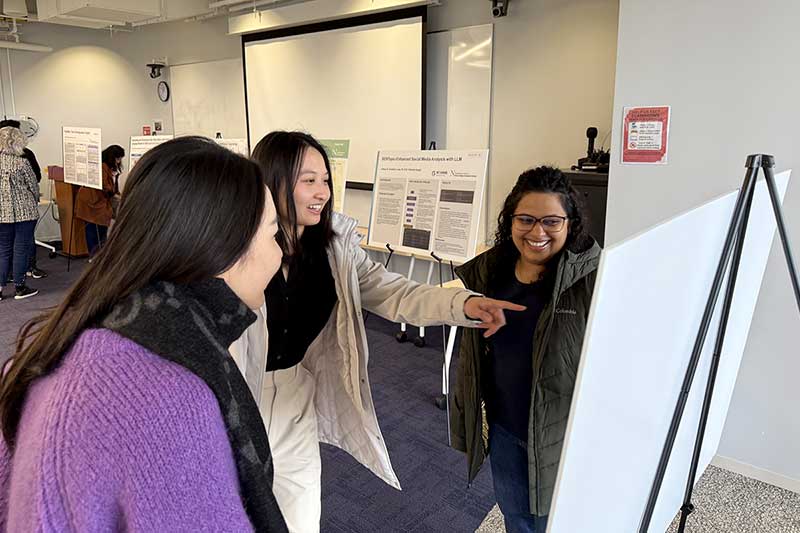
From flood simulations and autonomous drone systems to computers playing Super Mario, Khoury College’s master’s students contributed research in many fields across Northeastern University’s global network in 2025. And though many of these researchers were based at Northeastern’s largest campus in Boston, their counterparts in Silicon Valley, Vancouver, and Portland, Maine were just as prolific.
Below is a sampling of their projects. To read more, click on any of the following links, or simply read on:
- Scalable Book Recommendation Service
- Interactive Simulation of Lane Merging Strategies at Traffic Signals
- Drone Ranger
- Real World Flooding Simulation System
- A Geo-Meta Ensemble Framework for Robust Cross-Well Pore Pressure Prediction
- NN4SysBench V2: Automatic Specification Generation in Computer System
- Automated Deep Learning Segmentation of Muscle Tissue Degradation in Zebrafish Dystrophy Models
- Learn to Play: Lightweight Generative Modeling for Super Mario
- AI for Organizations: Designing for Cognitive Resilience using the Controlled Exposure Framework
Scalable Book Recommendation Service: Microservices Architecture with Redis Caching
Mansi Modi, Snahil Dasawat, Junyao Han, Theodore Pei
Vancouver
The team designed a service that quickly suggests books to users while retaining speed as more users are added. The team’s primary objective was to solve “cold start” algorithmic challenges and reduce latency through caching strategies and experimentally validated horizontal scaling limitations.
Using a Docker-based FastAPI microservices setup, the team applied collaborative filtering to recommend books based on users’ similarity to one another. A Redis caching layer was added to store frequently requested results, which greatly reduced the time users had to wait for recommendations. Testing showed that caching could increase speed by up to 90%. However, simply adding more servers did not increase overall performance because the database became the main bottleneck. This work highlights why efficient data management is just as important as adding computing power when building scalable systems.
Interactive Simulation of Lane-Merging Strategies at Traffic Signals
Dianna E
Portland
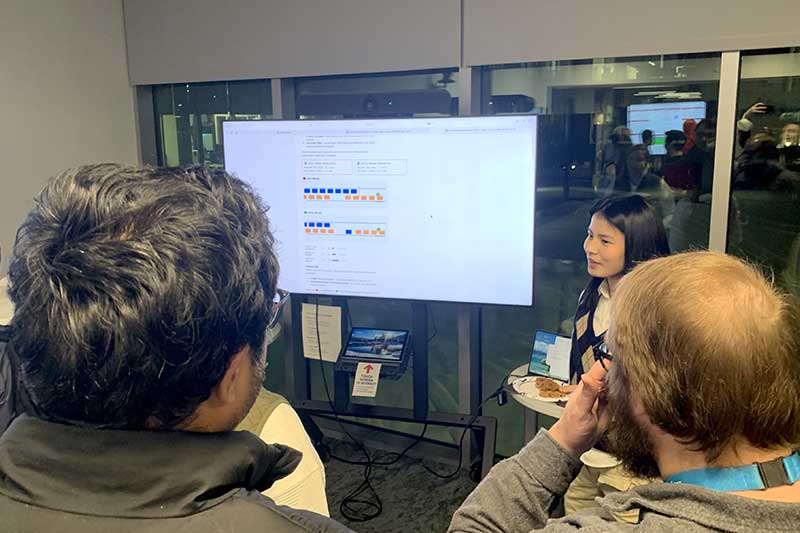
E studied how different lane-merging strategies before a traffic light affect congestion and driver delay. The project compares late merging near a lane drop with early merging farther upstream.
Using a side-by-side animated simulation, E modeled car behavior with simple, intuitive rules such as accelerating when space is available, slowing near traffic, and merging only when safe. Early results suggest that early merging can lead to smoother flow and slightly reduced waiting times under moderate traffic, though outcomes vary because the model does not yet include coordinated “zipper” merging. The project shows how interactive visual simulations can help explore and communicate traffic patterns, with E’s future work aimed at adding more realistic driver behavior and merging algorithms.
Drone Ranger
Renxiang Yin, Chunzhang Liu, Xiaoman Zou, Tanishq Pradhan, Haoran Liu, Jiading Zhou, Zhipeng Ling, Ilmi Yoon
Silicon Valley
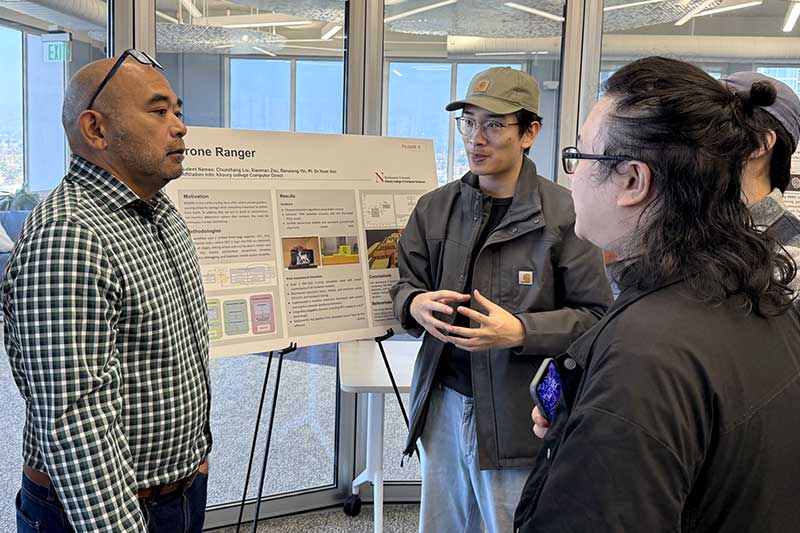
The Drone Ranger project aims to develop an autonomous drone system that can sense its environment, make decisions, and act reliably in real-world settings. The team built reusable autonomy modules using ROS 2 for perception, planning, and decision-making, designed to run identically for both simulated and physical drones.
By testing autonomous behaviors such as obstacle avoidance and navigation in both Unity and real hardware, the project demonstrates a tightly integrated simulation-to-real workflow. Early results show that this unified approach supports rapid iteration, safer testing, and reliable deployment. Future work will strive to expand autonomy features, improve simulation realism, increase real-world testing, and establish Drone Ranger as a flexible platform for scalable autonomous drone research.
Real World Flooding Simulation System
Bhanu Chandra Pachipala
Portland
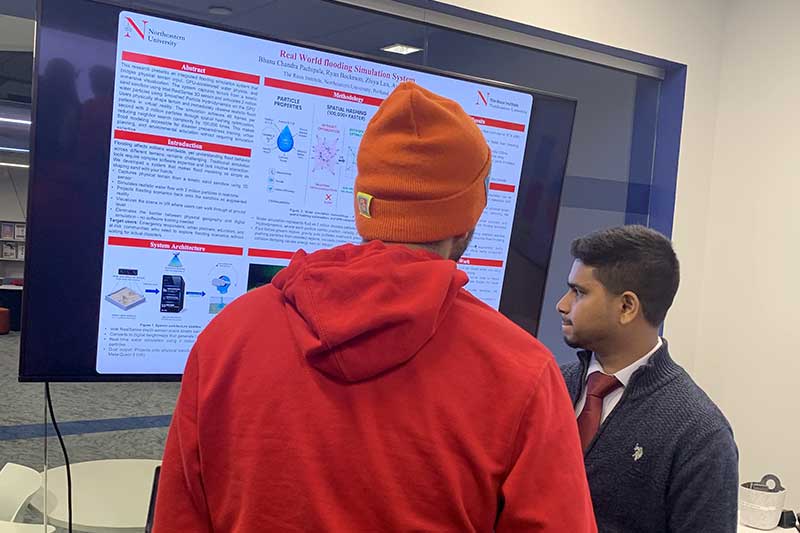
Pachipala developed an interactive simulation system to make flood modeling accessible to non-experts. The project allows emergency responders, urban planners, and students to explore flooding scenarios in an intuitive way by shaping physical terrain with kinetic sand, removing the need for complex simulation tools.
Using a 3D sensor to scan the sandbox in real time, the system simulates realistic water flow with millions of GPU-driven particles and projects the results back onto the sand as augmented reality. The simulation is also streamed to VR headsets for immersive exploration. The project achieved smooth, real-time performance and realistic water behavior, with Pachipala planning for future work to focus on improving VR performance and adding erosion effects for educational use.
A Geo-Meta Ensemble Framework for Robust Cross-Well Pore Pressure Prediction
Pranav Patel, Rohan Benjamin Varghese
Silicon Valley
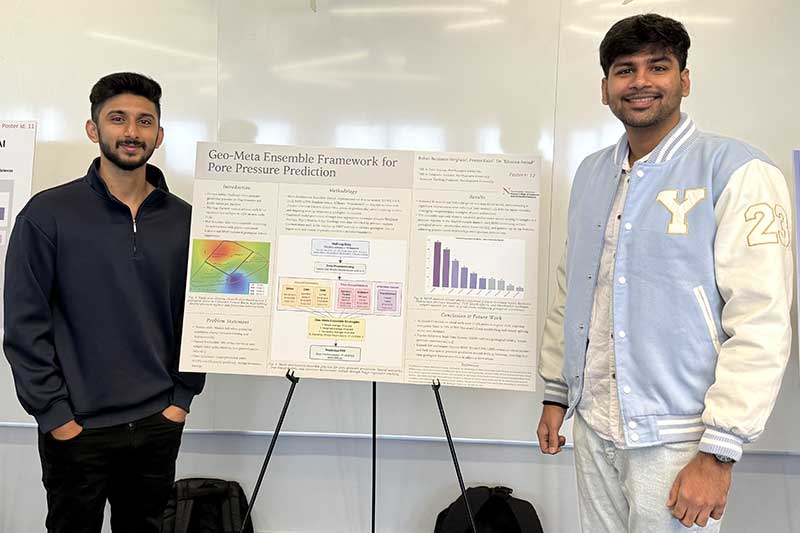
Patel and Varghese developed an AI framework to improve safety in oil and gas drilling. The project addresses a major challenge known as domain shift, where models trained using data from existing wells often fail when applied to new wells with different geological conditions.
The researchers combined multiple machine learning models into a single, robust predictor, which can then use physics-informed features and strict testing on unseen wells. The system achieved strong accuracy on new geological data while remaining fast enough for real-time use; in doing so, it set a new standard for pressure prediction and pointed toward future improvements, which could adapt models based on local geology and extend the approach to other drilling variables.
NN4SysBench V2: Automatic Specification Generation in Computer Systems
Duy Tran, Shuyi Lin, Cheng Tan
Portland
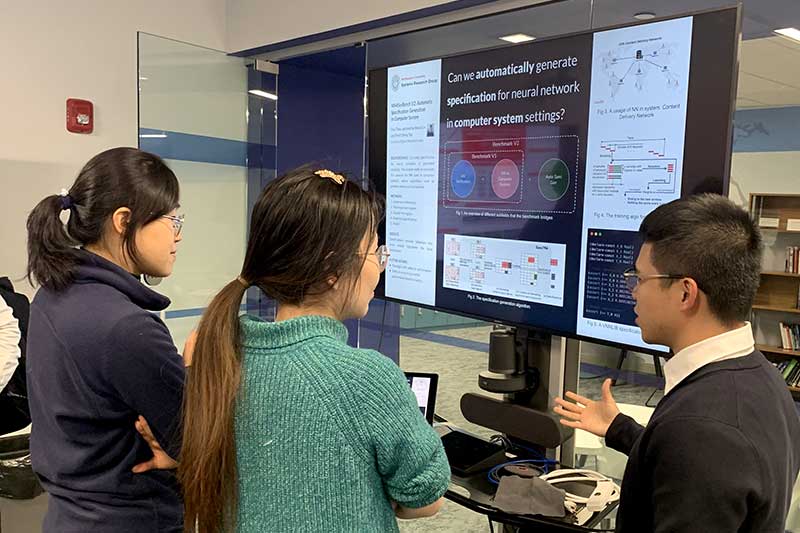
The team developed NN4SysBench V2 to automatically generate specifications for neural networks that could be applied to computer systems tasks. The project bridges neural network verification (which ensures a network meets input-output specifications) and neural networks in systems applications (like cache management or network congestion control), where specifications were traditionally handcrafted.
The system generates specifications by analyzing existing heuristic algorithms, extracting common behaviors, and creating new specifications that better capture the patterns in training and testing data. Initial results show that this method encodes more realistic behaviors than previous approaches. Future work will apply this method to tasks without existing references and shift the focus from safety guarantees to performance-based specifications, ensuring neural networks enhance overall system efficiency.
Automated Deep Learning Segmentation of Muscle Tissue Degradation in Zebrafish Dystrophy Models
Rohan Tanwar, Harshil Bhojwani
Portland
Tanwar and Bhojwani developed a deep learning system to automatically classify muscle fiber degradation in zebrafish models of muscular dystrophy. The goal was to accelerate drug discovery by replacing slow, manual analysis of confocal microscopy images with an automated, high-throughput approach.
Using a transformer-based Swin-Unet model trained on GPU-accelerated clusters, the system segments images into healthy, bad, and degenerated muscle classes. Balanced weighting and focal loss were applied to address severe class imbalance, improving detection of minority classes while maintaining overall accuracy. The pipeline reduces analysis time from hours to minutes per image, enabling faster drug screening. Future work includes expanding the dataset, adding uncertainty quantification for more reliable predictions, and optimizing the model for real-time inference during experiments.
Learn to Play: Lightweight Generative Modeling for Super Mario
Feiyan Zhou, Zhaoyang Lu, Qingzheng Gao
Silicon Valley
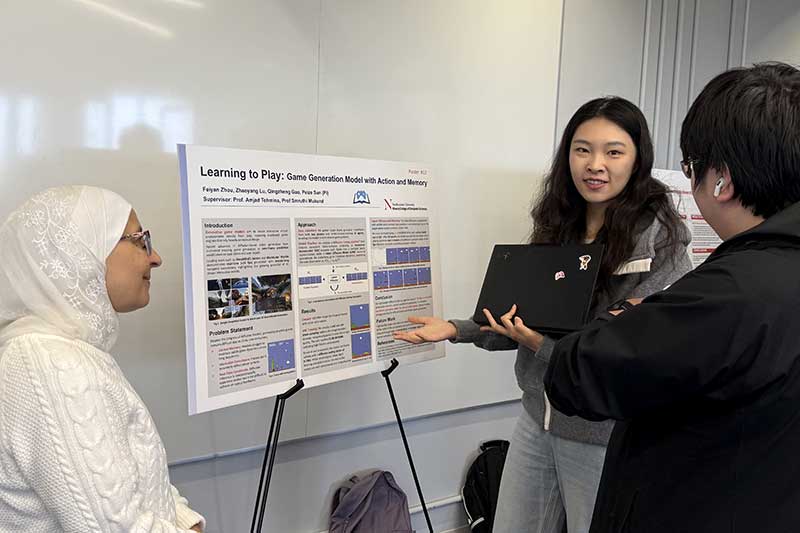
Zhou, Lu, and Gao developed an AI system to learn and generate playable Super Mario levels. The project combines human gameplay data with reinforcement learning to create a compact model that allows students and researchers to experiment without expensive hardware.
The team trained a video model on a 522,000-frame dataset, producing 32-frame sequences that closely mimic real gameplay and correctly reflect player actions more than two-thirds of the time. The system runs at nearly real-time speeds on a single GPU. Future work will improve long-term memory for longer sequences, capture rare gameplay situations, and optimize performance for faster, more accurate generation, supporting affordable and accessible game-based research.
AI for Organizations: Designing for Cognitive Resilience Using the Controlled Exposure Framework
Qingzheng Gao, Shreya Chavan
Silicon Valley
Gao and Chavan developed a framework to help organizations adopt AI tools without undermining human judgment. The Controlled Exposure Framework guides when and how employees interact with AI, ensuring people stay “in the loop” while benefiting from AI assistance.
The framework integrates research on trust, privacy, governance, and change management into three key components: limiting auto-acceptance of AI outputs, inserting short reflection prompts, and providing managers with anonymized trust dashboards to detect overreliance. Pilot planning shows that the framework can be incorporated into existing workplace tools without new infrastructure. Future steps include randomized testing of the framework components, refining dashboard metrics with partner companies, and publishing practical implementation guidelines for HR, compliance, and IT teams.
The Khoury Network: Be in the know
Subscribe now to our monthly newsletter for the latest stories and achievements of our students and faculty