Khoury News
Northeastern’s Center for Inclusive Computing debuts map to track AI programs at US colleges
As universities respond to the AI boom with new programs, a team of researchers built an interactive map to track them — partly as a resource for students and educators, but also to help ensure the field is open to beginners.
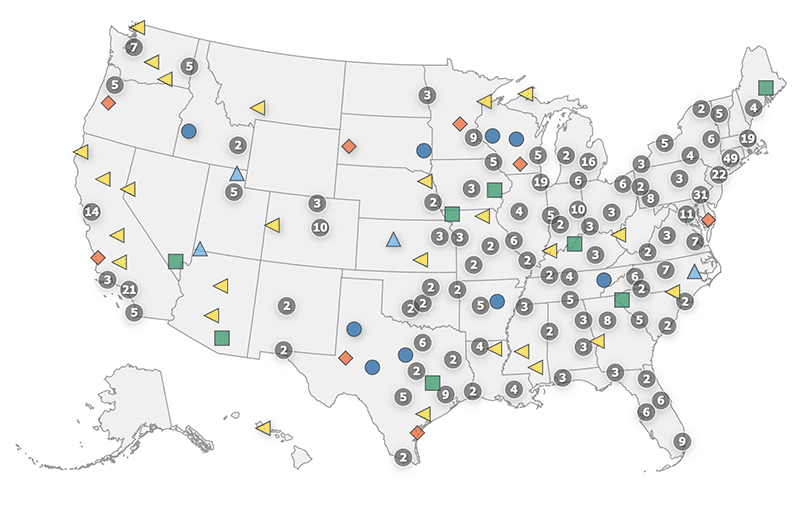
When Northeastern University’s Center for Inclusive Computing (CIC) set out to understand the state of artificial intelligence education in the United States, its researchers faced a deceptively simple first question: Where are the AI programs?
Their solution: an interactive map that tracks AI majors, minors, concentrations, and other undergraduate programs across the US. The project, led by Khoury Associate Teaching Professor Felix Muzny, CIC Founding Executive Director Carla Brodley, and a team of student researchers, intends to provide a clearer picture of how higher education is responding to the rapid growth of AI.
For the CIC, the project is about more than just counting available degrees. It is about understanding who has access to AI education, what those programs teach, and how the emerging field can develop without repeating the inclusivity challenges that have affected the broader field of computer science.
“The goal of [the CIC] is to work with universities across the country to make sure that all students have a pathway — an equitable pathway — to discover and thrive in all areas of computing,” Brodley said.
READ: 100+ university partners, $30 million, one key idea: Make computing education welcoming for everyone
For Muzny, the idea for the AI map grew in part from their experience teaching natural language processing and seeing students arrive in upper-level computing courses with varying levels of experience. AI itself has also changed, with distinct techniques from different subfields increasingly converging, Muzny said. This makes it especially important for universities to think carefully about how they structure their AI curricula.
“In order to actually do any type of analysis, going and finding all the programs was an essential first step,” Muzny explained.
That became particularly important as the number of AI-focused academic programs has skyrocketed, leaving applicants with a dizzying number of options.
“By allowing prospective college students who are interested in AI to see the set of universities offering AI majors, the map can help them make a decision about where to apply,” Brodley said, adding that the map allows students to access the website of each school’s AI program.
The map also has a second audience: university administrators and faculty who are developing new programs. The map allows them to “go shopping” among existing programs and examine how different institutions structure their degrees.
The research team is also examining the programs’ curricula in depth, including required courses, electives, and how the curricula differ from one another. The CIC is comparing the programs to understand their differences and similarities.
One finding, which Muzny found unsurprising, was the lack of AI ethics courses in the AI minors and concentrations. These courses primarily showed up in AI majors, or in specific AI ethics minors or concentrations.
“As somebody who teaches AI, we’re frequently very, very focused on the math of AI,” Muzny explained. “Ethics in AI has been a relatively recent addition to things that we think students should be covering.”
The team is also focusing on when students in all disciplines first encounter AI coursework. Technical AI education often requires substantial mathematical and other prerequisites to understand the material, raising questions about how accessible these programs are to students who are new to computing. That concern connects directly to the CIC’s broader motivation in creating the tracker — ensuring that universities developing AI programs avoid perpetuating the barriers that can make computer science inaccessible to beginners.

“Imagine you walked into a French 101 or Japanese 101 course, everyone else spoke that language, and the teacher answered in that language,” Brodley explained by way of comparison. “You might walk back out feeling that true beginners were not welcome.”
As AI programs become increasingly widespread, the CIC is watching closely to see whether the field expands access — or creates barriers.
“There is a danger that some of the strides we’ve made in creating equitable discovery and access to computing might fail to go forward because of the perception of what AI is in the public,” Brodley said.
At the same time, Brodley emphasized the enormous interdisciplinary potential of AI. Her own research background is in machine learning, and she pointed to applications in medicine and science as examples of how powerful AI can be when combined with other fields.
“There are incredible things that we can do with applications of AI that are life changing for people,” Brodley said. “So, I really hope that the field will draw a diverse population.”
That diversity, she said, should encompass not only demographics and identity, but also students with different academic backgrounds and ways of thinking.
The map is updated quarterly and includes a Canadian version. The CIC plans to continue analyzing the underlying program data and tracking changes over time. The goal is not simply to create a snapshot, but to build a resource that can reveal how AI education changes as universities respond to the growth of the field.
The Khoury Network: Be in the know
Subscribe now to our monthly newsletter for the latest stories and achievements of our students and faculty