Khoury News
Giving rural educators a seat at the table in the generative AI conversation
Rural educators and students often lack the same access to tech that their urban counterparts have. As AI continues to infuse our world, Shira Michel and Mahsan Nourani are seeking to understand its promise and its challenges in these often-overlooked rural communities.
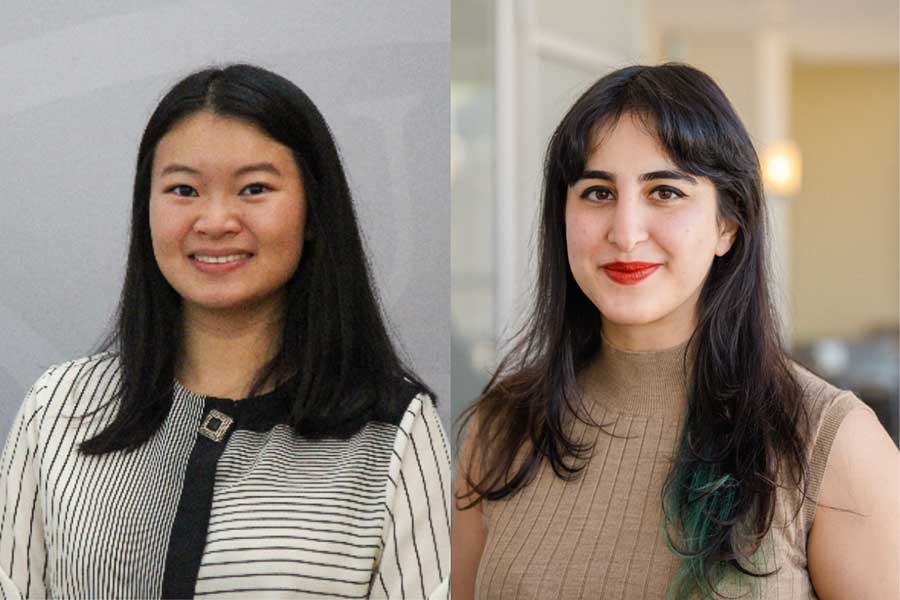
Although there have been many studies on the impact of generative AI in K–12 settings, there has been little focus on the ways that AI impacts rural educational settings. Most studies have focused on urban areas or did not describe a setting at all. This has left the unique challenges faced by rural educators out of the conversation on responsible AI policy.
Khoury PhD student Shira Michel and Assistant Professor Mahsan Nourani set out to bridge this gap in human–computer interaction research. Michel, who grew up in rural Pennsylvania, saw her community grapple with educational challenges distinct from those in urban centers. Her family home had no cell service and stable internet access was hard to find.
“There’s an assumption that students across all geographical regions have stability of internet access and can afford subscription costs,” Michel said. “I want to shed light on communities that are underserved. It’s informed by my journey in grad school as a first-generation college student from a low-income rural background.”
Nourani focuses on human-centered and responsible AI. She and her team study how people interact with AI systems personally and within society. They form part of the larger Khoury Vis Lab, a global community of human-centered computing researchers that studies ways to visualize data and build interfaces and visualizations for AI systems.
Michel and Nourani’s study, “Amplifying Rural Educators’ Perspectives: A Qualitative Study on the Impacts of Generative AI in Rural U.S. High Schools,” was presented at CHI 2026. Through surveys and interviews of 31 rural high school educators in Arizona, Maine, and North Carolina, Michel and Nourani found that while some educators use generative AI tools to streamline their work, they face infrastructural barriers, values-driven resistance to adoption, and a lack of access for responsible AI literacy training.
READ: For third straight year, Khoury researchers set new publishing benchmark at CHI
These hurdles became evident immediately as the researchers struggled to find K–12 partners for the study. Rural educators are not online as often and have less established connections with universities; even the definition of “rural” is hard to pin down. The researchers relied on word of mouth to connect with many participants, as well as the outreach of their partners: Ed Finn at Arizona State University, plus Joseph Wiggins, Benjamin Taylor, and Sabrina Parra Diaz at Katabasis — a nonprofit helping low-income children access educational resources.
Katabasis had already worked with rural communities in North Carolina in their mission to connect rural students with technology. ASU helped recruit in Arizona. Nourani and Michel, based in Portland at Northeastern’s Roux Institute, focused on Maine recruitment with help from the Maine Mathematics and Science Alliance.
An initial survey asked questions such as how classrooms changed after the advent of generative AI, whether the educators know what AI was, what their day-to-day tasks were, and how they used AI for those tasks. Nourani and Michel conducted in-depth follow-up interviews with participants on Zoom, gauging their hopes for how AI could serve them and their students. The researchers found that most rural educators believe AI should be reserved for educators only, with a potential for AI to fill gaps and provide complimentary expertise that would otherwise be out of reach due to financial or regional constraints.
“We wanted to hear from educators themselves as people being impacted by these tools, rather than developers and designers,” Nourani said. “Rural educators are not always at the table for policymaking. We need to seek out and bring them into the conversation. In the past three years, every time I’ve met an educator from rural or under-resourced districts in Maine, they were extremely passionate to chat about AI and to be heard. This has always been so inspiring to me and a testament to why we need to support equitable access across the board.”
Nourani notes several challenges she faces as a person trying to use AI and get ideas from a chatbot, even as an expert. Is she good enough to use it? Is she too reliant on the system to write on her own? Rural users, who may be less tech savvy due to having less exposure to these new tools, could struggle even more.
Generative AI has advanced quickly, especially since 2023 when Nourani finished her own PhD. Many human-centered researchers like her are still trying to catch up to the hype, study how to design and deploy these models responsibly, and understand how they impact communities, society, and marginalized groups.
“This research is slow and takes time, and cannot respond to the ever-growing demand,” Nourani said.
Michel sees AI bringing a sense of immediacy and urgency to technology that schools are not used to, and in doing so, it requires a new form of literacy for urban and rural educators alike. Companies building these tools assume schools can easily adopt and use them, but this would require educators to teach students AI literacy when many educators lack the training, knowledge, or confidence to do so.
Rural schools also face distinct challenges such as teacher shortages, especially in science, technology, engineering, and mathematics fields. Overstretched and overworked, teachers are sometimes the only science teacher in a school district, or they may teach across multiple grades and difficulty levels. Schools often prioritize agricultural and experiential learning and don’t yet see value in incorporating AI into career preparation. A lack of standards and policies for AI in K–12 settings leaves schools uncertain about how and whether AI belongs in the classroom at all.
“My personal experience is seeing a lot of people whose traditional path isn’t to higher education,” Michel said. “They stay close by. That path is just as valid, and high school must prepare students for all of it, including AI. AI has already shown itself to be very transformative, but we must be careful of its limitations and trust our own judgment on when and how we use it.”
Michel took a qualitative, thematic approach to the work and relied on critical rural theory, which examines the societal view of rural areas as less desirable than urban and suburban areas. She sees how the conversation they started with rural educators can be expanded beyond those settings to other marginalized populations.
“[Michel] is a brilliant junior researcher,” Nourani said. “What makes her special is how she deeply cares about equity and responsible AI that is democratized across different communities, especially those that are often overlooked.”
“We want to reach out to other communities,” Michel added. “We want to reimagine what good and responsible AI tools look like and give communities a platform to show how they can meaningfully apply it in their settings. When communities are supported and involved in the process, that is when AI can be shaped by users that work for them, instead of given to them.”
The Khoury Network: Be in the know
Subscribe now to our monthly newsletter for the latest stories and achievements of our students and faculty