Khoury News
Inspired by sci-fi, Khoury student’s open-source tool offers greater visibility for runtime behavior
The idea behind Barx is straightfoward, says creator Karthik Barma. Users run their Python code through the tool, and it tells them in simple, transparent terms how that code is actually behaving.

Before Karthik Barma ever built technology, he watched it come to life on screen. From viewing WALL-E in the ninth grade, and then Terminator Genisys and Robo, he found stories that shaped his belief that technology should put people first.
“I wanted to align myself with safe and transparent AI,” Barma explained. “[The movies] show the importance of making sure that technology is not being overruled by the robots.”
Now, as he enters the second year of his master’s in AI, Barma has done just that. He recently built and released Barx 1.0.0, an open-source runtime intelligence layer for Python software focused on making runtime behavior transparent. The tool performs runtime (or dynamic) analysis, so developers can see how their code actually behaves, including which functions execute, how they are nested, where time is spent, and where potential issues occur.
“I wanted to see how I could build something that doesn’t just trace execution, but also checks behavior, applies policy-style guardrails, generates evidence, produces local reports,” Barma said. “The goal is not to replace testing or observability. The goal is to make runtime behavior easier to see, verify, and explain.”
The idea for the project began in 2023, shortly after ChatGPT launched. Originally, Barma envisioned Barx as an entirely new programming language. Then he realized that convincing developers to adopt another language would be an uphill battle.
“People are struggling to learn existing languages,” he said. “Just because I have knowledge of and am capable of building a new language doesn’t mean I have to do one.”
Instead, Barma shifted his focus toward building something that could work alongside existing programming languages. In need of a place and system of organization to compile all his projects, Barma created the Augmenter User Reality Assistant, or AURA, an umbrella platform under which Barx would eventually be developed.
In May 2025, Barma debuted a beta version of Barx — named as an homage to the open-source operating system Linux — as a package in Python, but it didn’t go as smoothly as he had planned.
“It was a disaster,” Barma said. “It had a lot of bugs and people were complaining about it.”
Rather than abandon the project, Barma used the setback as motivation to move from India to the United States and pursue a master’s degree. Conversations with professors and months of refining his ideas gave him the confidence to rebuild the project from the ground up.
The redesigned Barx centered on solving a problem Barma believed many AI tools overlooked: helping developers understand why software behaves the way it does instead of simply producing an output.
“The goal of Barx is to make sure that it is being used in cases where you want to reduce cost, you want to reduce time, you want to understand why something happened, what caused the trigger,” Barma said. “The problem with the existing models is that they’re not trustworthy.”
Barma designed Barx around this idea of trust. The tool monitors how code executes, explains what happened during execution after being fed runtime data, and summarizes its findings. The report is intentionally simple — green means the run passed all expected checks without meaningful risk; yellow means the run produced warnings, drift, incomplete evidence, or medium-risk findings; and red signals a blocking failure.
For a glimpse of how the tool operates, Barma shared some snapshots from a demonstration run:
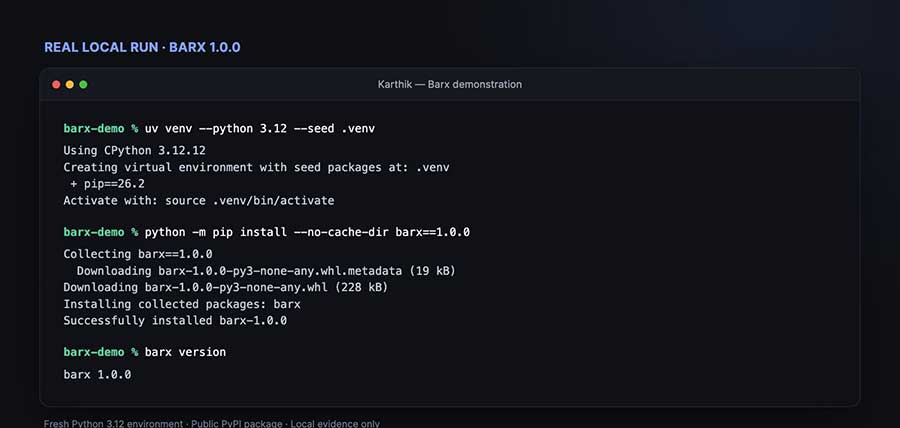
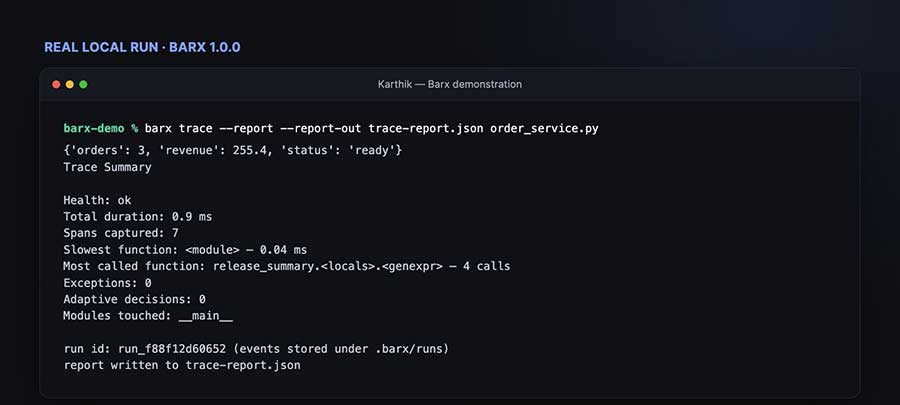
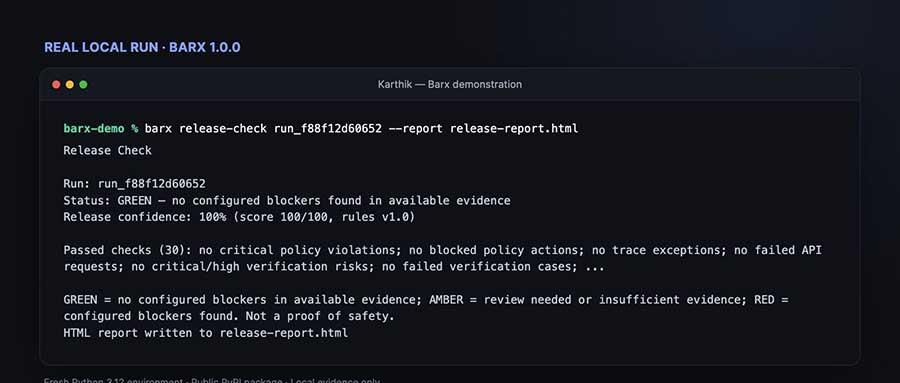
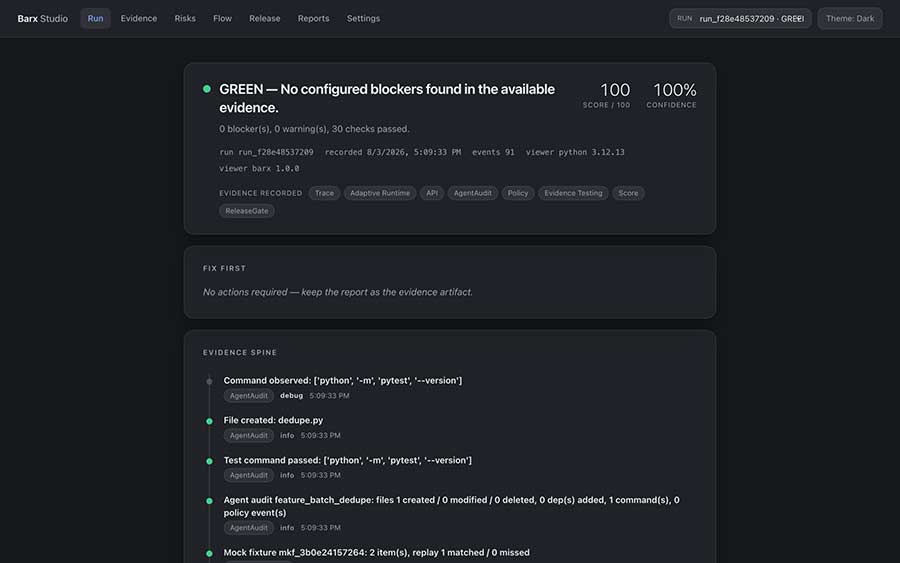
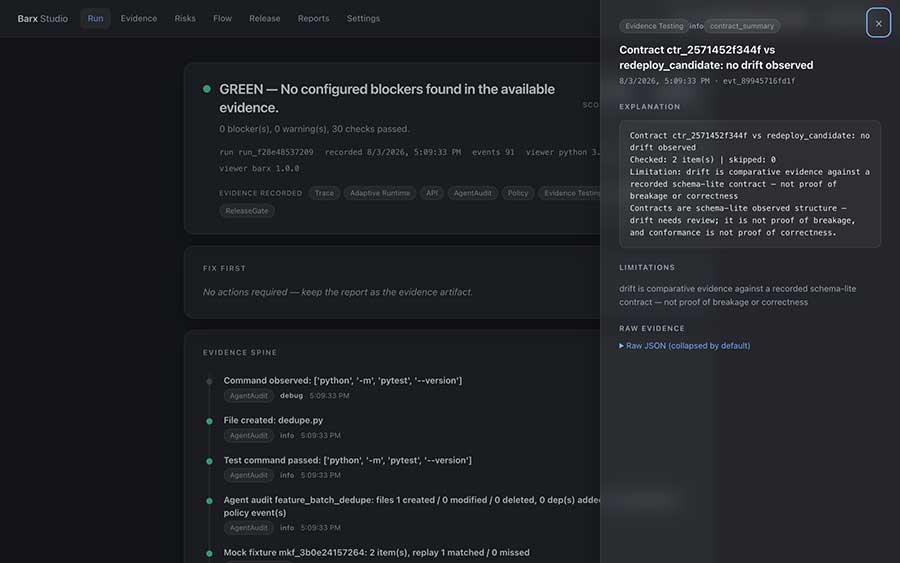
Barx becomes useful after code has been written but before it is released. A developer can run a Python program through Barx, collect structured evidence from the execution, review what was observed, and generate a report. The same evidence can be viewed in Barx Studio, a visual workspace that runs on a developer’s own machine.
While Barx was built as a cost-efficient alternative for developers, Barma always intended for the tool to be approachable for people with little technical knowledge.
“Let’s say someone from a humanities background wants to build an application, and they have asked Claude to generate code but still want to understand how the runtime behavior [is] actually happening,” Barma said. “That product didn’t exist.”
One defining feature of Barx is that it is entirely open source. Rather than relying on cloud processing or storing user data on external servers, the software runs locally on the user’s machine. Keeping data this way not only protects user privacy; it also reinforces the transparency Barma sees as central to the project’s mission.
“I think of Barx as a vision; it doesn’t need to be monetized,” Barma said. “The first thing [is that] I have to establish trust with my user.”
One of the project’s biggest technical hurdles was designing the software as a compact local tool capable of producing meaningful evidence without relying on cloud infrastructure.
“You can plug in [data], use it, and the entire data actually stays with you locally,” he said. “There’s no way that I’m getting access to it, and that’s the technical challenge.”
Looking ahead, Barma wants to expand Barx beyond software development by adapting it for nonprofits working in environmental conservation, wildlife research, marine engineering, and space exploration. He hopes the tool will help these organizations process massive amounts of scientific data more efficiently, and reduce the cost required to analyze information collected from sources such as ocean drones.
As AI continues to advance at a rapid pace, Barma believes tools that prioritize transparency will become increasingly valuable, and that developers will consider the same question that birthed Barx: In a future that increasingly resembles science fiction stories, how do you keep people in the loop?
“Are you able to answer all the “W” questions: where, why, what, how?” Barma said. “If you’re going to answer those questions with whatever you are building, I think you are building a meaningful product.”
The Khoury Network: Be in the know
Subscribe now to our monthly newsletter for the latest stories and achievements of our students and faculty