the read
Anton Schuster
Artist’s statement
The Read
Artist’s statement
I’m drawn to games where the real opponent is a person’s habits: poker, chess, Brawlhalla, the hand-slapping game Red Hands. I study finance, where the same rule holds with money on the line. Markets and credit models learn from your history, and anything predictable about you gets priced. The Read turns that into a two-minute fencing duel. Your opponent, IT, cannot see faster than you. It can only remember better. Predictability is the only real weakness, and your most predictable moments are emotional ones: what you do right after landing a touch, or taking one.
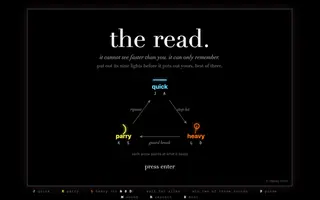
Three decisions carry that idea. First, IT obeys human limits. My first prompt set the core rule: “QUICK is faster than human reaction time, so it can only be beaten by predicting it. HEAVY has a slow, visible windup, so it can be beaten by reacting to it.” The same limits bind IT, so its only advantage is memory: four small predictors, a tiny society of minds, voting on how you will open each exchange. I rejected a superhuman opponent: losing to reflexes teaches nothing, but losing to a habit you didn’t know you had teaches you about yourself.
Second, color appears only when someone decides. On a black-and-white stage, a thrust flashes sky blue, a heavy blow vermillion, a parry gold, in a colorblind-safe palette. The Brawlhalla energy I wanted comes from impact instead: freeze frames, sparks, a slow-motion final touch.
Third, the difficulty curve is the story. Round one, it watches. Round two, it reads. Round three, it knows, and once you learn its tell, the tell starts to lie. In simulation, a player who rushes every exchange wins round one about three times in four and almost never after. The last screen is a mirror, not just a score: it names the habit that beat you.
The collaboration was real when Claude Code argued with me. Before writing any code, it warned that my spec contained a free win: a quick thrust the instant the referee says “allez” could never be stopped. It built the flaw anyway so I would feel it; its own test landed that thrust 900 times out of 900. I asked for a game and got a critic. The collaboration was not real when it came to fun. After the fixes, its balance test said rushing was solved. Then I played and told it: “I can spam J and win every round. IT never counters anything, because my speed is somehow faster than it.” I never landed a single parry, either. Its bots pressed once per exchange; I mashed. Claude traced the cause in minutes, but only after my hands found it. I threw out that verdict. The fixes that followed, a false-start rule from fencing and a tell you can actually see, exist because a person played it. Is the game mine? Partly. Claude helped brainstorm the concept, drafted the brief, turned my playtest notes into prompts, wrote every line of code, and tuned the numbers across thousands of simulated matches. What I authored was judgment: choosing this idea out of six, insisting that a
game won with one key is not a strategy game, keeping the sparks Claude Code wanted to cut, and deciding when it finally felt right. Chess had no single author either; players shaped it over centuries by noticing what was broken. My role was closer to theirs. The game is about a machine that models a person, and I made it by directing one.
AI disclosure
Tools: Claude in claude.ai (Claude Opus 5.5) and Claude Code in the Claude desktop app. In claude.ai, Claude helped me brainstorm (it offered six concepts; I chose this one), researched game design, drafted the design brief and the CLAUDE.md spec, wrote each Claude Code prompt from my direction and playtest notes, diagnosed balance problems with headless simulations, and drafted this statement, which I reviewed before submitting. Claude Code wrote and tested all 1,730 lines of the game and built its balance test. Iteration: five Claude Code rounds and six exchanges in claude.ai, with my own playtesting along the way. Corrected or abandoned: an unstoppable thrust at “allez” and a counterattack that could never land, both caught by Claude Code before building; one-key mashing and parries that never worked, caught in my playtest; the dip lock; a move-by-move predictor, replaced by one that reads openers; a scripted warm-up, replaced by one-time hints; seven lights per round, now nine; and four cut features: a player feint, two-player mode, cross-match memory, and blade trails.