Inbox Zero
Tianhao Liu
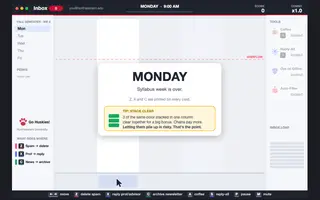
Artist’s statement
InboxZero – Artist’s Statement
Alan Tianhao Liu · Northeastern University · Class of 27 · Marketing CS1700 · Society of Minds: AI for Everyone
What the game is about
I’m bad at replying to emails. As a college student, I get dozens of emails every day, and when the pile up I get anxious. Inbox Zero is about the feeling that the unread/unreplied emails pile grows and the relief and satisfaction of finally clearing it.
But the game isn’t a lesson about staying on top of things because sometimes I don’t. I let things pile up and clear them all at once just like the way I do laundry. And whenever I’m doing it, I’m hyper-focused. That’s exactly how the game feels to play. One of the gimmicks in the game is the have the same type of emails stack up and clearing them together to get bonus points. So ironically, I’ve designed something that rewards my bad habit.
The ending says the same thing. After surviving the week, the screen goes quiet and reads “inbox: 0”, and then one more email arrives. Th pile always comes back.
Design decisions
My first idea of the arcade game was Stairwell, a game about carrying furniture up a narrow staircase every move-in day, However, when I played what clade code has created, I realized that I could hold down on the forward key and he game would play by itself. It was just not fun to play so I got rid of it. The first version of InboxZero had a smaller version of the same problem: every email had one right answer, so there was nothing to think about. Tetris, my favorite arcade game as a kid, is exciting because every piece is a choice. So, I added a Tetris-style stack clear, which turns letting the pile grow into a real gamble. My own boring games taught me that fun comes from meaningful choices, not just buttons to press.
The daily perks come from my favorite videogame genres: roguelike deckbuilding. It’s the idea that you get stronger the more you play. After each day you pick one of three perks that offers you in game abilities or consumables to help you clear the pile faster.
Where the collaboration was real
Claude code was able to deliver some of the best elements of the game without me prompting for it. Claude Code filled the interface with Northeastern details I didn’t describe like the “Go Huskies” sidebar, or basically the content of the emails. It also put in different sound effects for different actions, so deleting, replying, and archiving emails feel different. The ending was Claude’s idea as well: Claude suggested it while we’re still brainstorming and when I saw Claude Code’s version, I like it so much I just left it as is.
Is the game mine?
Not entirely. I gave vague ideas, and Claude turned them into clear prompts that Claude Code used to build the whole thing. Also, I didn’t write a single line of the code. Claude wrote the code, proposed mechanics and details I would’ve never thought of.
Claude wrote the code, proposed mechanics and added stuff I would never have thought of. I chose what the game is and where it came from: my email anxiety ad my laundry habit. I played every version, make changes to reject the ones that weren’t fun and choose between options Claude gave.
Prompts that shaped the game
1. Build a single-file HTML arcade game called Inbox Zero.
The player controls a cursor at the bottom of the screen with the arrow keys and handles falling emails with three actions: Z deletes (for spam), X replies (for professors and bosses), C archives (for newsletters). Each email type is color-coded and shows a funny subject line. Using the wrong action on an
email causes a penalty, like a reply-all chain splitting into more emails. The challenge is emails that reach the bottom pile up in the inbox, and if the pile reaches the top, the player is overwhelmed and the run ends. The game has roguelike structure: a run is one week, each weekday is a wave that gets harder, and after each day the player picks one of three random upgrade cards (auto-filter, coffee break that slows time, reply-all screen clear, out-ofoffice shield, unsubscribe from one email type). A round lasts about 60–90 seconds per day, five days per run, and ends when the inbox overflows or the player survives Friday.
The feel I'm after is frantic and funny, with notification sounds and silly subject lines, but surviving the week ends on a quiet "Inbox: 0" screen before one more email arrives.
Requirements: everything in one .html file, with no external images, no audio files, no CDN links, and no installation. Draw all graphics with canvas and synthesize any sound with the Web Audio API. Show keyboard controls on screen. Include a score and a game-over state.
2. The game isn't challenging or exciting enough. Make three changes. First, increase the pressure: emails should fall about 2.5x faster on every day, spawn about 30% more often, and the overflow limit should be 8 rows
instead of 10. Second, add a stack-clear mechanic: when three emails of the same type are stacked in a row in one lane's pile, they clear together with a satisfying effect and a big score bonus, and clearing several at once gives a bigger bonus. The idea is that players can choose to let emails pile up as a risky strategy. Third, show a short tip on the Monday intro screen explaining the stack clear. Keep everything else the same.
3. Bug: in a column with a pile, Z/X/C hit the top (most recent) email of the pile, but players expect to hit the lowest email, nearest the cursor. Change targeting so actions hit the lowest email in the pile that isn't currently clearing, and when it's removed, the emails above it slides down to fill the gap. After any email is removed from a pile (by the player, a wrong-action penalty, Reply-All, or Auto-Filter), re-check for stack clears, so that emails dropping into place can trigger new clears and chains. Also add a subtle highlight on whichever email the cursor is currently targeting. Keep everything else the same.
AI disclosure
Claude: brainstorming game concepts, turning my ideas into prompts,
reviewing the game's code, diagnosing the targeting bug, and drafting this statement from my answers to its questions. I then revised it in my own words.
Claude Code: built Stairwell and every version of Inbox Zero. I wrote none of the code.
Rounds of iteration: about 5 rounds of changes in Claude Code.
Corrected or abandoned: abandoned Stairwell after playtesting; reworked the first Inbox Zero because it wasn't challenging enough (faster emails, lower overflow line, stack clears); fixed targeting so keys hit the oldest email first.