Khoury News
Two years in, Northeastern-led NDIF project works to unravel the mysteries of AI thought
"It's a shared system for taking the biggest AIs and putting them under the microscope," says NDIF principal investigator David Bau. "This is one of the oldest scientific mysteries of life — how does thinking work?”
Today’s large AI models can perform remarkably complex tasks, but we often aren’t sure how they arrive at their answers. Unlike conventional software, neural networks are not programmed line by line; they are instead trained on enormous data sets.
“AI is different from software that we’ve made before as computer scientists because it’s grown instead of made. We train it instead of programming it,” Khoury College Assistant Professor David Bau explains. “Instead of understanding how it works when we make it, we need to understand how it works after we’ve made it.”

That is the mission of the National Deep Inference Fabric, or NDIF, a Northeastern-led research infrastructure project that received a $9 million National Science Foundation grant in 2024. By giving scientists remote access to large, open AI models and the tools needed to inspect and manipulate their internal computations, NDIF turns AI models from black boxes into objects that can be experimentally studied, with the goal of closing the gap between AI’s capabilities and scientists’ ability to explain them.
“We look inside AI. We ask, ‘What is it thinking on the inside, on the way to doing whatever it’s doing?’” said Bau, the project’s principal investigator.
NDIF uses high-performance computing resources at the University of Illinois Urbana-Champaign’s National Center for Supercomputing Applications to host large open AI models. Researchers can then remotely run experiments on them without needing their own massive graphics processing unit (GPU) clusters. The open-source software allows researchers to inspect the model’s internal computations and then modify them to test hypotheses.
“It’s a shared system for taking the biggest AIs and putting them under the microscope,” Bau said.
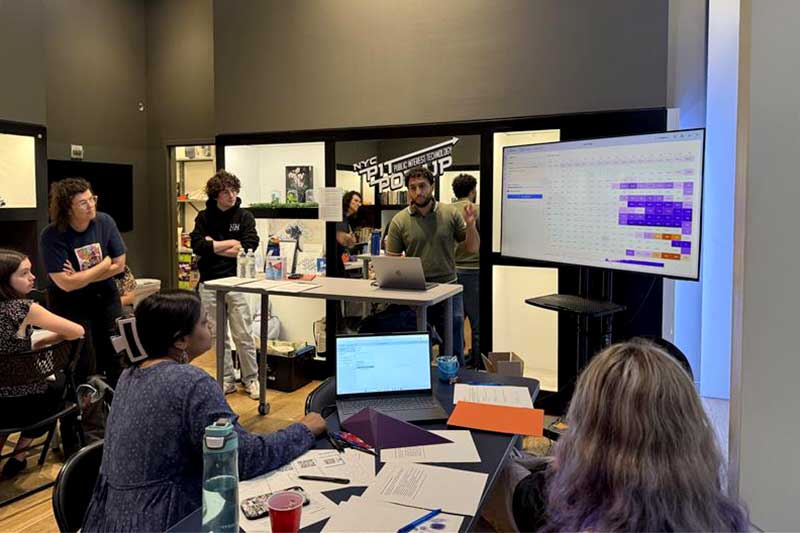
NDIF also provides workshops, tutorials, and other resources designed to teach researchers how to conduct this kind of research, in partnership with the Public Interest Technology University Network.
NDIF is not giving researchers access to an AI chatbot; it is allowing them access to the machinery inside it. The goal is for researchers to ask not just what answer the model produces, but what happened inside the model when the answer was produced.
“The NDIF project is focused on opening the black box of AI. This is a national infrastructure project,” said Emma Bortz, NDIF’s technical outreach and education manager. “So, it really is our goal to make this something that people are using across the country.”
Empowering external researchers
Now that researchers can send experiments to remotely shared models and computing resources, experiments are much cheaper and more accessible, allowing researchers across the country to reproduce and build on one another’s work.

“We have an actual backend where we are hosting the models on GPUs,” Bortz said. “And this enables people to run experiments on large models from their laptop that they couldn’t run otherwise. So, we see that as democratizing research on large scale AI models.”
“We want to study how we can build systems that help people better understand what’s happening inside those large language models, rather than just make them powerful and useful,” adds Zikai Wang, a Khoury PhD student and NDIF research assistant.
NDIF has also invested in workshops, training, and outreach so researchers can learn how to use the complex system and tools rather than simply being handed access to them. Bortz points to Workbench, a newly developed no-code interface that allows users to conduct experiments with minimal programming, which can help streamline their research process.
NDIF’s infrastructure was tested this summer during Aletheia’s Quest, a competition in which researchers attempted to create an AI lie detector and determine if AI systems were lying to users. The competition was an important test of whether NDIF could support so many researchers using the infrastructure similarly and under demanding conditions — and it did. More than 50 researchers from around the world participated in the challenge remotely without needing to build their own infrastructure.
Projects in progress
In the two-and-a-half years since NDIF launched, researchers have begun using the infrastructure to investigate questions that were previously difficult or impossible to study in large AI systems.
One area of research has focused on how AI models represent emotions. Researchers have found that the models’ emotional representations become richer and more complex as the models grow larger. Earlier research could examine relatively small models such as GPT-2, but NDIF allows researchers to examine larger systems capable of much more sophisticated thought.
Another line of research examines the theory of mind: the ability to reason about what another person knows, believes, or thinks. Researchers have found that large language models can solve increasingly complicated theory-of-mind problems, while smaller models often can’t. NDIF provides a way to investigate what happens inside the model as it reaches those conclusions.
According to Bau, researchers have found that models appear to develop internal pointers that allow them to keep track of relationships between people, events, and information. These mechanisms resemble the networks of references that human programmers create in conventional software, although they emerge through training rather than being explicitly programmed.
For Bau, that experiment demonstrated one of NDIF’s central ideas: Sharing the AI itself can dramatically expand the amount of research scientists can conduct.
“This is one of the oldest scientific mysteries of life — how does thinking work?” Bau said. “We’re at a really remarkable moment in AI.”
For the everyday AI user
For daily users of AI chatbots, research into the internal workings of neural networks may seem distant. But understanding what happens inside AI systems could have direct consequences for how trustworthy and predictable these systems are.
“I think everyone should care. Because AI is kind of being forced on you at this point, no matter who you are,” Bortz says. “You Google something, and an AI summary shows up. So, I think it’s really important to teach everyone that we have power over understanding these systems.”
As AI systems become more capable, false answers may no longer just be the result of a model making a mistake. Researchers are increasingly interested in whether a model can internally represent information that conflicts with what it ultimately tells a user. Understanding that distinction is vital for identifying and mitigating dangerous behavior.
NDIF could also help people develop a more accurate understanding of what AI systems do, which would help them to harness AI power more effectively. Bau encourages the public to experiment with NDIF’s Logit Lens, which allows users to examine a model’s internal computations. Rather than seeing only the final response, users can observe the thought processes of the model.
For example, Bau described experiments in which researchers examine how a model handles questions involving dates and numbers. When asked to reason about months, the internal representations can reveal numerical patterns developing before the final answer is produced. In another example, researchers can examine how a model processes a question in Italian and see evidence of internal processing in another language before it produces the Italian response.
These observations do not mean that researchers can simply read an AI’s thoughts like a transcript, but they do offer a peek into the computations that produce its behavior.
That distinction could become increasingly important as AI becomes more integrated into everyday life. If scientists can better understand why a model reaches a particular conclusion, they can more easily identify errors, improve reliability, and recognize dangerous behaviors.

Gabriele Sarti, a postdoctoral researcher working on NDIF, said improving accessibility has been a major focus of the project. The team has developed web interfaces that allow researchers without programming experience to interact with language models and explore their internal workings — a key ability as AI systems evolve from tools into agents that carry out complex, multi-step tasks.
“They will become much closer to our current perception of coworkers,” Sarti said. “And for this reason, it will be especially important that we can trust these coworkers.”
What’s next for NDIF
NDIF’s next challenge is scaling both technology and science. The project has demonstrated that researchers can share access to large AI systems, but the larger goal is to establish interpretability as a collaborative, cross-institutional research field.
When NDIF launched, some of the most advanced AI systems were proprietary, meaning researchers outside of the companies had little or no ability to inspect their internal workings. Since then, the open-source AI community has advanced rapidly, producing models capable of increasingly sophisticated reasoning and cognitive behaviors.
That shift could give researchers access to previously unreachable questions, including how AI systems plan over longer periods, how they represent goals, and how they reason about their own thinking. This could yield methods for determining why those systems behave the way they do, particularly when their behavior is unexpected.
“We see part of our role in the future as setting these standards and being the infrastructure to create a standardized way to access and understand models,” Bortz said.
The Aletheia’s Quest competition offered an early glimpse of what that approach could accomplish. Dozens of research teams could work simultaneously on the same underlying AI system, testing different approaches to a difficult problem.
For Bau, the broader significance goes beyond any individual discovery.
“We’ve created these systems that are sort of like genius babies,” he said. “They can solve sophisticated problems but still lack some of the common sense people expect from humans.”
That makes understanding them increasingly urgent. AI systems are demonstrating forms of flexible reasoning that were once considered uniquely human, while scientists are still working to understand how those abilities emerge. NDIF is an attempt to give researchers the microscope they need to investigate that mystery.
The Khoury Network: Be in the know
Subscribe now to our monthly newsletter for the latest stories and achievements of our students and faculty