Many users have information which does not fit neatly into the clean, categorical organization schemes favored by
computer software. Many users may not wish to categorize all of their information, particularly information that
may be short-lived, where the time spent categorizing might easily exceed the time spent using the information.
Instead, such users use a very different organizational system that relies on placing items spatially within the
organizational system.
Often, these users have an organizing consisting, from an outward view, of a messy desk with disorganized piles of
paper. Most such users constantly have new pieces of paper coming in to their system, and often need to find
particular pieces of information. Despite the messy appearance, it works surprisingly well. However, such a
paper-based system has serious limitations. The system of mess and piles quickly grows to unmanageable size, and papers
can easily be lost entirely, or damaged in the shuffle. Computer programs, on the other hand, often are designed
around a more categorical organizational scheme, making them unnatural to use in such a way.
The user group includes adults, of both genders. All interview subjects were between the ages of 21 and 30. However,
we believe that this is a result of the limited time available to do interviews, and the limited pool of subjects
easily available for interviews. Two of the interviewees gave anecdotes of other people with similar organizational
schemes who spanned a much larger age range.
Computer experience varied greatly among the subjects, but all had significant knowledge in at least one area that
involved fairly large amounts of information. (For example, one was a librarian, and one a bookkeeper). Typing
and reading skills were high.
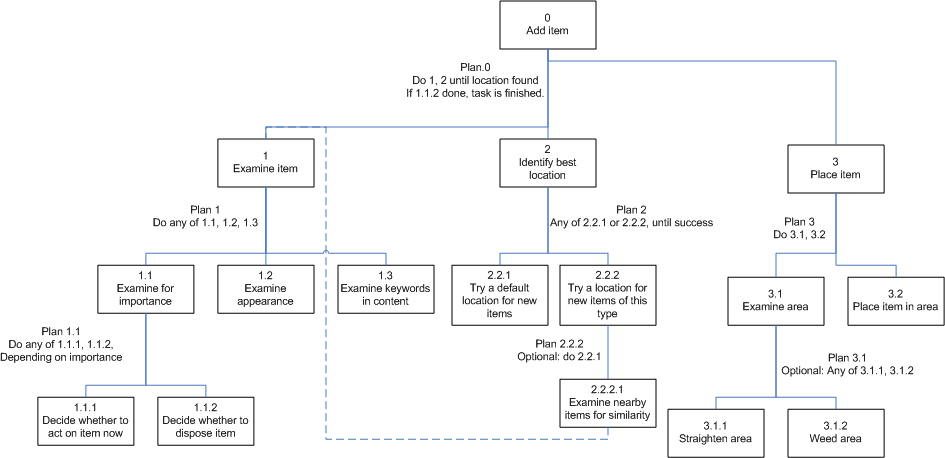
Adding an item
A new item, with new information has arrived. This may be either information the user has creator, or
information that arrived from some other source. The user's goal is to add this item to his or her organizational
system. As a precondition, a new item of information must be in the user's possession.
Several exceptional cases are possible. The user may decide not to add the item to the system. The user may
decide that some re-organization is needed before adding an item. In this case, task #6 (straightening up), or
task #7 (weeding) may become a sub-task. Also, the user may be interrupted due to something more urgent
within the system. Task #2 (noticing urgent items) acts as a sub-task in this case.
This task is among the most common. There are no firm time constraints, but it must be relatively quick, as
otherwise the user organizational system will not keep up if there are many new items.
Noticing urgent items
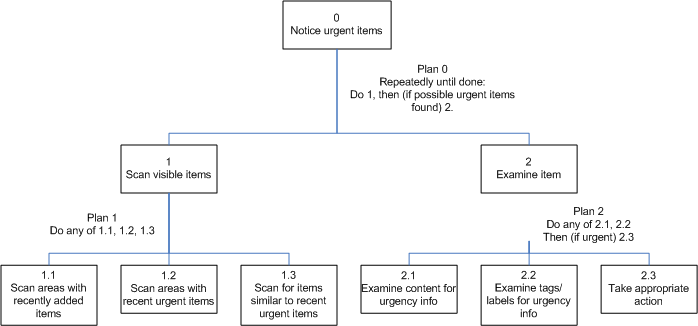
The user wishes to scan the system for items which need attention in the near future. The user's goal is to
identify any items which need immediate attention. A precondition is that there is time-sensitive information
in the organizational system.
An exceptional case is when time-sensitive information is present, but the user fails to find it.
This task occurs as a sub-task of most other tasks. Therefore, it must be quick, so
that it does not affect other time-constrained tasks.
Searching for an item (context search)
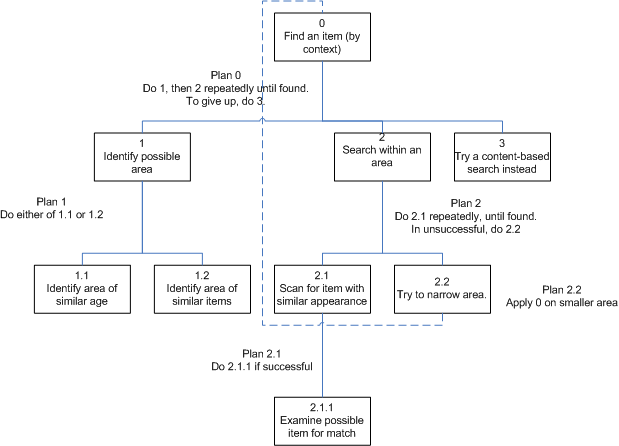
The user wishes to find a particular item in the system. He or she has some knowledge of what area of the
organizational system the item is in, and possibly also some knowledge of some other items that are "near"
the target item (for whatever "near" means in this organizational system).
An exceptional case is when context-based searching fails to find the target item. In this case, the user
may instead use content-based searching, and that task (#4) becomes a subtask.
This task is moderately common. In paper-based organizational systems, interviews indicated that it is much
more common than task #4 (content-based searching). This may or may not hold in a computer-based system.
Searching for an item (content search)
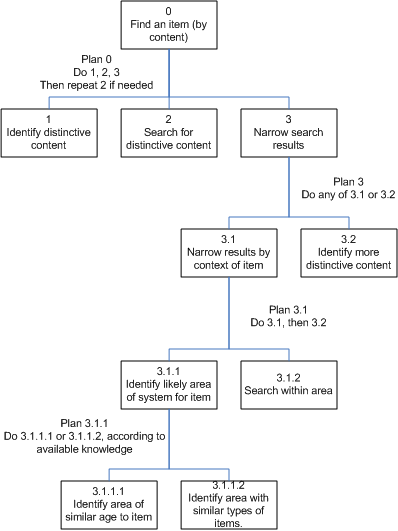
The user wishes to find a particular item in the system. He or she has some knowledge of the content of the
item, and possibly also some knowledge of the context of the item (as in the previous task).
Task #3 (context-based searching) is often a sub-task of this task. This is not truly an exceptional case,
as subjects in interviews indicated that it was normal to switch between different types of searching tactics.
This task is moderately common. In paper-based organizational systems, interviews indicated that it is much
less common than task #3 (context-based searching). This may or may not hold in a computer-based system.
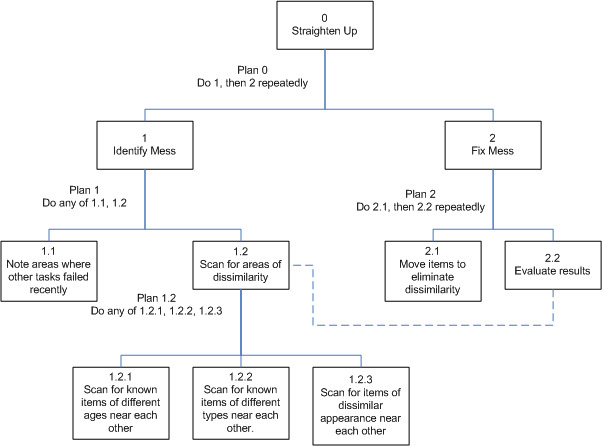
Straightening up
The user's goal is to modify the organization of the system in order to make other tasks more efficient.
The user wishes to accomplish this by revising the arrangement of either the entire system, or an area of it.
This task is uncommon. According to interviews, many users attempt to perform it on paper-based systems at
regularly scheduled times. Some subjects also indicated that they perform this task on areas of their
organizational system as they notice that it is needed, often during execution of other tasks.
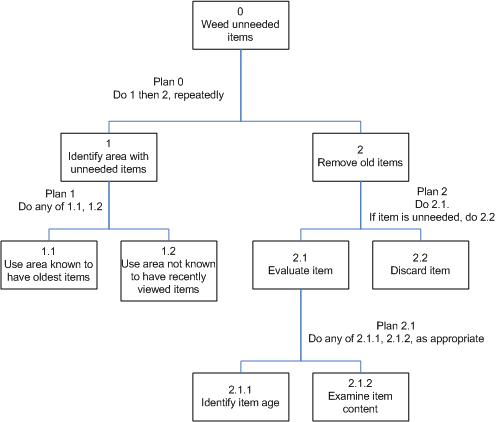
Weeding information
The user's goal is to modify the organization of the system in order to make other tasks more efficient.
The user wishes to accomplish this by removing outdated or unneeded items.
This task is uncommon. According to interviews, many users attempt to perform it on their paper-based systems
at regularly scheduled times. Some subjects also indicated that they perform this task on areas of their
organizational system as they notice that it is needed, often during execution of other tasks.
John receives a great deal of both e-mail, and paper mail. He keeps track of paper mail by use of a large,
messy area of kitchen counter, containing many piles of papers of various sizes. He keeps track of e-mail with
the e-mail program that comes with his computer, but he is dissatisfied with it - he finds that he has to
use the search functionality to find almost anything in an e-mail, whereas he believes that he finds items much
more quickly in his paper-based "disorganization". As a result, he tends to rely on paper mail, avoiding places
where many would consider e-mail more convenient.
John checks his (paper) mailbox, and discovers that he has received a couple bills, some junk mail, and a
couple letters from friends. He scans quickly through all the mail. He recognizes the bills since they tend
to come in rather plain envelopes with a company logo on them. He notices that one bill is due tomorrow, so
immediately opens it. The other is not due immediately, so it gets placed on a pile of other bills, which he
knows the location of through practice, and can immediately recognize by the appearance of the envelopes.
Unfortunately, that pile of bills is getting pretty high -- there must be some late bills in there, but it
would require moving around some other piles just to get at them.
Some of the junk mail gets immediately thrown out, since it is clearly unimportant. John gathers the remaining
mail into a pile, and places it on one side of his "mess". It is directly on top of yesterday's mail, turned
sideways so he can easily see where one day's pile starts and another ends. Unfortunately, a lot of paper tends
to collect at this one side of the "mess", and sometimes letters spill out onto the floor. Once they're no longer
in piles, John finds it very difficult to find anything.
Jane keeps a large number of reminders to herself, written on various kinds of sticky notes that cover the top,
front, and sides of her desk. Today, she's a little worried, because she just remembered that she has to buy
a gift for her brother's birthday. She vaguely remembers that she had a perfect idea for the gift a few months
ago, and jotted it down quickly on one of the sticky notes. Unfortunately, at the time, she hadn't decided
exactly who the gift would be "perfect" for, so she just wrote down the name of the gift on a note, with no
other information.
Jane first glances around her layers of sticky notes. She can't quite remember when she wrote that note down,
but she does remember it was right before her own birthday. Aha! Towards the upper left, she sees a bright
green sticky where she drew a picture of a birthday cake with suspiciously few candles on it. The note she's
looking for must be near there.
Unfortunately, the bright green note has since been covered over. She begins moving around the upper layers.
While doing so, she finds a different gift idea, and puts it aside for additional consideration.
Eventually, she finds the note she was looking for, but decides it wasn't so perfect after all. There might
be a better one nearby, but it doesn't seem likely she'll find it - in the course of searching, she's
disturbed the "archaeology" of her sticky notes, and in that case, she usually has no choice but to go through
all the notes one by one.
Eric keeps all of his notes to himself in the form of text files on his computer desktop. He's tried putting
them into folders, but he didn't like this - he found that he never remembered to look at them once they were
put away neatly.
Usually, when he wants to find something, he can at least vaguely remember what part of the computer screen its
on. Today, however, he wants to find a particular news story about Iraq, and can't remember where he put
it - it's probably somewhere on the desktop, but he's been leaving a lot of news stories on the computer lately,
to read when he gets around to it. There were too many of them to put it one place without it looking messy,
so they've gotten scattered around.
He attempts his usual methods of searching (much as Jane did), but doesn't have any luck, so he tries the
computer's "Search" facility. It searches quickly, but finds more than 40 possible matches, and presents them
to him in a list. Eric finds himself going through them one by one, seeing no cues to look by, other than a
one sentence excerpt, usually just taken from the start of the article. A few minutes later, he finally finds
what he was looking for.