Khoury News
Enshittification and reverse centaurs: Beth Mynatt and Cory Doctorow discuss what’s next for AI
In a wide-ranging conversation hosted by Harvard's Berkman Klein Center, the dean and the author hashed out the state of play in AI — how we got here, who's driving the bus, and where we might be headed.
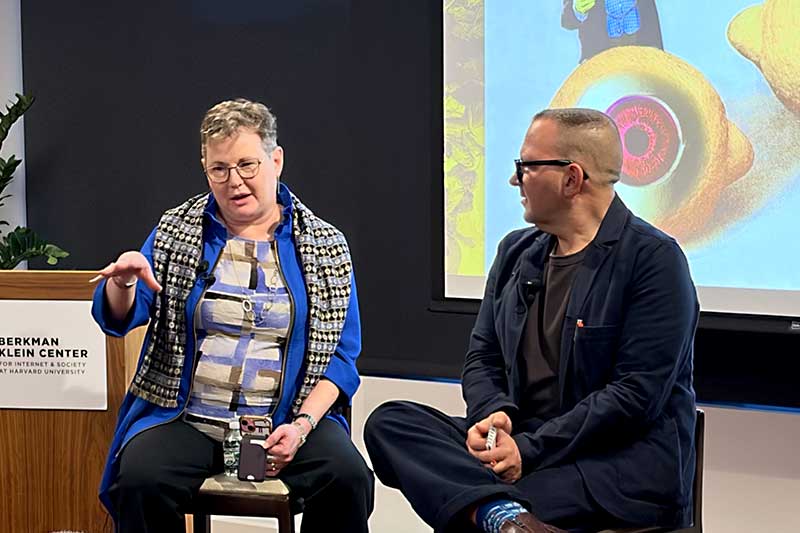
The explosion of AI onto the global stage has raised countless questions. What can it — or should it — be used for? Who stands to benefit, and at whose expense? Will it supplant humans and dominate the world, as if by an occult hand?
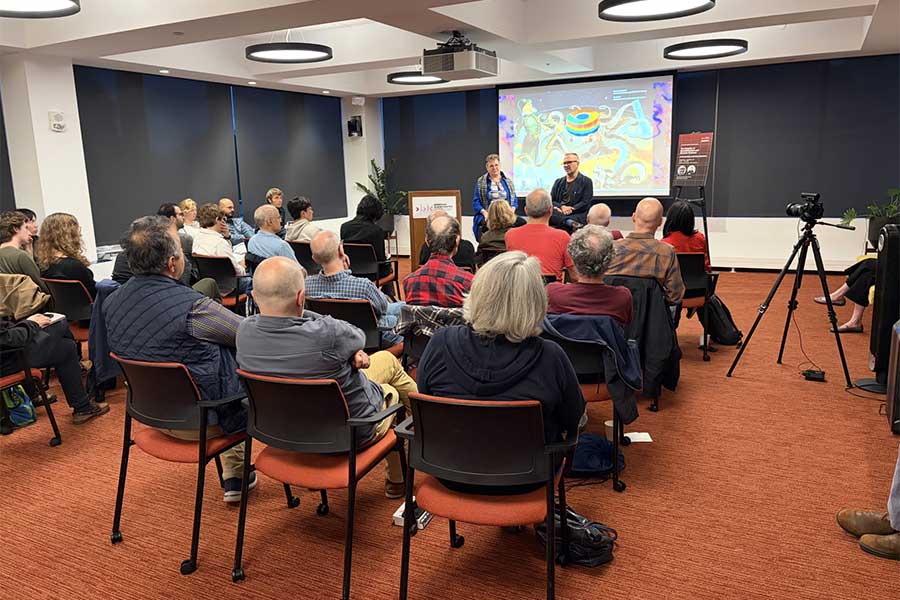
These were the topics on the table at Harvard Law School on September 30, as Khoury College Dean Elizabeth Mynatt welcomed journalist, tech activist, and sci-fi writer Cory Doctorow for a frank, wide-ranging, and sporadically sardonic chat on the head-spinning progression of AI, hosted by the Berkman Klein Center for Internet & Society.
“There is a window of opportunity for researchers to stand up work that says, ‘We’re not just going to take AI as a magical creature that’s running loose and hacking into Hugging Face,” Mynatt said. “There is science to be done on reliable, safe, economical AI, but we have to move it away from the top six or seven firms that are controlling the future of what we define as AI.”
On the menu for discussion were the centerpiece ideas of Doctorow’s most recent books. One such idea, which he coined “enshittification,” refers to a three-stage decay process in digital platforms. At first, the platforms are good to their end users, who flock in. Then the platforms cater to business customers at the expense of end users. Finally, they squeeze the business customers to boost profit for the platforms.
In the case of Facebook, Doctorow said, enshittification meant offering a useful service, then peppering users with targeted ads, and finally upcharging the advertisers that had come to rely on the platform. For Google, it meant multiplying ads and degrading search results once it had cornered the search engine market and knew that users wouldn’t switch browsers.
“There will be struggles within any firm about how it’s going to conduct itself,” Doctorow said. “Mostly those arguments cash out based on material factors — which side’s going to make the firm the most profits or lose it the least money.”
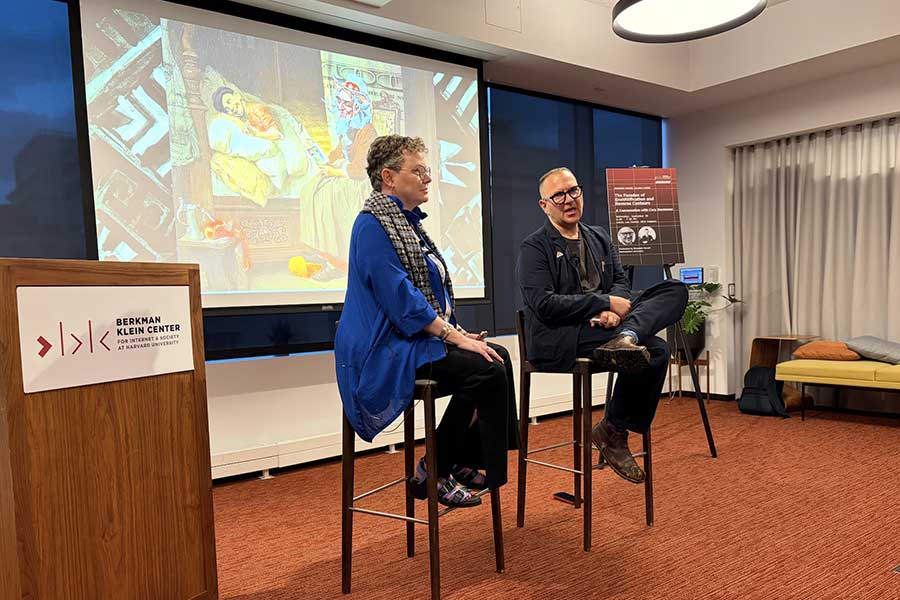
From there, Mynatt and Doctorow pivoted to “reverse centaurs.” In automation theory, a “centaur” is a human assisted by a machine, with the human head providing judgment and guidance while the fast, powerful, relentless machine body assists. A reverse centaur, then, is one in which the technology drives and the human serves the machine.
“There will be some part of the job the machine in charge can’t do, so you become the machine’s assistant,” Doctorow explained. “Because the machine is faster, stronger, and has more endurance than you, you have to work as long, hard, and fast as you can.”
“As someone who has worked my entire career on centaurs, on empowering human beings through computation,” Mynatt added, “the market seems determined to focus on reverse centaurs because of the money in the equation. There’s just not enough money in centaurs and all of the hype is around reverse centaurs … It’s ill-advised, because that value isn’t going to materialize.”
But as novel as AI is in technological terms, Doctorow notes that, economically speaking, it’s another in a long line of automation transformations.
“Labor-driven automation is generally taken up in service of improving the quality of the output; workers pick up a tool because they think it’ll help them do a better job,” he explained. “Capital-driven automation — when your boss makes you use a tool — is typically in service of improving throughput. They want you to make more of something, and if they have market power, they often want you to make more of something worse. [AI] is capital-driven automation.”
So what should be done? Doctorow advocated strong workplace unions, as well as getting involved with civil society groups and political campaigns that advocate for workers’ safety, dignity, and prosperity instead of unchecked AI development.
“Currently, we have an enshittogenic policy environment where the worst ideas and people make the most money,” he said. “This is not the great forces of economics. It wasn’t the iron laws of history. It wasn’t a guy coming down the mountain with stone tablets. We have this environment because individuals in living memory decided this was the environment we should have. We can make sure those people are never allowed to touch the levers of power again, and we can make different decisions.”
For her part, Mynatt emphasized the value of interdisciplinary study in breaking the barrier between hard-charging AI developers and everyone else, noting that more than 60% of Khoury students are working on a combined major.
“They have to, at some point, understand the market economics of commerce or health care or game design or biology, and that’s at least forcing new conversations and training,” she said. “We have to quit the silos of ‘It’s a beautiful, shiny toy that may be god, and I’m just going to idolize it and push it forward.’ We need to integrate it with other sectors and domains, and so we have to shift our model as educators.”
The Khoury Network: Be in the know
Subscribe now to our monthly newsletter for the latest stories and achievements of our students and faculty