Khoury News
Aging with AI: When it’s grandma’s well-being on the line, accuracy is essential
When it comes to AI embedded in an older person's home, accuracy isn't just about correct facts. It's about personalized functionality, responsible reminders, and conveying key info to loved ones.
This story is the first of a three-part series on Khoury research into tech and aging through the AI-CARING Institute. The second story covers the importance of AI that yields flexibly to human autonomy, while the third examines the relationship between human caregivers and AI supports.
What does life look like for the average American senior?
The picture in your mind should include a lot of people; one in six Americans is 65 or older, and that number is growing fast. It should be set in the senior’s own home, where over 90% of older adults live. That’s a good thing, since most older adults want to age in place. But it comes with concerns about care, as the health care industry fails to grow at the pace of the population it serves, and traditional caregivers like adult children often live elsewhere.
And for most older Americans, life includes technology. Three quarters of American seniors own a smartphone, and half of adults 50 and older say they have used AI technologies like Siri, Google Assistant, or ChatGPT. If your parents have ever asked Alexa for the weather or used voice-to-text to write a grocery list, then they are among the majority of older Americans already aging with AI.
Which brings up another question: What do we want the technology that we age with to do?

“The opportunity is to think about our parents, not our grandparents — about how they use technology today, and what they’re going to expect from technology in the future,” said Khoury College postdoc Tamara Zubatiy. “It’s a deeply human thing. Hopefully we will all get old — what do we want in that time?”
Zubatiy is one of over 70 researchers across seven schools who make up the AI Institute for Collaborative Assistance and Responsive Interaction for Networked Groups, or AI-CARING. Funded by the National Science Foundation, AI-CARING researchers have spent the past five years studying how older adults use AI and working out how to develop personalized, collaborative AI systems that support quality of life and independence. Rather than funding one massive study, the Institute has encouraged researchers to pursue diverse tracks, creating a body of nearly 200 papers that cover human activity recognition, ethics, tech literacy, user experiences, robotics, and more.
Three of those tracks — smart display reminder and alert systems, smart home speakers and conversational agents, and AI-generated daily activity summaries – have been led by Khoury researchers like Zubatiy. With the AI-CARING Institute drawing to a close at the end of 2026, those researchers are reflecting on three major insights they’ve surfaced about how to design AI care tools that meaningfully support human aging. The first — a responsible AI tool must be accurate.
Take AURA, an intelligent reminder and alert system developed by a team led by Khoury Assistant Professor Zhi Tan and PhD student Reina Chan. Through a touch screen, it gathers data from sensors in the home, interactions with users, and information about the community to send its aging users alerts and reminders — for instance, “The door of your freezer has been open for 15 minutes, remember to close it” or “Remember, there are trips to Marshalls and HomeGoods today.” By closely monitoring small-scale deployments of up to five months, the researchers have learned how AURA was integrated into older users’ lives.
“The thing that scares me the most is if the reminder didn’t fire correctly,” Tan said. “For something like a med reminder, it could be very dangerous; I don’t want a case where it fails because the AI decided to not fire the reminder.”

To avoid an inaccurate alert from AURA, Tan and Chan’s team distinguished between two pieces of the alert process — and two possible applications of AI.
The first piece is to set up the reminder. Applying AI as a user interface allows an older user to give their instruction in plain language to an AI that turns the phrase into code, instead of the user manually coding a “take the blue pill” reminder to fire at 2 p.m. every day. This application relies on AI capacities like intent extraction and natural language processing, much like the voice-to-text function on a smartphone; this is the challenge Tan and Chan’s team is actively working on.
The second piece is to decide if the reminder should fire. Applying a modern agentic AI system as a decision-making agent would mean that at 2 p.m. every day, the AI would reason using its observed data to generate a statistically probable answer to the question of whether it should fire a reminder to take a pill. Tan and Chan steered clear of using AI to make decisions because a statistically probable answer isn’t the same thing as a correct answer. Instead, the team chose to use code to decide whether to fire a reminder.

“If I ask what medications I take in the afternoon, that needs to be a very specific, accurate answer. It’s not based on all of the data from older adults in the world,” said Beth Mynatt, the AI-CARING co-PI who brought the project to Khoury College when she joined as dean in 2022. “Neural networks give us flexibility, agility, and an easier user experience. But they’d better be accurate, and they’d better be focused.”
To ensure accuracy, Tan and Chan require that all of AURA’s alerts and reminders be deterministic (the same input will always produce the same output) and explainable (they can open up the code and show you why). Their AI can translate instructions into code or personalize the phrasing of reminders, but it’s never responsible for deciding whether an alert should fire.
“There is a knee-jerk reaction of applying AI to everything, and that misses the point,” Tan added. “We need to train researchers to be thoughtful about what they’re working on and to apply AI in the right place, knowing its limitations and what the problem needs.”
But Khoury researchers didn’t just discover how much accuracy mattered; they also found out what a messy concept accuracy can be.
Imagine someone asks you to summarize what your mother did today. You know she’s done some chores, called a friend, gone for a walk, and eaten dinner at the kitchen table. You could say she spent most of her day around the house; you could also say she stayed active and took care of her health by going for a walk. Both summaries are true, but they communicate two different answers. Which one is accurate depends on who’s asking and why, and on what kind of day your mother felt she had.

“For me, the number-one takeaway that came out of our initial pilot is that accuracy is subjective, which is a weird thing to say,” said Khoury Assistant Professor Varun Mishra.
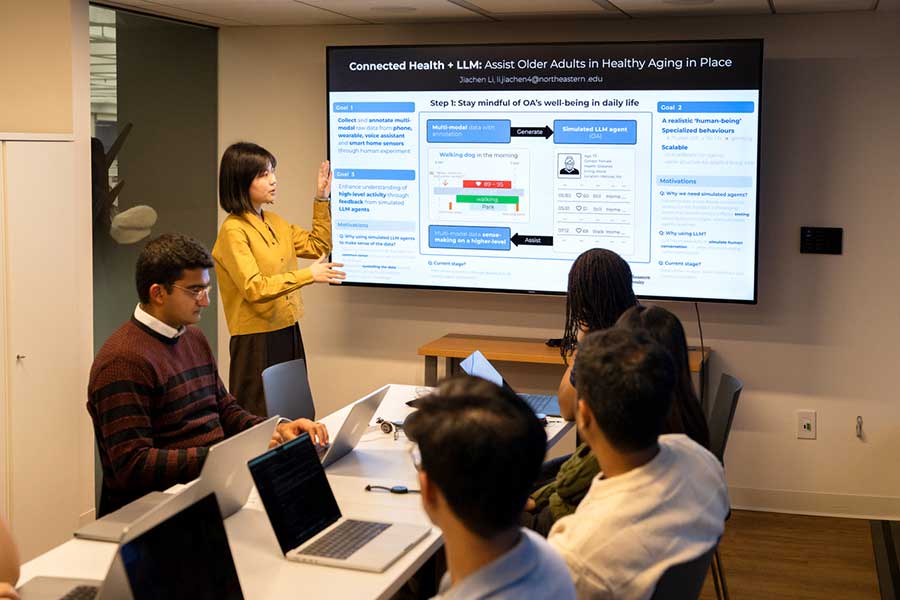
Unlike AURA, which uses AI to turn plain language into computable data, Mishra and PhD student Jiachen Li are using AI to turn data about an older adult’s day into a short, plain-language summary for remote care partners, often adult children living elsewhere. By having a solid enough grasp of a loved one’s routine to notice when that routine changes, partners can spot early warning signs for issues like Alzheimer’s or depression.
But families react differently to hearing “Your parent stayed at home most of the day” than to “Your parent went for a walk this afternoon,” and older adults know that. In a three-month deployment in Atlanta, Li and Mishra found it distressed an older adult to send her son a summary that was technically accurate but didn’t reflect her subjective experience.
“The first summaries gave her a feeling that she was inactive and homebound all the time, and this became more concerning for her when she knew it was going to be shared with her son … she really didn’t know how her son would react,” Li said. “We realized that it’s not just about factual error; we need to proactively ask about the important activity they want to convey to their families.”

As she worked to balance the summary’s technical accuracy with its psychological truth, Li was grateful to be at a college that prioritizes an interdisciplinary approach.
“My PhD advisors, Varun Mishra and Beth Mynatt — they’re awesome, responsible people,” added Li, who followed Mynatt from Georgia Tech to Northeastern in 2022. “The most important thing is, they recognize the value of interdisciplinary human–computer interaction work — the vision of everything.”
And when an AI system can be counted on to be accurate and responsible, the researchers found it could have a significant and positive impact on an older adult’s ability to live a full and independent life.
A great example is Zubatiy’s work on a smart speaker. Using many of the same principles Tan and Chan’s team applied to AURA, she and her team hooked up an Alexa device to a private, HIPAA-compliant, open-source LLM conversational agent named Robin, and distributed devices to older adults in an Atlanta retirement community. The participants she worked with enjoyed the extra support so much that, at the end of the study, several asked her if they could keep their Robin devices.
“We had a woman who had stopped cooking because she kept forgetting to turn off her stove, and we gave her back the confidence to cook. Every time she would start cooking, she would tell Robin to set a timer to make sure the stove is off,” Zubatiy said. “It’s different for everybody, what they want out of these technologies, and when you can achieve that it really does make people feel happy and empowered.”
The Khoury Network: Be in the know
Subscribe now to our monthly newsletter for the latest stories and achievements of our students and faculty