Khoury News
Aging with AI: Supportive tech that adapts to you as you age — and defers to you by default
It's a myth that older adults don't want to use tech, Khoury College's AI-CARING researchers say. They just want flexible tech that respects their routines and complements their connections with loved ones.
This story is the second of a three-part series on Khoury research into tech and aging through the AI-CARING Institute. The first story covers the importance of responsible, accurate AI, while the third examines the relationship between human caregivers and AI supports.
If you had a personal robot to make your life easier, what would it do? Manage your schedule? File your taxes? Wash the dishes? Serve as a constructive critic during brainstorming?
There’s infinite variety in the kinds of support that people want, but everyone can agree on one thing: Support technology must respect your wishes and help with what you want to do.
Across five years and three separate study tracks under the NSF-funded AI-CARING Institute, Khoury researchers have surfaced key insights into how to design AI tools that meaningfully support human aging. Among them: Respectful AI tools yield flexibly to human autonomy.
The importance of being flexible to users’ wishes goes all the way back to one of AI-CARING’s first published papers, which Khoury postdoc Tamara Zubatiy began working on during the early days of the COVID pandemic under then-Georgia Tech Distinguished Professor and current Khoury Dean Beth Mynatt. Zubatiy installed Google Homes for older adults and their care partners, then tracked their interactions with the devices over 10 weeks to better understand the group’s preferences, priorities, and use cases for a smart speaker.

“There she was in the pandemic, meeting people in their driveways in a HAZMAT suit, making progress despite all the crazy COVID protocols,” Mynatt recalled with a laugh. “To make such substantial strides in understanding how older adults really use commercial systems was huge.”
Zubatiy discovered that the participants loved their smart speakers and used them several times a day for tasks like playing songs, looking up the weather, and putting events on their calendars. But for older adults, the initial systems were impersonal, inflexible, and couldn’t proactively offer the support users wanted.
“There was a lot of templatization. It was not flexible; you had to speak your commands in a really specific way,” Zubatiy said. “This was particularly challenging for older people in the South, who like to talk slowly and work in all sorts of fun slang.”

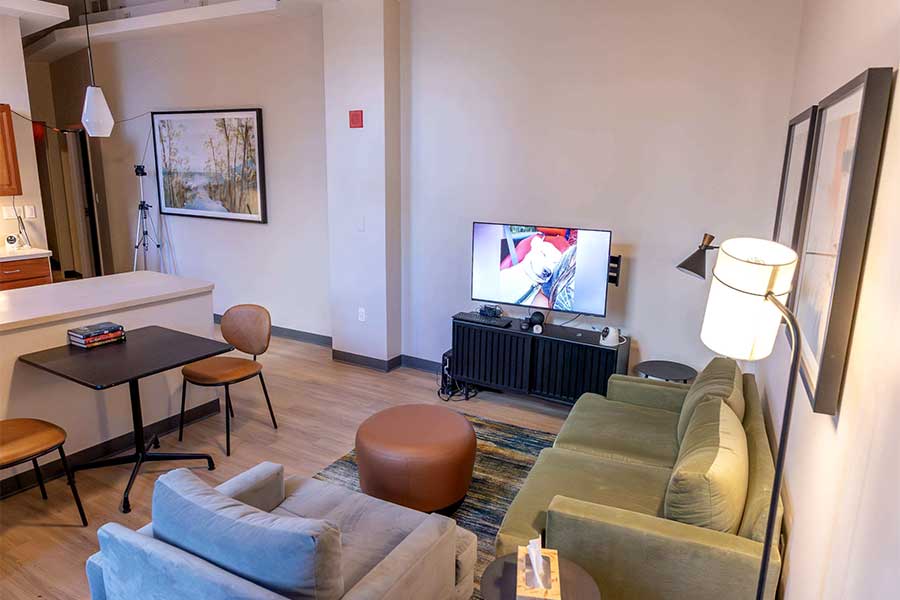
For their next study, Zubatiy and her team developed Robin, a private, open-source conversational agent that responded to those pain points. They created user profiles so Robin could learn about its users’ preferences and respond with personalized recommendations, all while using HIPAA-compliant data practices to ensure users weren’t targeted with ads. By using AI for the user interface, they ensured Robin could understand users’ speech even when they didn’t use the rigid command phrases of traditional robotics. They installed sensors on things like ovens and front doors, then gave Robin the ability to initiate an interaction if, for example, it detected that the front door had been left open long after a user arrived home. Lastly, they installed Robin on commercially available Alexa hardware to ensure interoperability with other devices and avoid the cost of building a new device, then did a test deployment with aging users in an independent living community in Atlanta.
“The data that we’re seeing on the engagement with Robin is really high, which is promising,” Zubatiy said. “There’s a myth that older adults don’t want to use technology, and I think we’ve dispelled that myth.”
Other users in the same community received AURA devices, an intelligent reminder and alert system developed by Assistant Professor Zhi Tan and PhD student Reina Chan that users accessed through an interactive screen in the apartment. They, too, discovered that participants wanted flexibility in how they used their devices.
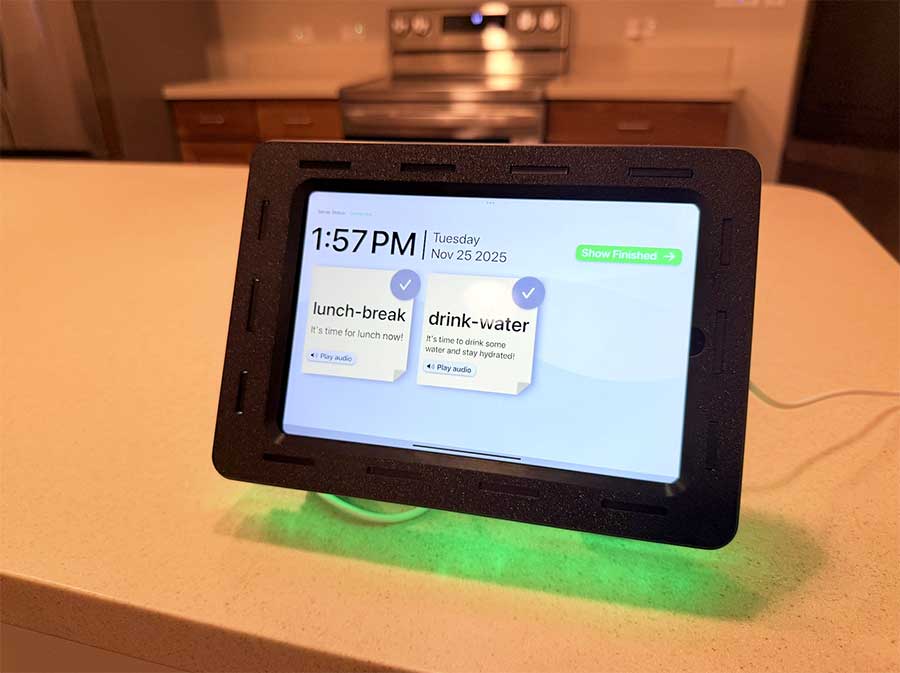
“Older adults have different needs … some go to activities with their friends outside of the community, so they set reminders for those. There were one or two who set up reminders for habits, like drinking water. One participant set up reminders to make sure they set aside time every day so they can paint,” Chan said. “It’s those edge cases; if this user study didn’t happen, we wouldn’t think about them.”
Treating users with respect and flexibility was baked into even the smallest choices, like how the AI should phrase its alerts.
“You don’t say, ‘You need to do this, you forgot to do this,’ because that’s not respectful, and people will walk away,” said Mynatt, who has led research into assistive technologies for older adults since the late 1990s. “AURA treats people like ‘Hey, I just want to check in — you normally take your medication at lunch but you were out, so there’s a chance that you missed it today.’ I see that level of respect throughout the project.”
Although the two studies were conducted separately, Zubatiy’s collaborations with Chan and Tan’s team through the AI-CARING Institute surfaced another insight: Designing for flexibility and a user-led experience meant offering a range of devices that work for different people. For example, Robin’s spoken interactions might be a great choice for a visually impaired user, but a visual system like AURA would better suit a hard-of-hearing user.
“We’re getting to the root of what these systems should do: Support the person in the way that they want to be supported, in the context of their unique ecosystem,” Zubatiy said.
But respecting human autonomy means more than designing flexible tools. It’s also critical to give aging people agency over how their technology represents them to other people. That’s one thing PhD student Jiachen Li and Assistant Professor Varun Mishra came to understand well while studying how to send a short, AI-generated summary of an older adult’s day to their remote care partner.
As they began limited, closely monitored deployments, they quickly discovered that two summaries of the same day could both be technically accurate, yet communicate very different pictures. Sending a summary that didn’t reflect the older person in the way they wanted to be seen was distressing and could even damage communication.

“They were not necessarily worried about their care partner finding out a secret; it was more like, ‘What do they think about me? Will they think I’m not being active enough?” Mishra explained, giving the example scenario of whether a summary should highlight a short walk. “The other part is that sometimes, the older adults want them to know that they’re walking so their care partners might feel motivated, like ‘If my grandfather is walking so much, then I can also do that.’”
So, the researchers decided not to treat the data as a conclusive source or to try to solve the balance of technical accuracy and psychological truth from the lab. Instead, they empowered their older adult participants to correct the AI’s summary before their care partners saw it, allowing the seniors to communicate more flexibly than the researchers could have imagined.
Li gave the example of an older woman whose care partner — her adult son — had a demanding work schedule. When she’d been sick in the past, she’d had to decide whether to call her son about it. If she wasn’t very sick, was it worth distracting him from something important at work? If he couldn’t pick up his phone, would describing her symptoms to a silent voicemail inbox make her feel lonely, or make him feel guilty for missing her call?
This time, she checked to make sure her illness was noted on her daily summary, knowing that her son read it even on days he didn’t have time to chat on the phone. That way, he would know to ask how she was feeling the next time he called, creating a natural opportunity for attunement and connection.

“For intergenerational relationships built over decades … they blend this whole thing into their original routines,” Li said. “We shouldn’t design AI summaries as a replacement for regular communication. We should provide information that can enrich their communication.”
When technology supports the experiences that aging people decide are important, the result is a more enriching, independent experience of old age. And when aging people can design those technologies with researchers who respect them and have the resources to build relationships over time, ideas and opportunities emerge that neither the users nor the researchers would have imagined alone. Reina Chan recalled catching up with the woman who had used her AURA device to commit to painting more regularly, a use case Chan hadn’t anticipated.

“I asked her how the painting reminder was working, and she was like, ‘Oh, that’s great; I finally get to do all my paintings.’ She showed me, one by one,” Chan said, smiling. “That was very cute … and the other participants were also very happy that they got the chance to participate in AI-CARING projects. I know some of them; they’re just so interested in technology.”
The Khoury Network: Be in the know
Subscribe now to our monthly newsletter for the latest stories and achievements of our students and faculty