
Aging with AI: Designing thoughtful tech for the fabric of everyday life
As we get older, what do we want the technology that we age with to do?
“Did mom have a normal day today?” It’s a question Khoury Dean Beth Mynatt first started asking nearly 30 years ago, and one she says is“very easy to say and very, very hard to answer.”
Mynatt has pursued that question since the late 1990s, from hand-built touch screens in early proof-of-concept studies to her role as co-PI of the National Science Foundation’s $20 million AI Institute for Collaborative Assistance and Responsive Interaction for Networked Groups, or AI-CARING. Over five years, the institute’s 70-plus researchers across seven schools have studied how older adults use AI, and how to build personalized, collaborative systems that support independence and quality of life — as well as for caregivers.
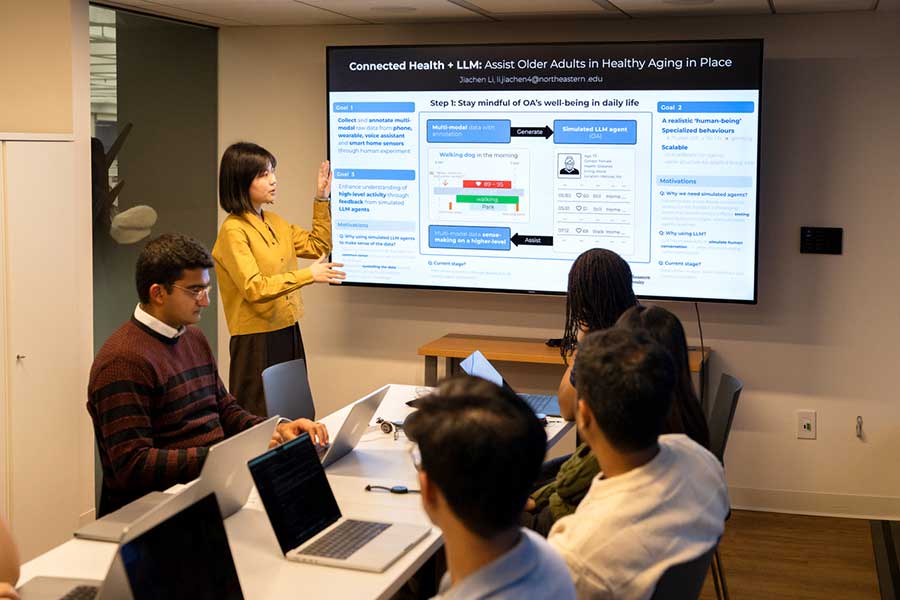
Khoury researchers — including Mynatt, postdoc Tamara Zubatiy, Assistant Professors Zhi Tan and Varun Mishra, and PhD students Reina Chen and Jiachen Li — have contributed key findings and innovations, including smart display reminders, conversational smart speakers, and AI-generated daily activity summaries. As AI-CARING draws to a close at the end of 2026, researchers share key insights in a three-part Khoury News series.
What accuracy means when well-being is on the line
When it comes to AI tools supporting older people, accuracy is both critical and more subjective than people might realize. Khoury researchers found that designing systems with that are accurate and responsible can have a significant and positive impact on an older adult’s ability to live a full and independent life.

Designing adaptive AI systems that defer to individual needs
For tech to be truly useful to aging adults, it must adapt around their needs and yield to their autonomy. Researchers explored systems that personalize the user experience, from respectfully worded reminders to daily summaries seniors can edit before their family sees them — support tech that puts users in charge.
Supporting caregivers without replacing them
Many caregivers told Mynatt that all they feel they do is nag their older loved ones. By offloading mundane tasks like medication checks and scheduling, AI can enrich existing communication rather than replacing it — letting caregivers be spouses and children again, and “making human caregivers more effective and supported,” said Mynatt.